The traditional approach to a doctorate is broken. Most prospective candidates treat a PhD as an extension of their undergraduate or master’s studies—a natural next step driven by academic interest or career uncertainty.
A doctorate is an intense, multi-year R&D contract. Treating it as anything less leads to chronic ambiguity, volatile advisor dynamics, severe technical debt, and eventual burnout.
Moreover, a PhD is not always difficult because you lack information. Sometimes the challenge is having no independent perspective with which to evaluate your options. Your supervisor, department, and peers each provide valuable perspectives, but they also operate within the university structure. In situations where you need an external perspective on a major academic or career decision, independent PhD guidance can provide a complementary layer of support.
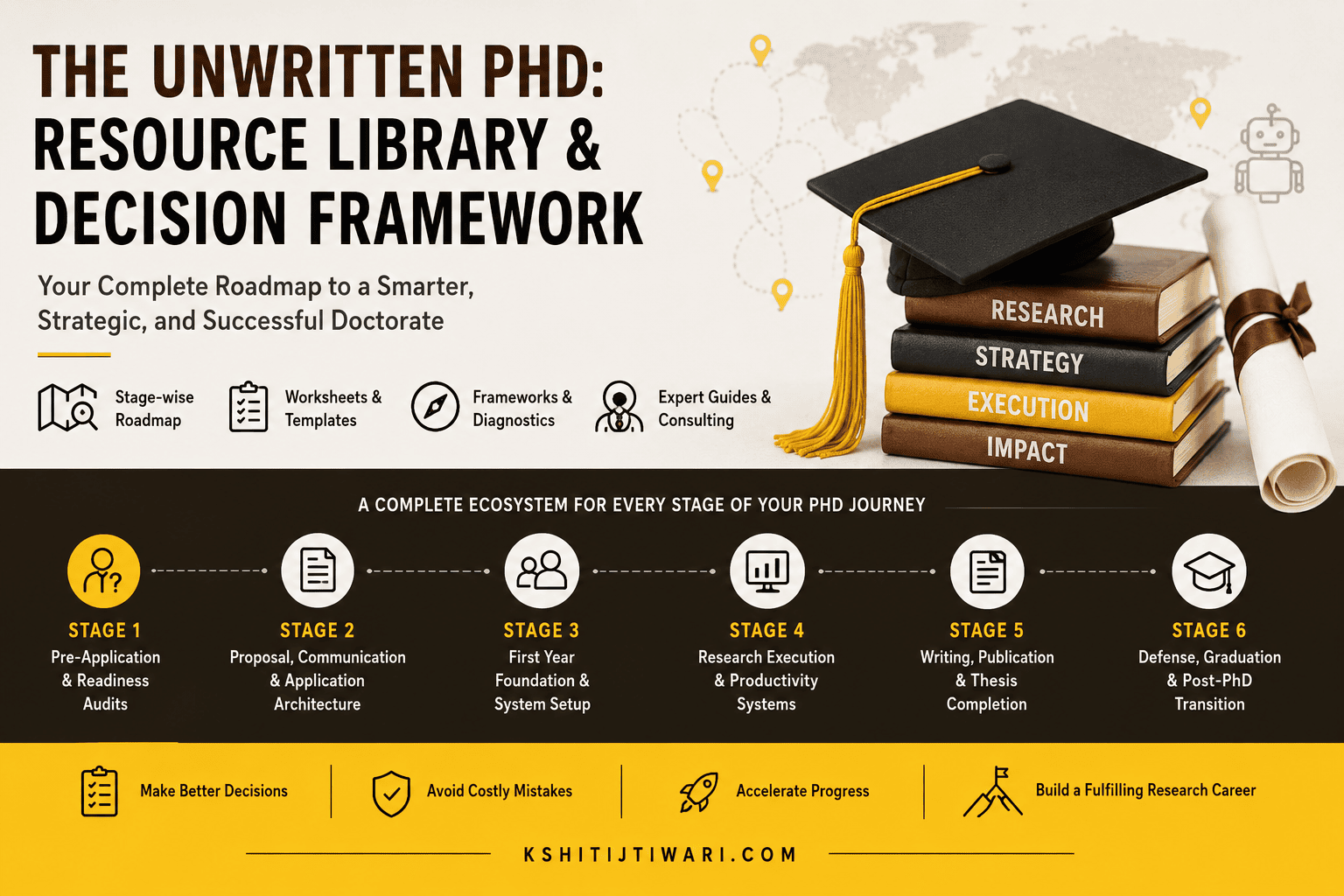
This PhD resource library functions as a diagnostic navigation hub. It maps out every phase of the doctoral lifecycle—from initial self-auditing to defending your dissertation—connecting our complete ecosystem of published guides, diagnostic tools, digital products, and high-ticket mentorship services.
Table of Contents
ToggleThe PhD Journey at a Glance
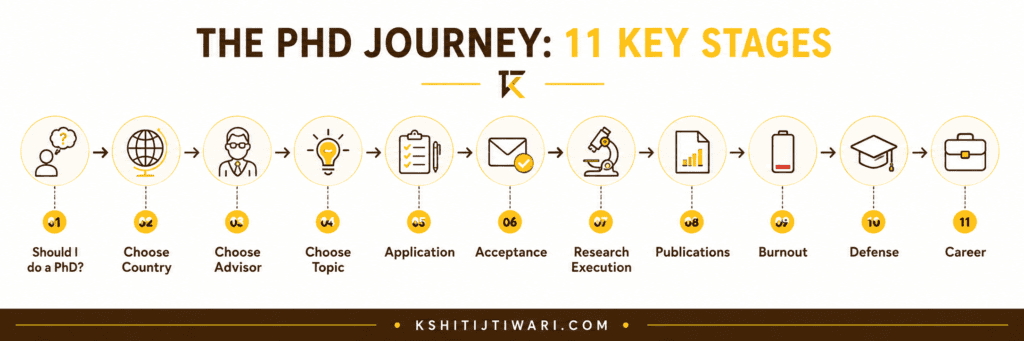
Pursuing a PhD is not a single decision—it is a journey made up of several interconnected stages. Each stage presents its own opportunities, challenges, and decisions that can significantly influence your academic experience and long-term career.
Many prospective researchers focus exclusively on getting admitted into a PhD program. In reality, admission is only one milestone in a much longer process that includes selecting the right country and university, identifying a compatible research supervisor, defining a meaningful research topic, managing publications, overcoming inevitable periods of self-doubt and burnout, successfully defending your dissertation, and planning your career beyond graduation.
Understanding this journey before you begin allows you to make better decisions at every stage rather than reacting to problems as they arise. It also helps you identify the right resources exactly when you need them.
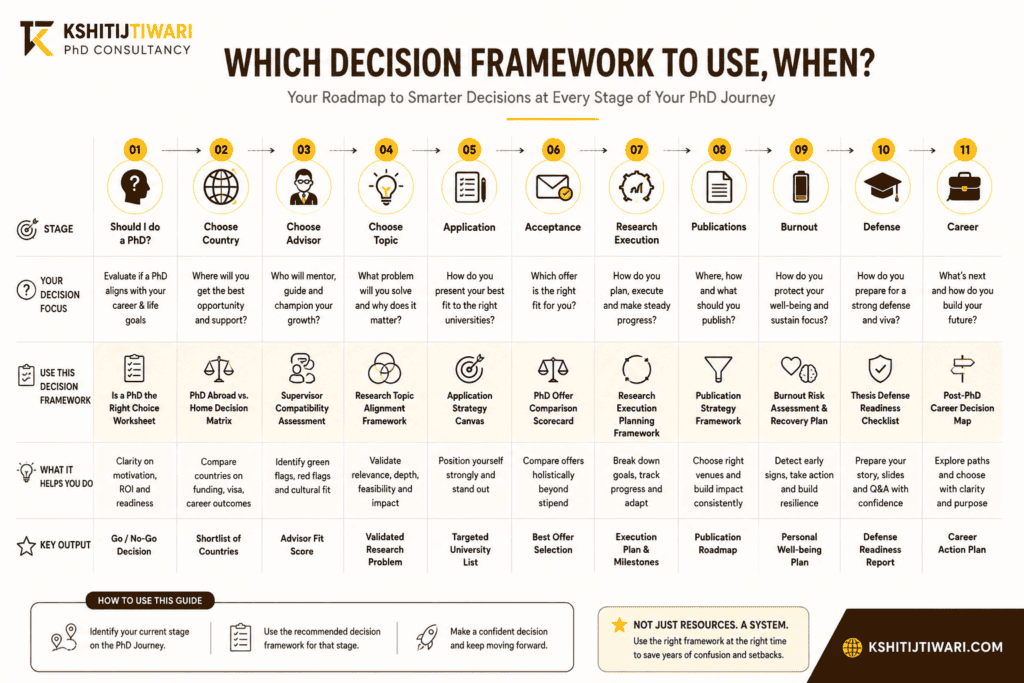
The roadmap below provides a high-level overview of the complete PhD lifecycle. Throughout this guide, each stage links to detailed articles, practical frameworks, and evidence-based advice that will help you navigate your doctoral journey with greater confidence and avoid many of the mistakes that delay progress or lead to unnecessary frustration.
Use this roadmap as your navigation guide and return to it whenever you reach a new milestone in your PhD journey.
Who is this guide for?
This guide is for:
- Final Year Master's Scholars
- Prospective International Scholars
- In-program PhD Scholars
Expected learning outcomes
By the end of this guide, you’ll know how to:
- Decide whether a PhD aligns with your career goals.
- Evaluate supervisors objectively.
- Select a research topic with long-term value.
- Write a compelling SOP.
- Contact professors effectively.
- Manage research without burnout.
- Publish strategically.
- Prepare for your viva.
- Plan your post-PhD career.
Where Are You in Your PhD Journey? Find the Right Resource
Every doctoral journey is unique, but the challenges faced by PhD scholars often follow recognizable patterns. Some readers arrive here because they are still debating whether pursuing a PhD is the right decision. Others are actively preparing applications, refining research interests, or contacting potential supervisors. Many are already enrolled in a doctoral program and looking for guidance on managing research, publishing high-quality papers, overcoming burnout, or preparing for their thesis defense.
Because no two researchers begin at the same stage, there is no single article that can answer every question. What matters is identifying the decision you need to make right now and starting with the resource that addresses that specific challenge.
This guide has been designed as the central hub for my entire collection of PhD resources. Instead of searching through dozens of individual articles, you can use the decision framework below to quickly identify where you are in your doctoral journey and navigate directly to the most relevant content. Each pathway leads to a detailed guide that explores the topic in depth with practical advice, proven frameworks, and actionable recommendations.
Whether you are a prospective applicant trying to decide if doctoral research aligns with your career goals, an incoming PhD student searching for the right supervisor or research topic, or an experienced researcher preparing for graduation, the roadmap below will help you determine your next step with confidence.
Think of this framework as a navigation tool rather than a checklist. You do not need to follow every path in sequence. Instead, begin with the stage that best reflects your current situation, work through the recommended resources, and return to this guide whenever you encounter a new challenge or milestone in your PhD journey.
The goal is simple: help you spend less time searching for answers and more time making informed decisions that contribute to a successful, rewarding, and sustainable doctoral experience.
How to Use This PhD Decision Framework
Stage 1: Before You Begin Your PhD
If you are still exploring whether a PhD is the right path, this is where your journey begins. Rather than jumping straight into applications, spend time evaluating your long-term career goals, understanding the realities of doctoral research, and assessing whether pursuing a PhD aligns with your personal and professional aspirations. Once you’ve made that decision, your next priorities become choosing the right country, university, funding opportunity, and identifying a research environment where you can thrive.
This stage includes topics such as:
- Should I Do a PhD?
- Choosing the Right Country
- Selecting the Right University
- Understanding PhD Funding
- Choosing the Right Research Supervisor
- Choosing a Research Topic
Stage 2: Applying for a PhD
Once you have identified suitable programs and research groups, your focus shifts toward building a competitive application. This involves presenting your academic background, research interests, and future goals in a compelling manner while demonstrating a strong fit with your prospective supervisor and institution.
This stage includes topics such as:
- Writing a Winning Statement of Purpose (SOP)
- Building an Academic CV
- Contacting Professors
- Recommendation Letters
- Preparing for Interviews
- Evaluating Admission Offers
Stage 3: Navigating Your PhD Successfully
Receiving an admission offer is only the beginning of your doctoral journey. The next several years involve learning how to conduct independent research, manage long-term projects, publish scientific work, collaborate effectively, and maintain consistent progress despite uncertainty and setbacks. This is also the stage where many researchers encounter productivity challenges, imposter syndrome, and burnout.
This stage includes topics such as:
- Starting Your First Year Successfully
- Literature Reviews
- Research Planning
- Scientific Writing
- Publishing Research Papers
- Productivity Systems
- Managing PhD Burnout
- Building Healthy Research Habits
Stage 4: Beyond the PhD
As your doctoral journey approaches completion, your attention gradually shifts from earning the degree to preparing for the next stage of your career. Whether your ambitions lie in academia, industrial research, entrepreneurship, consulting, or public policy, planning ahead will help you transition with confidence. This final stage focuses on successfully defending your thesis, showcasing your research contributions, and positioning yourself for opportunities after graduation.
This stage includes topics such as:
- Thesis Writing
- Preparing for Your Viva or Defense
- Career Planning
- Academia vs Industry
- Postdoctoral Opportunities
- Building Your Professional Brand
- Life After the PhD
No matter where you currently are in your journey, every successful PhD graduate has progressed through these four broad stages. The purpose of this resource library is to provide structured guidance at each milestone, helping you make informed decisions, avoid common pitfalls, and navigate your doctoral journey with greater confidence. Use the decision framework above to identify your current stage, explore the recommended resources, and return whenever you encounter a new challenge or transition.
Stage 1: Pre-Application and Readiness Audits
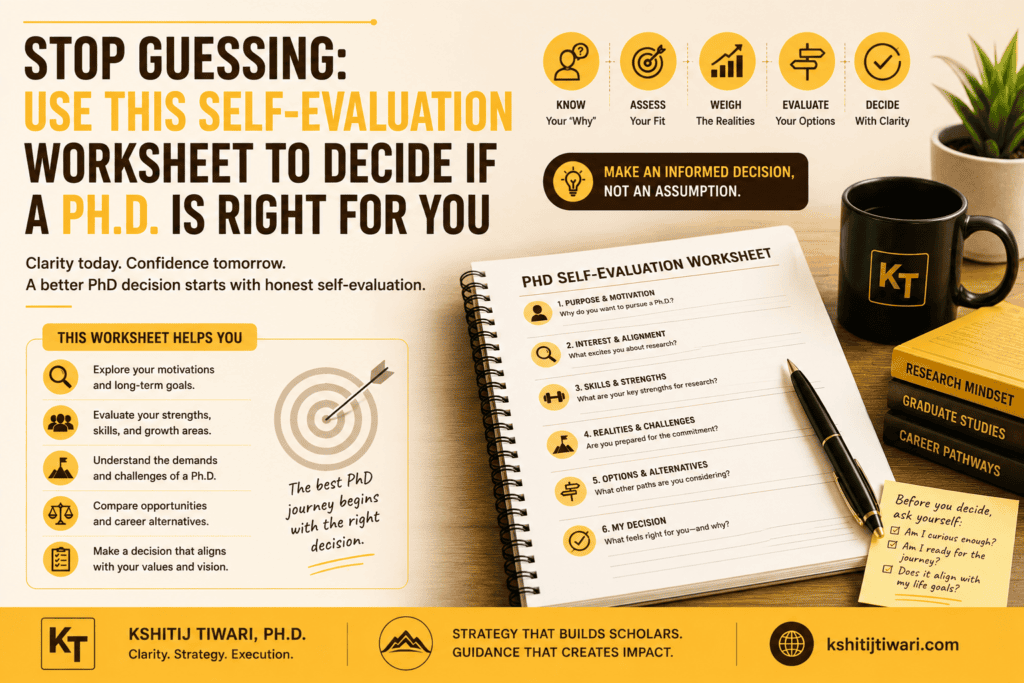
Assessment 01: Should You Do a PhD?
Before drafting a single research proposal or cold-emailing a professor, you must evaluate whether a doctorate aligns with your long-term career ROI or if you are using it as an escape from career uncertainty.
A PhD represents a massive opportunity cost in lost industry salary, equity, and early career progression. You are trading three to six years of prime earning capacity for a specialized title. If that title does not unlock a career path that is otherwise inaccessible—such as elite corporate R&D, specialized technical consulting, or tenure-track academia—the financial model fails.
The Opportunity Cost Audit: Calculate your expected industry earnings over a 4-year window versus your projected stipend. Is the delta offset by the career ceiling the PhD removes?
The Unstructured Work Test: Do you possess the self-directed project management stamina required to work for months without external validation, deadlines, or feedback?
To audit your readiness, complete our free Is a PhD the Right Choice for You? Worksheet.
Assessment 02: Evaluating the PhD Timing Trap
Deciding when to start—or when to exit—a PhD is as critical as the decision to pursue one. The timing equation changes drastically depending on whether you are entering directly from a master’s program or transitioning from mid-career industry roles.
If you are mid-career, your financial baseline is higher, making the stipend dip severe. However, your industry experience provides high-value clarity on market gaps. Conversely, entering directly from academia keeps momentum high but increases the risk of choosing a topic detached from real-world market demands.
Furthermore, if you are currently in a program that has devolved into structural stagnation, knowing when to pivot or execute an exit strategy is vital for protecting your career capital.
Evaluate your timeline using our comprehensive framework: The PhD Timing Trap: When Is It Too Late to Start or Quit Your PhD?
Assessment 03: Supervisor Compatibility and Advisor-Advisee Fit
Your advisor is the single greatest variable in your doctoral success. A brilliant topic in a world-class department will fail under an incompatible, micromanaging, or absent supervisor.
Many candidates approach advisors with a schoolteacher mindset, expecting step-by-step guidance. In reality, your advisor is an executive project stakeholder managing grants, administrative duties, and teaching loads. They do not have the bandwidth to manage your day-to-day work, nor should they.
The Funding Alignment: Does the supervisor have active, secured grants tied directly to your proposed research stream, or will you be forced to TA indefinitely to cover your stipend?
The Publication Trajectory: What is the average graduation timeline and publication output of their last five doctoral candidates?
The Management Style: Are they hands-off to the point of negligence, or hands-on to the point of choking your intellectual autonomy?
Audit prospective supervisors before signing an agreement:
Complete our free PhD Supervisor Compatibility Assessment Worksheet.
Read the full diagnostic guide: Advisor-Advisee Fit: The Red and Green Flags to Look for in a Prospective Ph.D. Advisor.
Assessment 04: Assessing Study Abroad vs. Staying Home
Choosing where to pursue your doctorate involves evaluating long-term immigration pathways, post-doctoral industry hubs, and structural funding models.
Traditional study abroad agencies treat PhD applications like undergraduate admissions, focusing on brand prestige rather than lab infrastructure and advisor fit. This leads technical applicants to waste thousands on generic consulting that fails to articulate their technical capabilities.
Evaluating Financial Reality: Read The Real Cost vs. Value: 10 Myths & Realities of Doing a PhD Abroad vs. Staying Home.
Avoiding Generic Agencies: Read Stop Wasting Money: Why Traditional Study Abroad Consulting Fails Technical PhDs.
If you are evaluating multiple international offers, download our free Compare Multiple PhD Offers Worksheet. For personalized, highly technical application auditing, explore our specialized PhD Study Abroad Consulting Services.
Assessment 05: Finding funded PhD positions
Looking for a funded PhD? Finding the right position involves much more than searching for open vacancies. Learn how to find funded PhD positions, evaluate research and supervisor fit, verify what “fully funded” actually means, and compare PhD offers before you commit to a multi-year research journey. Read the complete guide to finding funded PhD positions
Stage 2: Proposal, Communication, and Application Architecture
Step 01: Crafting the Strategic Statement of Purpose (SOP)
Your Statement of Purpose is not a personal essay; it is a technical R&D proposal. Admissions committees at top-tier institutions read hundreds of generic essays filled with personal anecdotes about childhood curiosities.
A strategic SOP must communicate technical readiness, alignment with active lab infrastructure, and a clear understanding of the research gap.
Learn how to structure your application to command immediate respect from admissions committees: Read The Strategic PhD Statement of Purpose (SOP): Beyond Generic Advice.
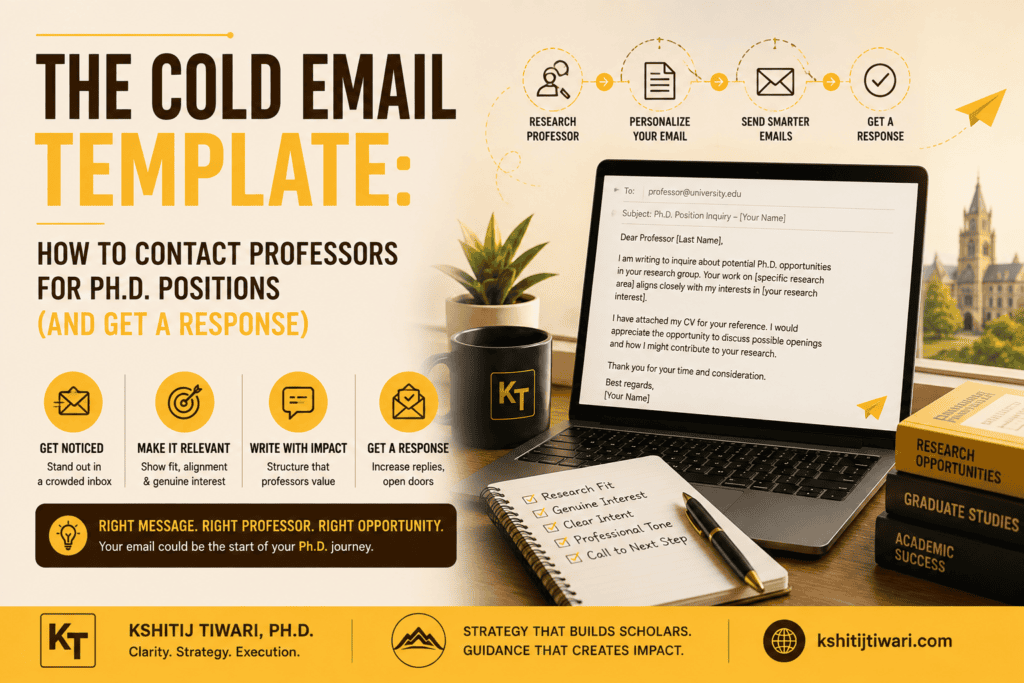
Step 02: Mastering Cold Outreach to Professors
Sending generic, blasted cold emails to busy professors results in a zero-percent response rate. Elite faculty members receive dozens of automated emails daily from prospective students asking for funding.
To get a response, your cold outreach must demonstrate that you have read their recent publications, identified an operational limitation in their work, and possess the specific skills to help solve it.
The Hook: Reference a specific paper published by the lab in the last 12 to 18 months.
The Bridge: Highlight a clear limitation or baseline assumption in that paper.
The Value Pitch: State how your background (e.g., C++ performance engineering, ROS 2 middleware tuning, or mathematical modeling) addresses that limitation.
Read the step-by-step masterclass: The Cold Email Template: How to Contact Professors for Ph.D. Positions (and Get a Response).
For ready-to-use scripts, email templates, and follow-up protocols for every stage of academic communication, access The PhD Communication Vault.
Step 03: De-Risking Topic Selection
Choosing a PhD topic based solely on “passion” is the fastest path to structural failure. A viable research topic must sit at the intersection of three technical vectors:
The Knowledge Gap (Intellectual Feasibility): Isolating an unaddressed friction point in the literature that can be resolved within 36 months.
Institutional Infrastructure (Operational Feasibility): Ensuring your target department possesses the compute clusters, hardware setups, or datasets required.
Long-Term Market Leverage (Career ROI): Guaranteeing the thesis output makes you highly employable in corporate R&D or tenure-track academia.
To build an unignorable research trajectory without burnout, study our comprehensive guide: The Definitive Guide to Choosing a PhD Research Topic (Without Academic Burnout).
Stage 3: Execution, Research Management, and Mental Equity
The PhD Scholar’s Compass Framework
Once enrolled, the lack of external structure becomes the primary cause of academic burnout. When you do not know what a “productive day” looks like, your default mechanism is to overwork—reading endless papers, running unstructured simulations, and accumulating technical debt.
To survive, you must abandon the idea that a PhD is a marathon and adopt a model based on 90-day calculated sprints.
Define the Sprint Deliverable: Isolate one concrete output for the quarter (e.g., benchmarking a baseline algorithm or validating a hardware-in-the-loop setup).
Strip Away Tangents: Ignore secondary literature or unaligned experiments that do not advance that specific quarterly goal.
Execute and Document: Run hard for 90 days, document failures cleanly, and reset.
Master this operational framework by reading our cornerstone guide: How to Conquer PhD Burnout: The PhD Scholar’s Compass Framework for Research Ambiguity.
To own the complete, step-by-step guidebook containing all our operational templates, weekly review checklists, and project management systems, get your copy of the book: The PhD Scholar’s Compass Guidebook.
Eliminating Communication Friction
Administering a PhD requires clear boundaries and professional communication protocols. Unclear emails, vague progress updates, and reactive scheduling lead to friction with advisors and committee members.
The 24-Hour Agenda Rule: Never attend a supervisor meeting without sending a bulleted agenda 24 hours prior.
The Post-Meeting Summary: Send a 3-sentence summary email after every meeting documenting agreed-upon decisions, next steps, and deadlines.
Email Batching: Protect deep-focus research blocks by communicating asynchronously rather than reacting to messages instantly.
Read the full operational strategy: Master Your PhD Communication Skills: How to Stop Email Anxiety and Reclaim Your Research Time.
To streamline your daily academic outreach, get instant access to our copy-paste template library: The PhD Communication Vault.
Stage 4: Publication, Defense, and Career Acceleration
Transforming Ideas into Publications
The ultimate metric of a successful PhD is published, peer-reviewed output. Yet, many scholars spend years running experiments without producing a single accepted manuscript because they lack a structured publication framework.
Moving from ad-hoc scripts to structured engineering standards accelerates publication timelines while eliminating technical debt.
Read our complete case study on publication acceleration: The PhD Competence Accelerator: Transforming PhDs from Clueless into Published Authors.
Apply to work directly with us to structure, write, and publish your research through the PhD Competence Accelerator Program.
Surviving the Defense and Viva (Q&A Strategy)
The final examination is a test of process defense, not a check on how many hours you worked. Committee members examine your work to test your academic maturity, challenge your assumptions, and evaluate how you handle technical scrutiny.
Master the art of defending your thesis without freezing or becoming defensive: Read The Art of Defending Research: How to Survive the Q&A Without Freezing.
For a complete toolkit containing the top 20 aggressive viva questions, response scripts, and slide presentation structures, download the PhD Q&A Survival Kit.
Complete Resource & Tool Index
Free Diagnostic Worksheets
Digital Products & Toolkits
Personalized Mentorship Services
Key Takeaways
The traditional doctorate is filled with unnecessary ambiguity, but your journey does not have to be. By replacing guesswork with structured R&D frameworks, you can de-risk your topic, manage your supervisor effectively, publish high-impact papers, and defend your research with confidence.
Explore our services, utilize our diagnostic toolkits, or book a direct session to structure your path to academic excellence.
Frequently Asked Questions (FAQs)
A PhD is a worthwhile investment if your long-term career goals require advanced research expertise, independent problem-solving skills, or leadership in academia, R&D, or deep-tech industries. However, a doctorate demands several years of sustained commitment and should not be pursued simply because you are uncertain about your next career move. Before applying, evaluate your career objectives, financial considerations, and personal motivation to determine whether a PhD aligns with your aspirations.
A PhD is best suited for individuals who enjoy solving open-ended problems, reading scientific literature, conducting experiments, and contributing new knowledge to their field. If your primary motivation is job security or delaying career decisions, a PhD may not be the right choice. Consider your long-term goals, interest in research, and willingness to embrace uncertainty before committing to doctoral studies.
A strong research topic lies at the intersection of your interests, technical feasibility, societal impact, and future career opportunities. Rather than chasing trendy topics, choose a problem that will remain relevant for several years and offers enough research depth to sustain an entire doctoral project.
Related Reading: The Definitive Guide to Choosing a PhD Research Topic (Without Academic Burnout)
University rankings should be only one factor in your decision. Research fit, supervisor compatibility, laboratory resources, funding opportunities, and career outcomes are often more important than institutional prestige. A highly supportive research environment at a moderately ranked university can provide a far better PhD experience than a poorly matched supervisor at a globally ranked institution.
Your supervisor will likely have the greatest influence on your doctoral experience. A good advisor provides mentorship, constructive feedback, research direction, and career guidance. Before accepting an offer, evaluate their advising style, publication record, communication habits, funding stability, and the experiences of current or former students.
A strong cold email should be concise, personalized, and demonstrate genuine interest in the professor's research. Introduce yourself, briefly explain your background, reference their recent work, and describe how your research interests align with their group. Avoid sending generic emails to multiple faculty members.
A compelling SOP explains your academic journey, research interests, relevant experience, motivation for pursuing a PhD, and why you are an excellent fit for a specific research group. Rather than listing achievements, focus on telling a coherent story that connects your past experiences with your future research goals.
Publications strengthen an application but are not always required. Many successful applicants gain admission based on strong academic performance, research experience, technical skills, and well-defined research interests. Quality research experience often carries more weight than a large number of publications.
The duration varies by country and discipline. Most doctoral programs take between three and six years to complete. Factors such as funding, research complexity, publication requirements, and dissertation scope can significantly influence the timeline.
Motivation naturally fluctuates throughout a doctoral journey. Building sustainable habits, setting realistic milestones, maintaining work-life balance, and focusing on consistent progress rather than perfection can help you navigate periods of uncertainty. Viewing your PhD as a long-term project instead of a series of deadlines often leads to better outcomes.
Yes. Many doctoral researchers experience periods of stress, self-doubt, and burnout due to the uncertainty and long duration of research. Recognizing early warning signs, maintaining healthy routines, seeking mentorship, and developing effective project management strategies can help reduce the risk of prolonged burnout.
There is no universal number. Publication expectations depend on your university, supervisor, funding requirements, and research discipline. Instead of focusing solely on quantity, prioritize producing high-quality research that contributes meaningfully to your field.
Collaborative research can expand your expertise, improve publication opportunities, and strengthen your professional network. Interdisciplinary collaborations are particularly valuable for solving complex research problems and often lead to higher-impact outcomes.
A successful PhD graduate develops far more than technical expertise. Communication, scientific writing, public speaking, project management, leadership, networking, grant writing, mentoring, and collaboration are equally important for long-term career success.
Graduates pursue diverse career paths including academia, industrial research, startups, government laboratories, consulting, product development, and entrepreneurship. Your doctoral experience should prepare you not only to conduct research but also to solve complex problems in a variety of professional environments.
Changing research direction is possible, particularly during the early stages of a doctorate. However, major changes later in the program can significantly delay graduation. Discuss potential modifications with your supervisor and carefully evaluate their long-term implications before making substantial adjustments. Additionally, if you are on a visa in an overseas institution, there might restrictions imposed on change of supervisor, change of department or even at University level so check your visa restrictions too.
In many universities, changing supervisors is possible if significant academic or professional issues arise. However, the process varies by institution and should be approached thoughtfully. Whenever possible, attempt to resolve communication challenges before considering a supervisor change.
International collaborations expose researchers to new methodologies, broader research networks, and diverse perspectives. They can also increase publication quality and improve future career opportunities in both academia and industry.
The answer depends on your interests and career goals. Academia emphasizes teaching, publishing, and securing research funding, while industry often focuses on solving practical problems, product development, and applied research. Understanding these differences early can help you build relevant skills throughout your PhD.
Many challenges encountered during a PhD—such as selecting a research topic, contacting supervisors, planning publications, managing burnout, and making career decisions—can be easier to navigate with structured guidance. Professional mentorship cannot replace your supervisor, but it can provide an independent perspective, accountability, and strategic advice throughout different stages of your doctoral journey.
Not Sure What Your Next Step Should Be?
Choosing a research topic, evaluating supervisors, preparing applications, or recovering from months of stalled progress can feel overwhelming—especially when every decision carries long-term consequences.
The resources in this guide are designed to help you make informed decisions independently. But some situations benefit from personalized discussion.
If you would like an objective second opinion before committing years of your career, I offer one-on-one strategic PhD consultations tailored to your specific goals.
During a consultation you can expect:
✓ Personalized review of your situation
✓ Actionable recommendations
✓ Honest feedback
✓ Clear next steps