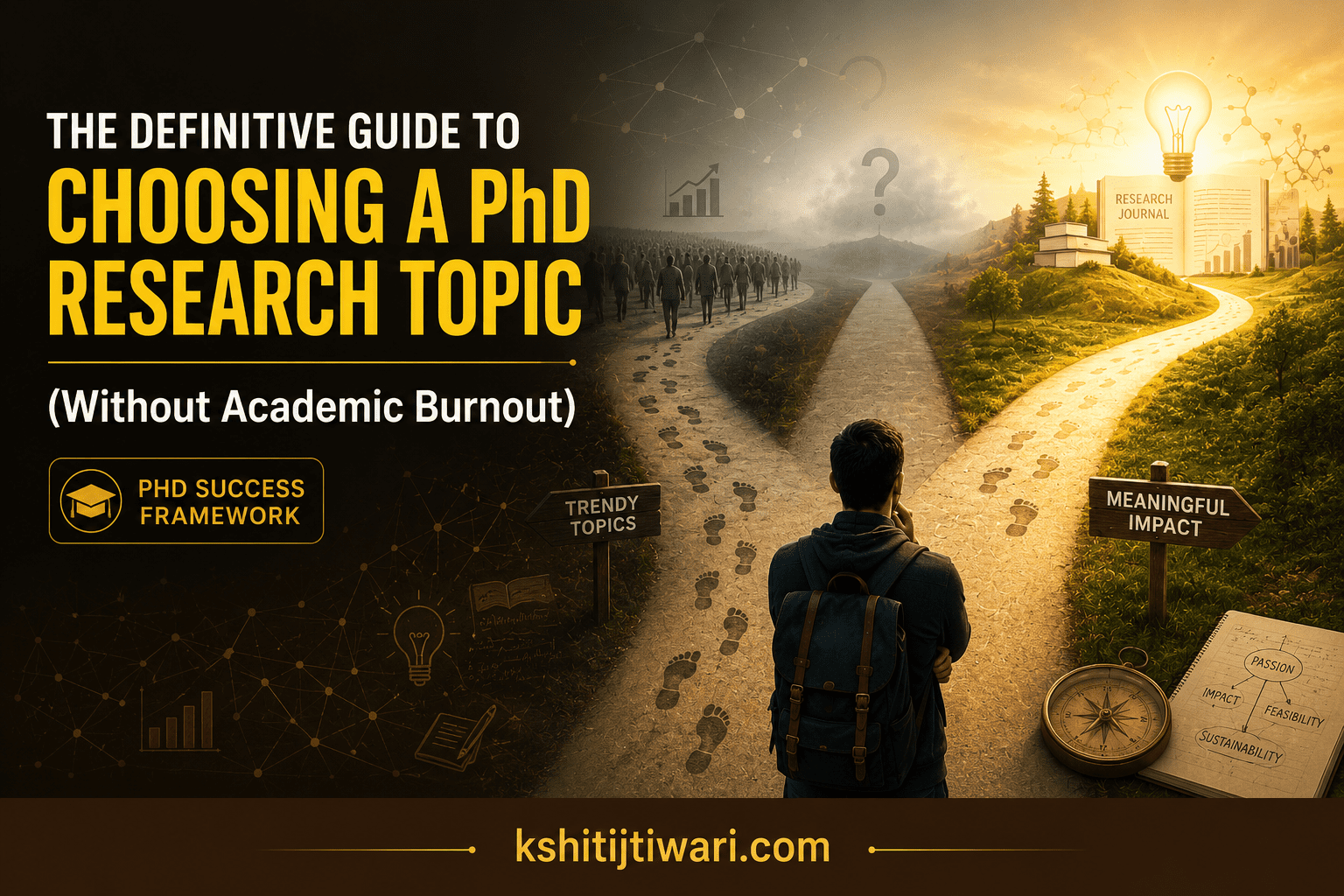
The most critical error early-stage scholars make happens before they ever step into a university archive or laboratory. It happens at the very beginning, staring at a flashing cursor, trying to answer a deceptively simple question: What is my PhD research topic going to be?
If you are currently combing through endless journals, completely perplexed about where to start, you aren’t alone. Most applicants treat topic selection like an exercise in pure passion. They look for a topic they “love.”
But here is the hard truth that traditional admissions consultants won’t tell you: A PhD is not an extension of your personal interests—it is an intense, multi-year research contract.
Choosing a topic based solely on academic curiosity is the fastest route to dead ends, volatile supervisor relationships, and eventual burnout. To secure admissions at a world-class level, you must treat your topic selection like a strategic business venture. Here is the framework to do exactly that.
 Related Resource: This article is part of the Unwritten PhD Resource Library—a comprehensive collection of guides, decision frameworks, and practical resources covering every stage of the PhD journey, from choosing a research topic and applying for a PhD to publishing papers, managing burnout, and planning your career after graduation.
Table of Contents
ToggleThe Three-Vector Matrix for Topic Viability
A successful doctoral project doesn’t live in a vacuum. To be viable, your prospective research topic must sit perfectly at the intersection of three distinct vectors:
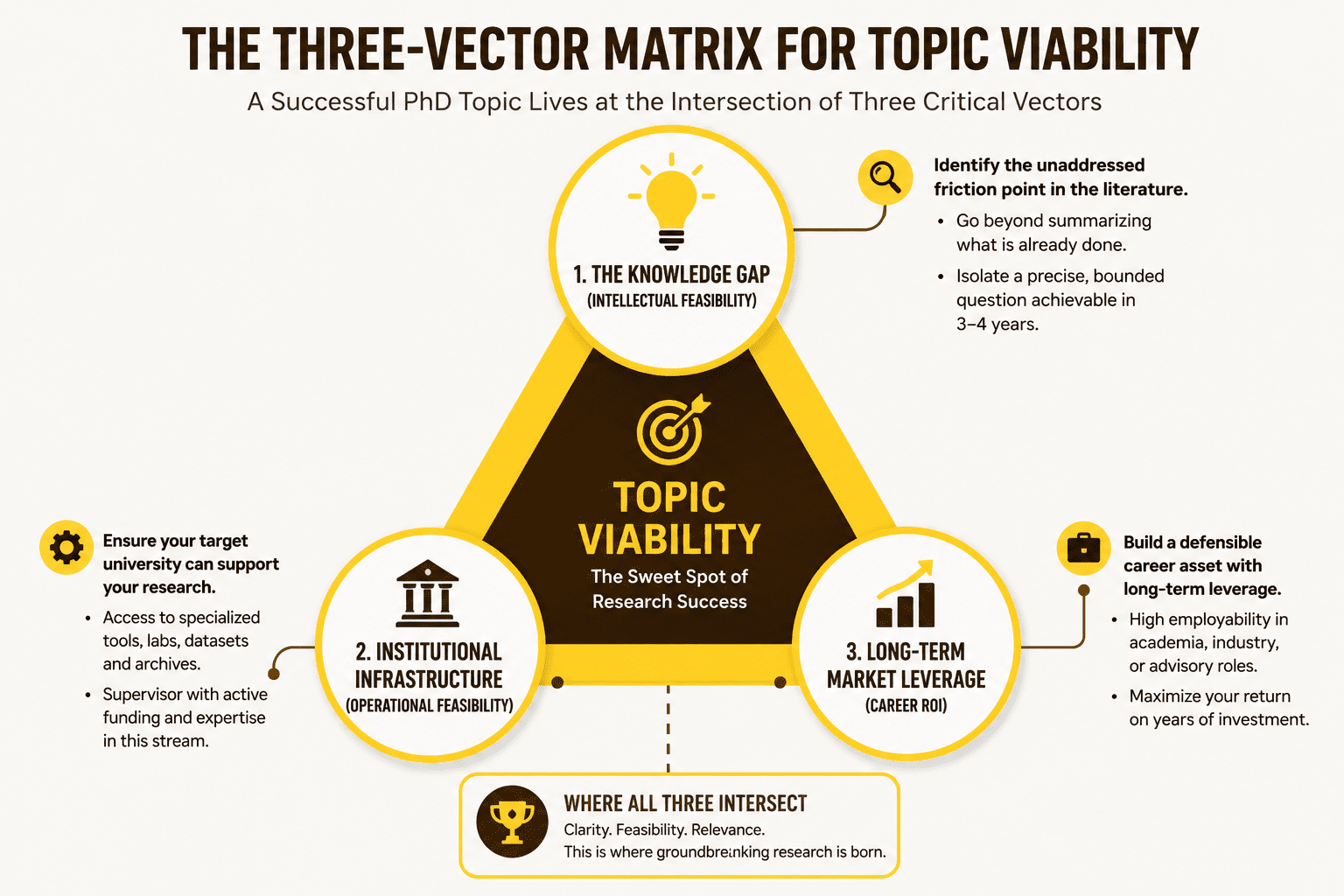
1. The Knowledge Gap (Intellectual Feasibility)
Your topic cannot simply summarize what has already been done. It must identify an unaddressed friction point in the existing literature.
The Common Mistake: Proposing a topic that is too broad (e.g., “The Impact of AI on Modern Logistics”).
The Strategic Shift: Isolating a precise, bounded question that can realistically be evaluated within a 3-to-4-year timeline.
2. Institutional Infrastructure (Operational Feasibility)
A great topic on paper is completely useless if your target university cannot physically support it.
Do they have the specialized archival access, the high-performance computing clusters, or the proprietary datasets required?
Does your prospective supervisor have active funding tied to this specific stream? If the lab or department lacks the tools, your project stalls before day one.
3. Long-Term Market Leverage (Career ROI)
A PhD is a massive opportunity cost. You are trading years of industry or institutional salary for a specialized title. Your topic must yield a highly defensible stack of “career capital.” Whether your destination is a tenure-track faculty position, a corporate R&D lab, or an elite advisory role, the output of your thesis must make you highly employable.
Shifting from "Passive Scholar" to "Strategic Partner"
When you leave vague comments on academic forums or YouTube videos asking someone to give you a topic, you are operating with a passive mindset.
Professors and elite mentors do not hand out topics. They look for independent researchers who can pitch a Solution-Oriented Proposal. Moving from a vague idea to an unignorable pitch requires a formalized framework—which is exactly what I track through the PhD Competence Accelerator to systematically eliminate research risk before day one.
When communicating with prospective advisors, your topic should never be framed as:
“I am highly passionate about this subject and want to explore it.”
Instead, it must communicate:
“I have identified this structural gap in the current literature. My background equips me to resolve this specific bottleneck using your department’s existing infrastructure within your active funding window.”
This single shift in framing instantly elevates you out of the mass pile of generic applicants and positions you as an indispensable asset to a department.
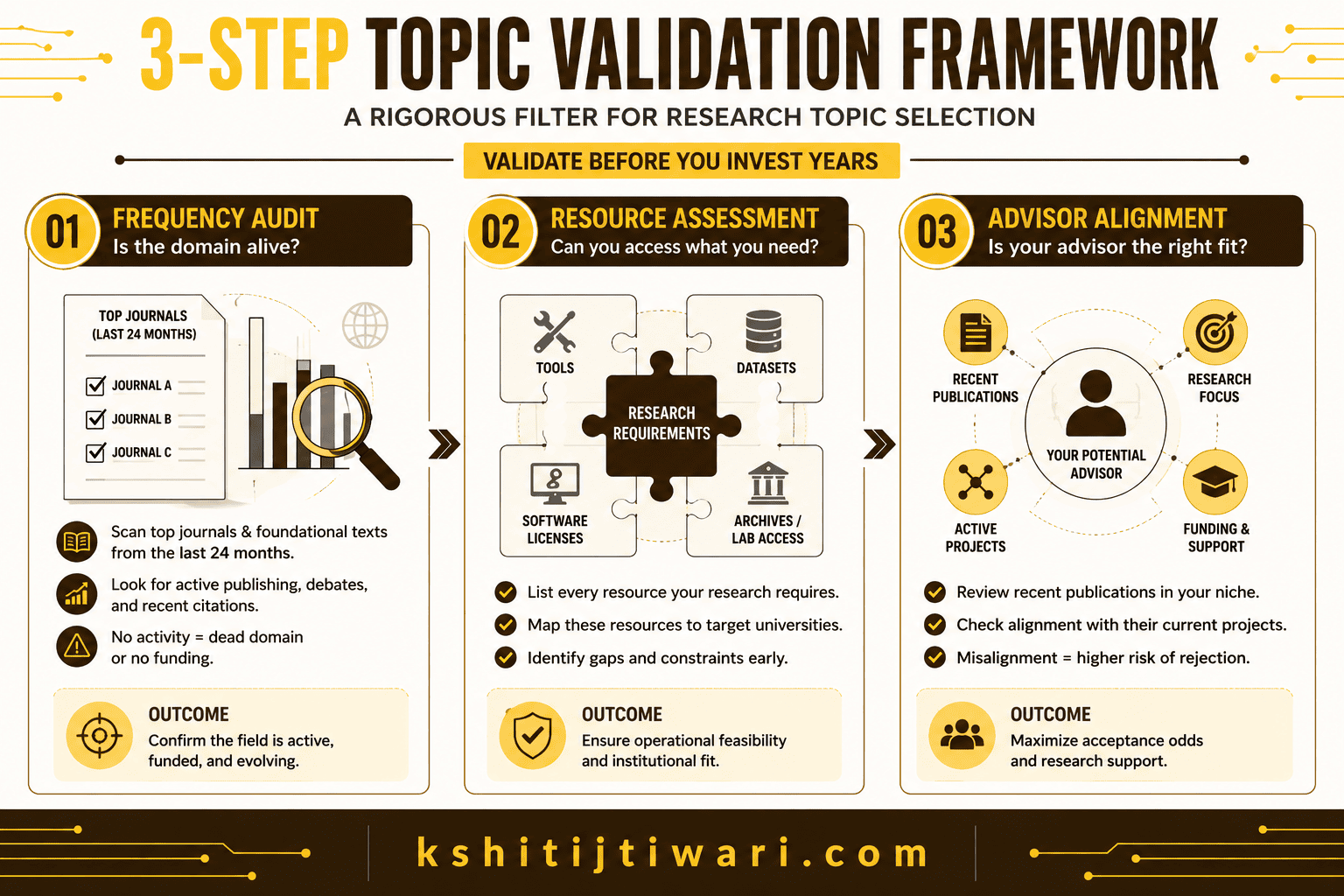
The 3-Step Topic Validation Framework
Before you commit to a research path, put your initial ideas through this rigorous filtration system:
The Frequency Audit: Identify the top three journals or foundational texts in your chosen field from the last 24 months. If no one is actively publishing updates or debating your core premise, the domain is either functionally dead or lacks funding.
The Resource Assessment: List every tool, dataset, software license, or physical archive needed to answer your research question. Cross-reference this list with your target universities. If there is a mismatch, the topic must be refined.
The Advisor Alignment: Ensure your target supervisor has published relevant work in this specific niche recently. Pitching a topic outside of an advisor’s current academic trajectory is a primary cause of immediate rejection.
Key Takeaways
The anxiety of choosing a topic stems entirely from a lack of structure. If you find yourself trapped in circles, guessing what admission committees want to see, it is time to stop treating your academic future like a lottery.
A successful proposal requires objective vetting, systematic de-risking, and a sharp understanding of global academic demands. My structured PhD Competence Accelerator methodology is built to take you from a blank page to a fully validated, internationally competitive research portfolio.
Ready to Validate Your Research Path?
I do not hand out generic PhD topics. I work 1-on-1 with high-intent scholars to deeply vet, stress-test, and architect bulletproof research proposals that command authority.
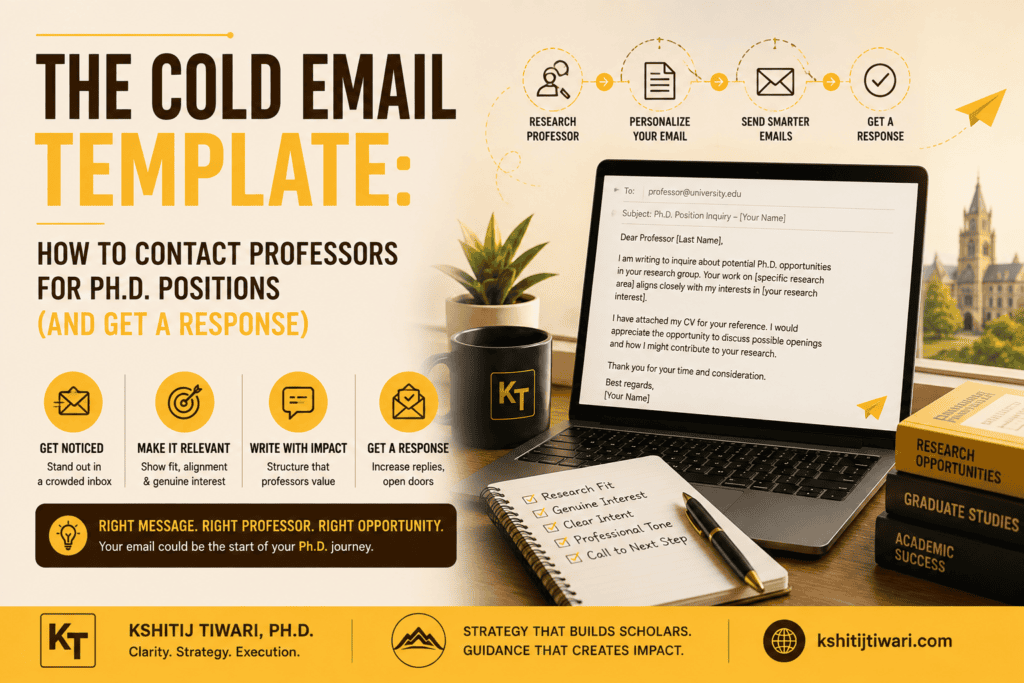
If you want to stop sending vague inquiries and start pitching an unignorable research trajectory, let’s look at your options under a microscope.