A PhD is one of the few career decisions where the consequences of a choice can extend across several years of your life.
You are not simply choosing a university.
You may be choosing a research problem, a supervisor, a funding arrangement, a country, a research environment, a professional network, and a career direction — often before you have enough experience to know which questions you should even be asking.
This is why some prospective and current PhD scholars eventually look for independent PhD guidance.
But there is an important distinction to make.
Independent PhD guidance is not the same thing as having a university PhD advisor or supervisor.
Your university supervisor has a formal academic role. They guide your doctoral research within the institution, help shape your research project, monitor your progress, and ultimately contribute to the academic process through which your doctorate is completed.
Independent guidance serves a different purpose.
An independent professional can provide an external perspective when you are making decisions about your PhD that may benefit from someone who is not part of your university, admissions committee, supervisory structure, or immediate academic environment.
That might mean deciding whether a particular PhD offer is worth accepting, evaluating a funded PhD position, preparing an application, thinking through supervisor fit, identifying risks in a prospective research environment, or simply getting a second opinion before making a high-consequence decision.
So the question is not:
“Do I need a PhD consultant?”
A better question is:
“Is there a PhD-related decision where an independent perspective would materially improve my ability to make it?”
For some people, the answer will be no.
For others, getting independent PhD guidance at the right moment can prevent months — or even years — of avoidable mistakes.
 Related Resource: This article is part of the Unwritten PhD Resource Library—a comprehensive collection of guides, decision frameworks, and practical resources covering every stage of the PhD journey, from choosing a research topic and applying for a PhD to publishing papers, managing burnout, and planning your career after graduation.
Table of Contents
ToggleWhat Is Independent PhD Guidance?
Independent PhD guidance is external, one-to-one support designed to help prospective or current PhD scholars make better-informed decisions about their doctoral journey.
The word independent matters.
The purpose is not to replace your university supervisor, make academic decisions on your behalf, or become another person telling you what research you should conduct.
Instead, independent guidance can help you:
- clarify what decision you are actually trying to make
- identify questions you may not have considered
- evaluate competing options systematically
- understand trade-offs
- challenge assumptions
- identify potential risks
- prepare for conversations with universities or supervisors
- evaluate information you have received
- develop a practical decision framework
- obtain an external second opinion
This distinction is important because doctoral education is already supposed to develop independence.
A good external support relationship should therefore make you better at making your own decisions, not permanently dependent on someone else.
Independent PhD guidance vs university supervision
These roles should not be confused.
|
University PhD supervisor/advisor
|
Independent PhD guidance
|
|---|---|
|
Formally associated with your doctoral program
|
External & unaffiliated to your university
|
|
Guides your doctoral research
|
Helps you evaluate broader PhD decisions
|
|
Familiar with institutional requirements & signs off on your PhD-related documents
|
No signing authority yet provides an independent perspective
|
|
May oversee research progress
|
Can help you think through options and trade-offs
|
|
Integral part of your academic environment
|
Deliberately outside that environment
|
A university supervisor should remain the appropriate person for questions concerning your formal research supervision, institutional requirements, thesis expectations, and academic responsibilities.
Independent guidance is complementary.
Who Actually Needs Independent PhD Guidance?
The short answer is: not everyone.
You do not need to hire someone simply because you are applying for a PhD.
There are excellent free resources available through universities, departments, graduate schools, current students, researchers, professional associations, and public funding databases.
You may be perfectly capable of navigating the process yourself.
Independent support becomes more useful when one or more of the following conditions apply.
You are making a high-consequence decision with incomplete information
Suppose you have two PhD offers.
One is from a prestigious university with a higher stipend.
The other is from a less famous institution but offers a stronger supervisor, better research infrastructure, a closer research fit, and substantially lower living costs.
There is no universal answer.
The right decision depends on your priorities.
An independent perspective can help you structure that decision rather than simply choosing the university with the most recognizable name.
You have information but cannot determine what matters
This is surprisingly common.
A PhD advertisement might tell you:
- the stipend amount
- project title
- duration
- university
- supervisor
- application deadline
- eligibility requirements
But those facts do not necessarily tell you whether the position is good for you.
You still need to understand:
- research fit
- supervisor fit
- project flexibility
- funding security
- infrastructure
- publication expectations
- intellectual independence
- career prospects
- workload
- location and cost of living
The problem is therefore not always a lack of information.
Sometimes it is a lack of a framework for interpreting the information.
You are too close to the decision
This happens particularly when someone has spent months pursuing one particular university, professor, country, or research topic.
Emotional investment can make objective comparison difficult.
An external person can sometimes ask a very simple question:
“If this were not your dream university, would you still consider this a good PhD?”
That question alone can expose assumptions that have become invisible to you.
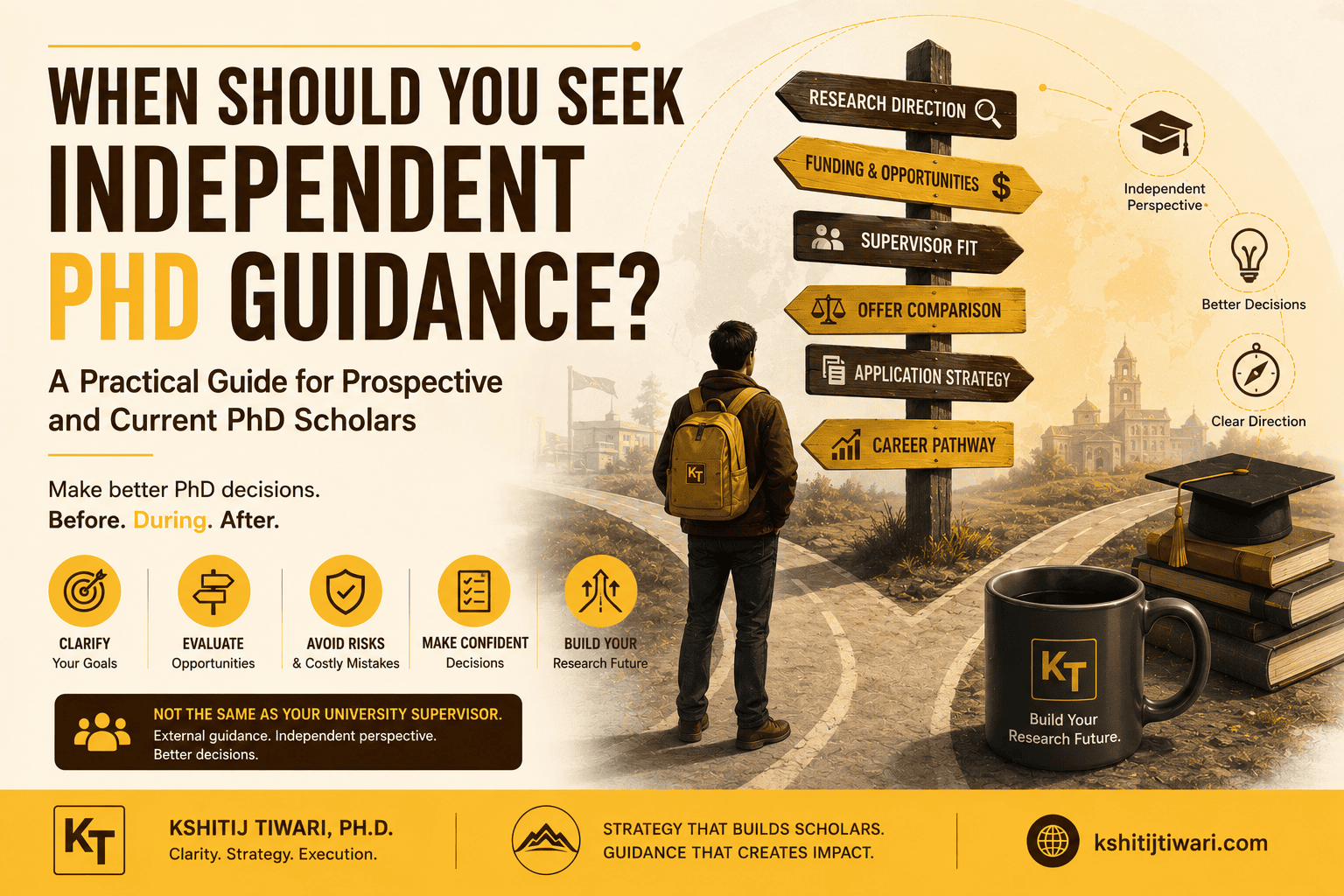
When Should You Seek Independent PhD Guidance?
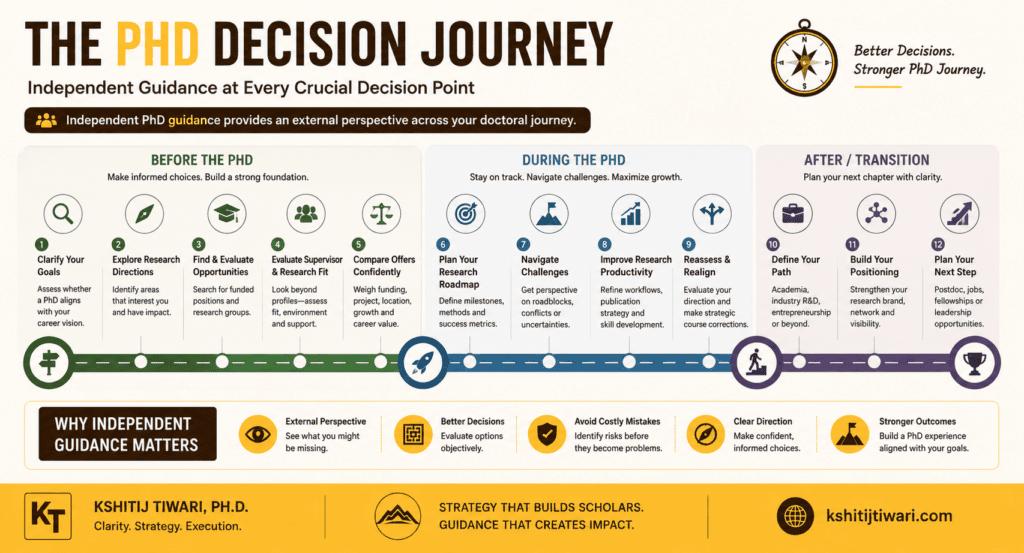
There are several points in the PhD journey where independent support can be particularly valuable.
Before You Decide to Pursue a PhD
You do not need a PhD simply because you enjoy research.
You also do not need one because your peers are pursuing doctorates.
Before investing several years in doctoral research, it is worth understanding what you actually want from the degree.
Ask yourself:
- Why do I want a PhD?
- What career do I want afterward?
- Does that career actually require a PhD?
- Do I enjoy research or simply enjoy learning?
- Am I comfortable with uncertainty?
- Do I want an academic career?
- Would an industry research role provide what I am looking for?
- What opportunity cost am I accepting?
Independent guidance can be useful here because the decision happens before you become committed to a particular university or supervisor.
The goal should not be to persuade you to do a PhD.
It should be to help you determine whether a PhD makes sense for your goals.
When You Are Trying to Find Funded PhD Positions
Finding a PhD position is not simply a matter of searching for universities and clicking “apply.”
You need to distinguish between:
- advertised PhD positions
- doctoral programs with separate funding applications
- scholarships
- research assistantships
- studentships
- externally funded projects
- self-funded doctoral programs
You also need to determine what “fully funded” actually means.
A position can advertise a stipend while leaving tuition, insurance, relocation, research expenses, or other costs to the student.
This is why finding a funded PhD position and finding a PhD position that is financially viable for you are related but different tasks.
External guidance can help you build a structured search and evaluation process rather than treating every funded position as automatically attractive.
When You Have Multiple PhD Offers
This is one of the strongest reasons to seek independent decision support.
Once you have an offer, the problem changes.
You are no longer asking:
“How do I get a PhD?”
You are asking:
“Which PhD should I choose?”
That decision can involve:
- research fit
- supervisor fit
- funding
- cost of living
- country
- visa considerations
- research infrastructure
- publication environment
- collaboration opportunities
- teaching obligations
- career opportunities
- institutional reputation
- personal circumstances
Prestige is only one variable.
Stipend is only one variable.
University ranking is only one variable.
The best PhD offer is the one that creates the strongest overall fit for your objectives and constraints.
This is an area where an independent framework can be particularly valuable because someone outside the decision can challenge the criteria you are unconsciously prioritizing.
When You Are Unsure About a Prospective Supervisor
Your prospective supervisor may have:
- an impressive publication record
- a prestigious position
- a large research group
- major grants
- a strong online profile
None of those automatically tells you whether they will be a good supervisor for you.
You should investigate:
- current students
- former students
- student turnover
- graduation timelines
- publication expectations
- meeting frequency
- research autonomy
- funding stability
- group culture
- authorship practices
- alumni outcomes
This is one of the areas where independent guidance can complement your own due diligence.
The objective is not to label a professor “good” or “bad.”
It is to determine whether the supervision model matches what you need to succeed.
When You Are Preparing a PhD Application
Independent support can also be useful before submission.
This does not mean someone should write your application for you.
In fact, that would defeat the purpose.
A useful application review should help you understand whether your materials clearly communicate:
- your research direction
- your preparation
- your motivation
- your technical or methodological capabilities
- your fit with the proposed research
- your fit with the research group
- why this particular PhD makes sense for you
University-based application review programs demonstrate that feedback can be useful without guaranteeing admission or replacing the admissions process. For example, Columbia’s pre-submission review program explicitly positions application feedback as independent from its admissions committee.
That distinction is important for any ethical external guidance service.
Guidance should improve your application. It should not manufacture an application that does not represent you.
When You Are Unsure Whether Your Research Direction Is Strong Enough
You do not need to have your entire PhD figured out before applying.
In many disciplines, prospective students are expected to have a broad research direction rather than a perfectly defined thesis.
For example, university guidance commonly emphasizes that a research proposal should demonstrate familiarity with the field and a convincing research direction without necessarily requiring every detail to be finalized at the application stage.
The difficult question is often:
“Is my idea sufficiently developed to approach a potential supervisor?”
Independent guidance can help you distinguish between:
A promising research direction
and
an idea that still needs substantial refinement.
That distinction can save you from sending poorly targeted applications or spending months refining a research proposal that is fundamentally misaligned with the opportunities you are pursuing.
When You Are Already Doing a PhD
Independent guidance is not limited to prospective scholars.
Current PhD scholars can encounter decisions such as:
- whether to change research direction
- whether a project has drifted
- how to prioritize competing research objectives
- whether to pursue an academic or industry career
- how to think about publications
- how to evaluate a difficult professional situation
- whether a collaboration makes sense
- how to prepare for major milestones
- whether their current trajectory aligns with their long-term goals
However, there is an important boundary.
Your external guide should not become a substitute for your supervisor.
If your question is:
“What does my university require for my annual review?”
your graduate program or supervisor is the appropriate authority.
If your question is:
“How should I think about the trade-offs between continuing this research direction and repositioning my work?”
an independent perspective may be useful.
When You Probably Do Not Need Independent PhD Guidance
A good service should also tell you when not to pay for it.
You probably do not need independent guidance if:
- you are comfortable researching the process yourself
- you have a strong academic mentor outside your immediate decision
- your university provides the support you need
- you have a clear research direction
- you understand your funding arrangement
- you have thoroughly investigated your prospective supervisor
- you have only straightforward administrative questions
- you are looking for someone to guarantee admission
- you simply want someone to tell you which university to choose
That last point is particularly important.
Nobody should be making your PhD decision for you.
A good independent support process should give you better questions, better frameworks, and better information — not remove your agency.
What Can Independent PhD Guidance Actually Help With?
The service becomes much easier to understand when broken down by decision type.
PhD Direction
You may seek support to think through:
- whether a PhD fits your goals
- research versus industry pathways
- broad research interests
- possible doctoral directions
- academic versus non-academic career objectives
PhD Opportunity Evaluation
You may need help evaluating:
- advertised positions
- supervisors
- research projects
- funding
- institutional environment
- infrastructure
- career opportunities
- geographic considerations
PhD Application Strategy
Support may include:
- application positioning
- research-interest articulation
- CV review
- statement review
- proposal feedback
- application strategy
- supervisor outreach strategy
PhD Offer Decisions
Support may involve comparing:
- universities
- supervisors
- projects
- funding
- countries
- cost of living
- career outcomes
- research environments
PhD Decision Support During the Program
Current scholars may benefit from an external perspective when evaluating:
- changing research direction
- major career decisions
- research priorities
- professional positioning
- longer-term doctoral strategy
The common thread is decision quality.
What Independent PhD Guidance Should Not Do
There are boundaries that any credible service should maintain.
Independent guidance should not:
Replace your university supervisor
Your supervisor remains your formal academic guide.
Guarantee admission
No legitimate external consultant can guarantee that a university will admit you.
Guarantee funding
Funding decisions belong to universities, departments, principal investigators, scholarship bodies, or other funding organizations.
Write your academic work for you
Guidance should not become ghostwriting.
That includes:
- thesis writing
- dissertation writing
- research papers
- fabricated research
- fabricated data
- application materials that misrepresent your own experience
Pretend to have insider access
An external guide should not imply that they can influence an admissions committee, supervisor, scholarship committee, or university decision unless they genuinely hold such authority.
Make the decision for you
The purpose is to strengthen your decision-making ability.
Not replace it.
How Is Independent PhD Guidance Different From a PhD Supervisor?
This is probably the most important question for someone considering external support.
A PhD supervisor is part of the university’s doctoral structure.
They guide the research that forms the basis of your doctorate.
An independent PhD guide operates outside that structure.
They can help you examine decisions from an external perspective.
Think about the distinction this way:
Your supervisor helps you navigate the PhD you are doing. Independent guidance can help you step back and evaluate the PhD decisions you are making.
There can be overlap in subject matter, but the roles are fundamentally different.
And that independence is precisely what can make external guidance useful.
How Is This Different From a PhD Consultant?
You may encounter services described online as:
- PhD consultants
- PhD admissions consultants
- PhD application consultants
- PhD coaches
- academic mentors
- research consultants
- doctoral consultants
The terminology is inconsistent.
“PhD consultant” in particular can mean very different things.
It could mean someone who:
- helps students apply for doctoral programs
- provides research guidance
- assists with academic writing
- offers admissions consulting
- provides career coaching
- or simply happens to hold a PhD and works as a consultant.
Therefore, the title itself tells you very little about the service.
Instead of asking:
“Is this person a PhD consultant?”
ask:
“What specific decision or problem are they helping me solve?”
That question will tell you much more.
How to Know Whether an Independent PhD Guide Is Actually Qualified to Help
A polished website is not enough.
Before paying for external guidance, investigate the person providing it.
Look for evidence of:
Direct doctoral experience
Do they understand the PhD process from actual experience?
Relevant academic experience
Do they understand research, supervision, publishing, academic careers, or the specific doctoral environment relevant to you?
Experience across doctoral contexts
A person who understands one university system perfectly may not understand doctoral education in another country.
Clear boundaries
Do they explain what they do and do not provide?
Transparent expectations
Do they explain what happens during a consultation?
No unrealistic promises
Be cautious of claims such as:
- guaranteed admission
- guaranteed scholarships
- guaranteed publications
- guaranteed PhD completion
- “inside access” to universities
Respect for academic integrity
External support should help you develop and communicate your own work rather than outsourcing academic responsibility.
Questions to Ask Before Paying for PhD Guidance
Before purchasing a service, ask:
What exactly will we work on?
You should receive a concrete answer.
Is this guidance independent of the university?
The provider should make the relationship clear.
Will you make the decision for me?
The answer should be no.
Do you guarantee admission or funding?
The answer from a credible provider should be no.
Will you write my application or research work?
If the service involves producing work that you submit as your own, you should examine the academic-integrity implications carefully.
What experience do you bring?
Look for verifiable experience rather than impressive-sounding claims.
What happens after the session?
Understand the deliverables, if any.
Is this actually the problem I need help with?
This may be the most important question of all.
When Is Independent PhD Guidance Worth Paying For?
A useful way to think about the value is not:
“How much does the consultation cost?”
but:
“What is the cost of making the wrong decision?”
Imagine you are choosing between two PhD offers.
A consultation costs a relatively small amount compared with:
- relocating internationally
- committing three to six years
- giving up income
- paying tuition
- leaving an existing career
- entering a poorly matched research environment
- discovering serious supervisor problems after starting
- discovering that funding is inadequate
- spending years working on a project that does not support your intended career
This does not mean every PhD decision justifies paying for external guidance.
It means the value of guidance increases with the consequence, complexity, and uncertainty of the decision.
A simple decision rule is:
Low consequence + low uncertainty
You probably do not need external support.
High consequence + low uncertainty
You may only need targeted information.
Low consequence + high uncertainty
Research and peer advice may be enough.
High consequence + high uncertainty
This is where independent decision support can become particularly valuable.
The Best Time to Seek Independent PhD Guidance
One of the biggest mistakes is waiting until something has already gone wrong.
External guidance can be more valuable before an irreversible decision than after it.
Consider the difference.
Before accepting an offer
You can still compare alternatives.
After accepting
Your flexibility may be reduced.
Before approaching a supervisor
You can improve your strategy.
After sending dozens of poorly targeted emails
You have already spent time without necessarily improving your chances.
Before committing to a research direction
You can investigate alternatives.
After spending a year building around a weak assumption
Changing direction becomes much more expensive.
The general principle is simple:
Use independent guidance when the decision is still changeable and the consequences of getting it wrong are significant.
Do You Need Ongoing PhD Guidance or Just One Session?
Not necessarily ongoing support.
In fact, for many decisions, targeted support may be more appropriate than a long-term arrangement.
You might need:
- one session to compare offers
- one review of your PhD search strategy
- one application review
- one research-direction discussion
- a short engagement around a major decision
Other situations may justify longer-term support.
For example, someone navigating several interconnected decisions may benefit from multiple conversations over time.
The right format depends on the problem.
Do not buy an ongoing package simply because it is available.
Buy the level of support that matches the decision you are trying to solve.
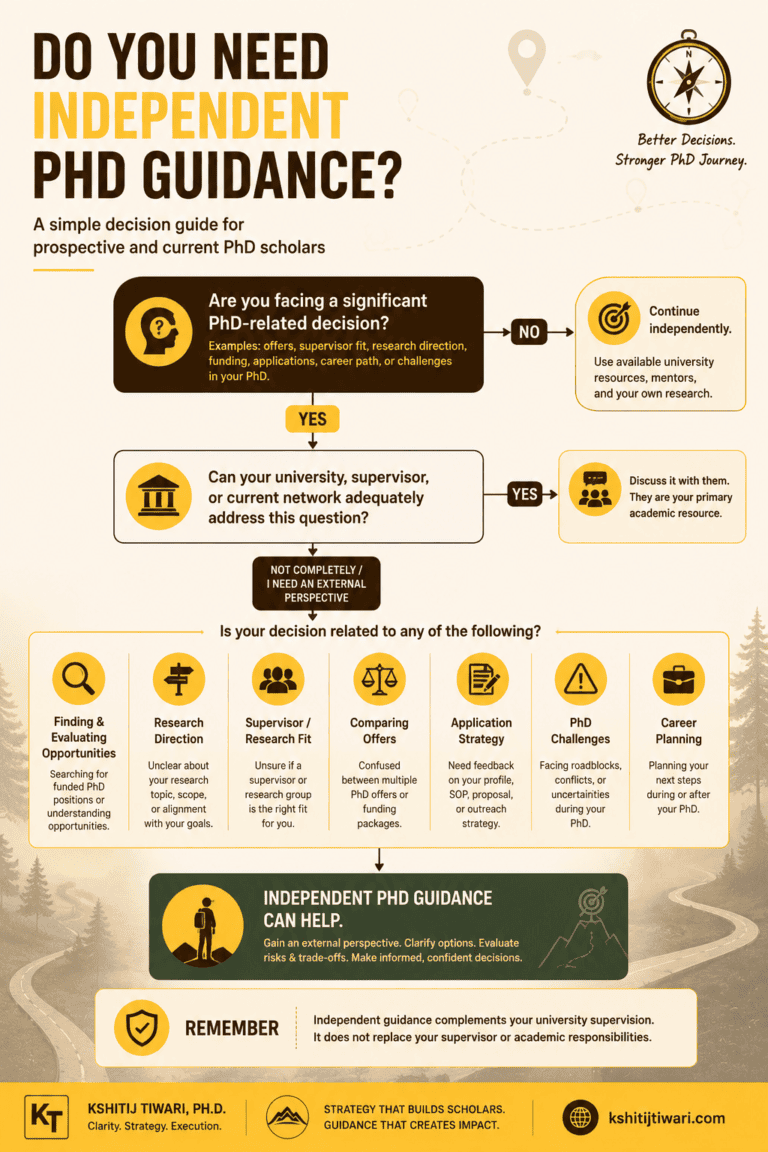
A Simple Test: Do You Need Independent PhD Guidance?
Ask yourself these seven questions.
1. Am I making a major PhD-related decision?
2. Do I have enough information to understand the available options?
3. Can I evaluate the trade-offs objectively?
4. Do I have someone independent and experienced whom I can ask?
5. Would making the wrong decision have significant consequences?
6. Is the decision still changeable?
7. Would an external perspective materially improve my decision?
If you answer yes to most of these questions, independent guidance may be worth considering.
If you answer no, you may simply need more information rather than professional support.
The Most Important Principle: Guidance Should Increase Your Independence
There is an irony in the idea of paying someone to help you navigate a PhD.
A doctorate is ultimately supposed to develop your ability to work independently.
So the best external support should not make you dependent on the guide.
It should make you more capable of navigating the system yourself.
After a useful session, you should ideally have:
- clearer priorities
- better questions
- a stronger decision framework
- greater awareness of trade-offs
- a more realistic understanding of your options
- a concrete next step
You should not simply leave thinking:
“Tell me what to do next.”
You should leave thinking:
“I understand what I need to evaluate, why it matters, and how I can make the decision.”
That is the real value of independent PhD guidance.
A Practical Framework for Deciding Whether to Seek Help
Before paying anyone, work through this framework.
Step 1: Define the decision
Write down exactly what you are trying to decide.
Not:
“I need help with my PhD.”
Instead:
“I have three funded offers and need to compare them.”
Or:
“I am unsure whether this research direction is strong enough to approach supervisors.”
Or:
“I have received several rejections and need to understand whether my application strategy is the problem.”
Step 2: Identify what you already know
Separate facts from assumptions.
For example:
Known: The position provides a monthly stipend.
Unknown: Whether the stipend is sufficient after local living costs.
Assumption: A higher-ranked university will necessarily improve my career prospects.
That separation alone can clarify a surprising amount.
Step 3: Identify what you cannot evaluate yourself
This is where external guidance may become useful.
Step 4: Determine whether the decision is reversible
The less reversible the decision, the more valuable careful evaluation becomes.
Step 5: Determine the cost of being wrong
Consider time, money, career impact, relocation, opportunity cost, and personal consequences.
Step 6: Decide what kind of help you actually need
You may need:
- information
- peer experience
- university support
- mentoring
- professional guidance
- legal/immigration advice
- financial advice
Not every PhD problem is a PhD guidance problem.
Step 7: Seek the smallest useful intervention
If one focused conversation can answer the question, do not turn it into a six-month engagement.
Independent PhD Guidance Is Not a Shortcut
It is worth emphasizing this because the term “consulting” can create the wrong expectation.
Independent PhD guidance cannot make the PhD easy.
It cannot guarantee admission.
It cannot guarantee funding.
It cannot guarantee a good supervisor.
It cannot eliminate uncertainty.
And it certainly cannot do the doctorate for you.
What it can do is help you make better decisions under uncertainty.
That is a much more realistic promise.
What Should You Expect From a Good Independent PhD Guidance Session?
A useful session should generally begin with your specific situation.
You should be able to explain:
- where you currently are
- what you are trying to achieve
- what options you have
- what you are uncertain about
- what constraints matter to you
The conversation should then move toward structured evaluation.
Depending on the problem, that could involve:
- identifying missing information
- comparing alternatives
- challenging assumptions
- evaluating risks
- identifying questions to ask universities or supervisors
- creating a decision matrix
- developing next steps
The output should be clarity and action, not simply more information.
Key Takeaways
You do not need an external person involved in every PhD decision.
And you certainly do not need someone to make your decisions for you.
But a PhD involves a remarkable number of high-consequence choices, often made with incomplete information.
The right question is therefore not:
“Should I hire a PhD consultant?”
It is:
“Would an independent perspective help me make this particular PhD decision better?”
If you already have the information, experience, and confidence required to make the decision, proceed independently.
If you are facing a complex or consequential decision and cannot confidently evaluate the trade-offs yourself, independent PhD guidance may be worth considering.
The purpose of that guidance should be simple:
not to tell you what to do, but to help you understand what you are deciding, what you may be overlooking, and how to make the decision with greater clarity.
Need Independent Perspective on a PhD Decision?
If you are evaluating PhD opportunities, comparing offers, preparing an application, reconsidering your research direction, or facing another major doctoral decision, independent guidance can provide an external perspective without replacing your university supervisor.
The goal is not to make the decision for you.
It is to help you make your own decision better.