Most prospective doctoral candidates treat their PhD research proposal like an extended academic essay: a document fueled by intellectual curiosity, broad theoretical questions, an impressive collection of citations, and a desire to demonstrate how passionate they are about their chosen field.
That approach often produces a document that sounds academic without actually demonstrating that the proposed research is important, original, feasible, and appropriately scoped.
A strong PhD research proposal is doing something fundamentally different.
Think of it as a structured research and development pitch. You are asking a university, department, prospective supervisor, and potentially a funding body to invest years of supervision, research infrastructure, laboratory access, computing resources, funding, and institutional capacity into a research project.
The proposal therefore has to answer a deceptively difficult question:
Why should someone believe that this particular research problem is worth investigating, that you understand what is already known about it, and that you have a credible plan for producing an original contribution?
That is the real job of a PhD research proposal.
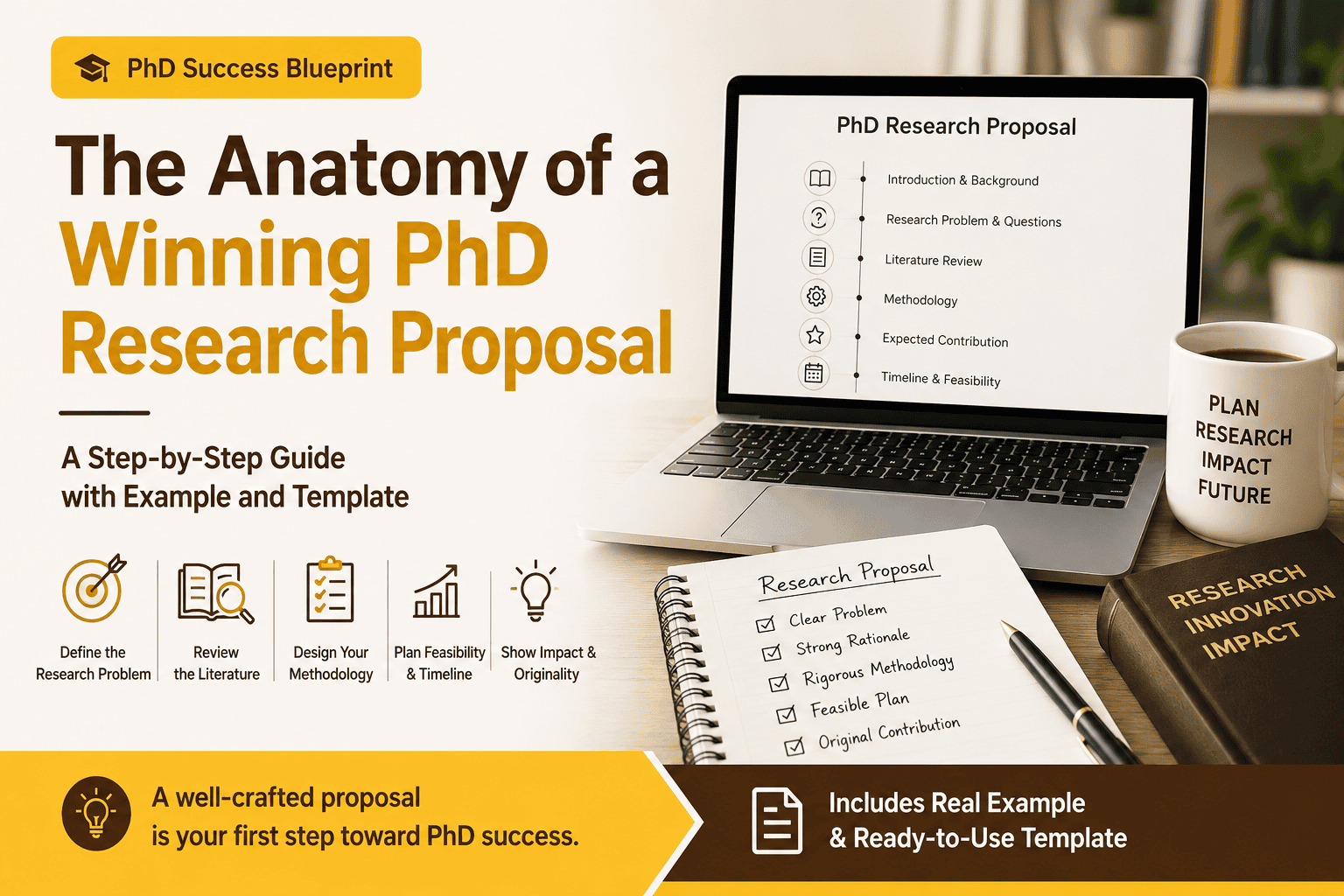
In this guide, I will break down the anatomy of a strong PhD research proposal, explain how to move from a research topic to a defensible research question, show you how to identify and articulate a research gap, explain what belongs in the methodology, demonstrate how supervisor fit affects your proposal, provide a complete proposal structure and template, and walk through a worked technical example.
If you are still deciding what you should research, however, do not start here. Begin with my guide to choosing a PhD research topic. This article assumes that you already have a reasonably defined research direction and are now trying to turn that direction into a credible proposal. A strong proposal can help you enter a PhD, but navigating the years that follow requires a different set of skills. The PhD Scholar’s Compass focuses on that larger journey.
 Related Resource: This article is part of the Unwritten PhD Resource Library—a comprehensive collection of guides, decision frameworks, and practical resources covering every stage of the PhD journey, from choosing a research topic and applying for a PhD to publishing papers, managing burnout, and planning your career after graduation.
Table of Contents
ToggleWhat Is a PhD Research Proposal?
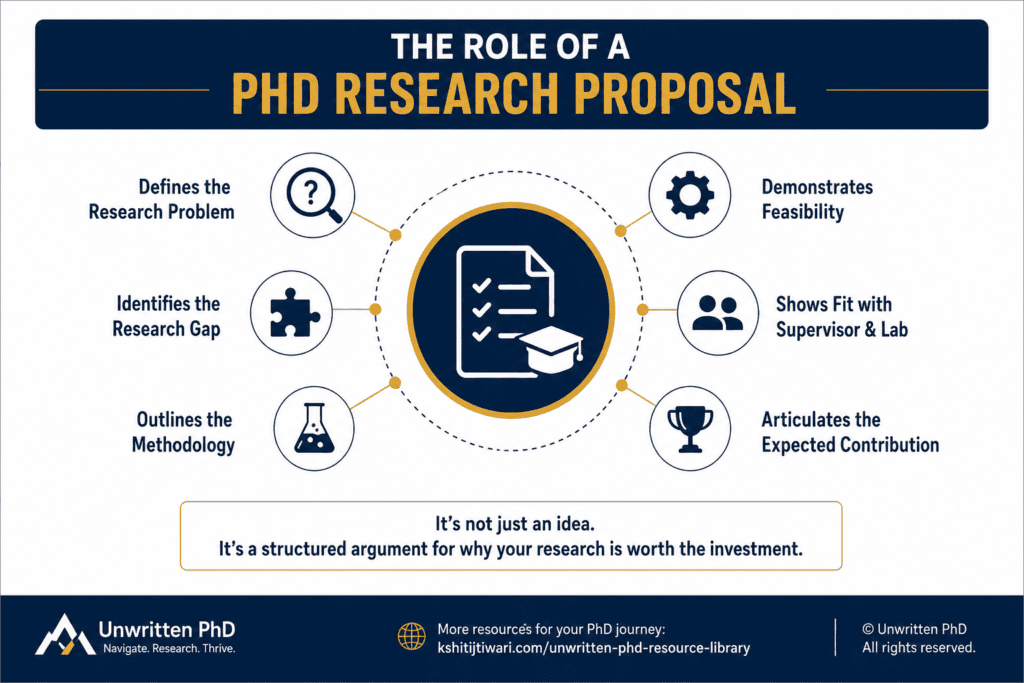
A PhD research proposal is a structured document that explains the research problem you intend to investigate, why that problem matters, what is already known about it, what gap remains in the existing literature, how you propose to investigate that gap, and what contribution the research could make.
It allows prospective supervisors, departments, admissions committees, or funding bodies to evaluate several things before the research begins:
- Whether the proposed problem is significant.
- Whether the proposed research is sufficiently original.
- Whether the research questions are clear and answerable.
- Whether the methodology is appropriate.
- Whether the project is feasible within the available time and resources.
- Whether the proposed research fits the supervisor and research environment.
- Whether the researcher understands the intellectual landscape surrounding the problem.
A research proposal is therefore not simply a description of an interesting topic.
It is an argument:
There is a meaningful problem → existing knowledge does not completely resolve it → this creates a research gap → I have formulated specific questions around that gap → I have a credible way to investigate those questions → the resulting work can make a meaningful contribution.
That chain of reasoning is the backbone of a strong proposal.
PhD Research Proposal vs SOP vs Research Paper vs Thesis
One common source of confusion is treating every academic document as though it serves the same purpose.
It does not.
|
Document
|
Primary purpose
|
|---|---|
|
PhD Research Proposal
|
Defines the research problem, gap, questions, methodology, and expected contribution.
|
|
Statement of Purpose (SOP)
|
Explains your academic background, motivation, goals, preparation, and program fit.
|
|
Literature Review
|
Synthesizes and evaluates existing research around a specific research problem.
|
|
Research Paper
|
Reports completed research, methodology, findings, and contribution.
|
|
PhD Thesis/Dissertation
|
Presents the complete doctoral research and its original contribution to knowledge.
|
The key distinction is timing and purpose. A research proposal explains what you intend to investigate and how you plan to investigate it. A research paper explains what you have investigated and what you discovered. Your thesis ultimately brings together the body of research conducted throughout your doctorate. An SOP, meanwhile, is primarily about you as a researcher—your background, motivation, preparation, goals, and fit—not the detailed architecture of the research project.
Phase 0: The Strategic Foundation (Before You Write a Single Word)
Do not open a blank Word document and immediately start writing your introduction.
That is one of the easiest ways to produce a 3,000-word document that still does not have a coherent research proposal.
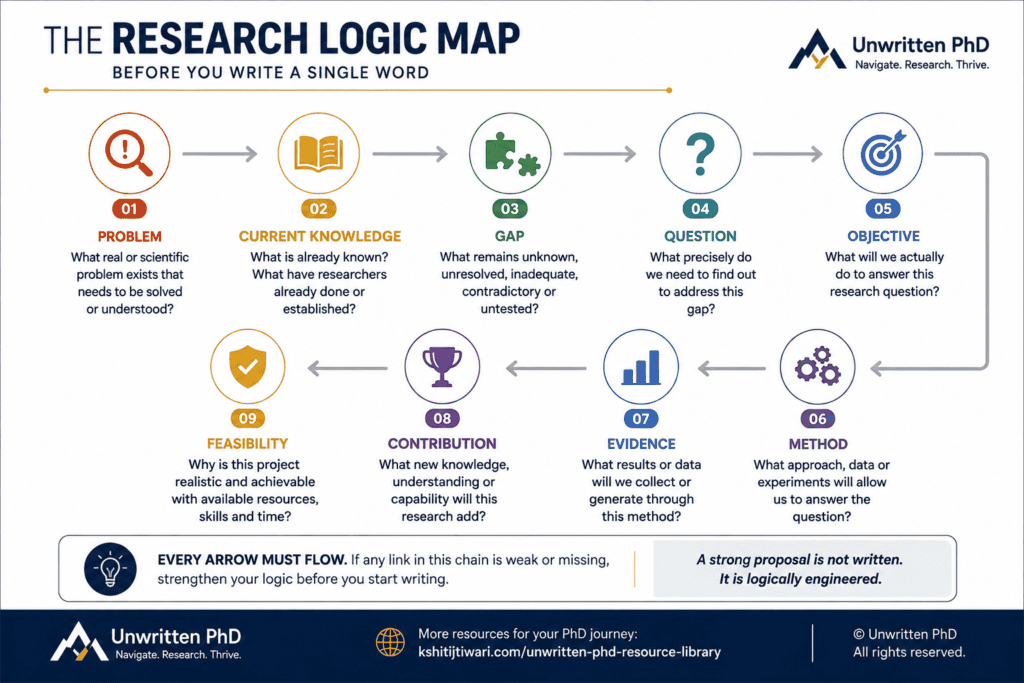
Before writing prose, create a one-page research logic map.
Write down:
Problem: What real or scientific problem exists?
Current knowledge: What has already been established?
Gap: What remains unknown, inadequate, contradictory or untested?
Question: What precisely do you want to find out?
Objective: What will you actually do to answer the question?
Method: What evidence or experiments will allow you to answer it?
Contribution: What will become possible or clearer because of your research?
Feasibility: Why can this project realistically be completed?
For example:
Problem: Mobile robots operating in degraded environments can experience significant sensing uncertainty.
Current knowledge: Existing navigation systems use combinations of visual, inertial, lidar, tactile or other sensing modalities.
Gap: Many approaches assume sufficiently reliable sensing or do not adequately address resource constraints when multiple sensing modalities must be integrated.
Research question: How can a resource-constrained mobile robot adapt its sensing strategy when environmental degradation causes individual sensing modalities to become unreliable?
Objective: Develop and evaluate an adaptive sensing framework for mobile robot navigation under degraded sensing conditions.
Method: Design the framework, implement it on a representative robotic platform, establish baseline comparisons, conduct controlled experiments and evaluate navigation performance under defined degradation conditions.
Contribution: A validated framework for adaptive sensing under resource constraints, together with experimental evidence showing when and why the approach improves robustness.
Feasibility: The research can be bounded around available robotic platforms, sensing modalities, computational resources, datasets and experimental environments.
Notice how each statement naturally leads to the next.
That is what you are trying to create before you start writing paragraphs.
Is a PhD the Right Vehicle for Your Goal?
There is also a more fundamental question to answer before investing significant time into proposal development:
Is a PhD actually the right vehicle for what you want to accomplish?
A research proposal requires substantial preparation. Before committing to the process, consider whether a doctorate aligns with your intended career, research interests and long-term goals.
If you are uncertain, use the PhD self-evaluation framework before proceeding.
The timing question matters as well. A prospective researcher considering a doctorate early in their career may have very different constraints from someone entering doctoral research after several years in industry. If timing is part of your decision, see The PhD Timing Trap.
The point is not to discourage you from pursuing a PhD.
It is to make sure you are solving the right problem before optimizing the proposal.
Validate Your Research Topic
Your proposal cannot rescue a fundamentally immature research topic.
If your starting point is something like:
Artificial Intelligence in Healthcare
you do not yet have a research topic.
You have a broad field.
Even:
AI for medical diagnosis
may still be too broad.
A doctoral research topic needs enough specificity to identify a research problem while remaining open enough to permit genuine investigation.
Your previous work on choosing a PhD research topic should therefore happen before this proposal-writing stage.
A useful progression is:
Broad field → research area → specific topic → research problem → research gap → research question → objective → methodology → contribution
If your topic cannot make that transition, it is probably not ready to become a proposal.
Validate Your Prospective Supervisor
A strong proposal sent to the wrong research environment can still fail.
Your prospective supervisor should not be evaluated simply because their job title contains your broad research area.
Look at:
- Their recent publications.
- Their active research direction.
- Their laboratory infrastructure.
- Their current students.
- Their methodological expertise.
- Their funding environment.
- Their likely ability to supervise your proposed work.
- Their broader advisor-advisee fit.
Your proposal should make sense in the context of the research environment you are applying to join.
For a deeper assessment, see Advisor-Advisee Fit: The Red and Green Flags to Look for in a Prospective Ph.D. Advisor.
Once you have established that fit, your communication with the prospective supervisor becomes important as well. See The Cold Email Template: How to Contact Professors for Ph.D. Positions for a structured approach to initial outreach.
Build Your Research Logic Map
At the end of Phase 0, you should be able to explain your proposed research on one page.
If you cannot, you should not yet be worrying about typography, formatting or word count.
The logic should look approximately like this:
Problem
↓
Current knowledge
↓
Research gap
↓
Research question
↓
Research objective
↓
Methodology
↓
Evidence
↓
Contribution
↓
Feasibility
If any arrow in that chain is broken, the proposal needs more intellectual work before it needs more prose.
Phase 1: Define the Research Foundation
Once your strategic foundation is clear, you can begin constructing the intellectual foundation of the proposal.
This phase answers a simple question:
What exactly are you proposing to investigate?
Define Your Working Research Title
Your working title should communicate the subject, problem, method, population, environment or contribution without becoming unnecessarily complicated.
Compare:
Artificial Intelligence in Robotics
with:
Adaptive Multi-Modal Sensing for Resource-Constrained Mobile Robots in Degraded Environments
The second title tells the reader substantially more.
However, do not confuse specificity with excessive jargon.
Your title should be precise enough to establish scope but flexible enough that you can refine the research during the doctorate.
A PhD proposal is a plan for investigation, not a binding contract that prevents scientific discovery.
Avoid titles that are:
- Extremely broad.
- Clever but ambiguous.
- Full of unexplained acronyms.
- Written like marketing slogans.
- So narrow that there is no room for research evolution.
A good title should survive being read without the rest of the proposal.
Establish the Research Context
Your introduction should orient the reader.
Start with the broader field, then progressively narrow the discussion.
A useful funnel is:
Field → Application → Problem → Existing approaches → Limitation → Gap → Proposed research
Avoid spending half of the introduction explaining the history of the entire discipline.
The reader does not need a textbook.
They need enough context to understand why your specific research problem matters.
For example, if you are researching robust mobile robot navigation, you do not need to explain the entire history of robotics.
Instead, establish the specific operational context:
- Mobile robots increasingly operate in environments where sensing may be unreliable.
- Navigation depends on sufficiently informative observations.
- Environmental degradation can affect individual sensing modalities.
- Combining additional sensors can improve robustness but introduces resource costs.
- This creates a research problem around how sensing resources should be allocated under changing conditions.
Now the reader has a reason to care about your specific problem.
Define the Research Problem
The problem statement is one of the most important sections of the proposal.
A useful test is:
If I removed my research questions and methodology, could the reader still explain exactly what problem this proposal is trying to solve?
If not, your problem statement needs work.
Avoid generic statements such as:
There is a need for more research.
There is almost always a need for more research.
Your job is to explain what research is missing and why that missing knowledge matters.
A strong problem statement should establish:
- What is happening?
- Why is it problematic?
- Under what conditions does the problem occur?
- Why are existing approaches insufficient?
- What consequence follows from the unresolved problem?
Establish the Research Gap
The research gap is one of the most misunderstood parts of a PhD proposal.
A research gap is not simply:
Nobody has studied this exact topic.
It is also not necessarily something that has never been mentioned anywhere in the literature.
In established fields, genuinely untouched areas are relatively rare.
A doctoral contribution can instead emerge from:
- An unresolved limitation.
- An untested assumption.
- Contradictory findings.
- A methodological limitation.
- A new context in which existing approaches have not been adequately evaluated.
- A missing comparison.
- A missing theoretical explanation.
- A need to extend an existing approach.
- A combination of existing ideas that creates new knowledge.
Methodological Gaps
A methodological gap exists when existing research uses methods that are inadequate for answering an important question.
For example, if existing work evaluates a robotic algorithm only under nominal conditions, but the actual operational problem involves degraded sensing, there may be a methodological opportunity to evaluate the approach under controlled degradation.
Contextual Gaps
A contextual gap occurs when an established approach has not been adequately evaluated under a particular environment, population, operating condition or application.
Empirical Gaps
An empirical gap exists when there is insufficient evidence to support or challenge an existing assumption.
Theoretical Gaps
A theoretical gap may involve an incomplete explanation of why a phenomenon occurs or how variables relate to one another.
The Important Rule
Do not manufacture a gap simply because you need one.
The gap should emerge from your engagement with the literature.
For example:
Although adaptive sensing strategies have been investigated, there remains limited experimental evidence on how resource-constrained mobile robots can dynamically allocate sensing resources when multiple modalities experience different levels of degradation.
Now the proposal has moved from a broad problem to a specific knowledge gap.
Formulate Your Research Questions
Your research question defines what you want to discover.
A good research question is:
- Specific.
- Answerable.
- Relevant to the gap.
- Appropriately scoped.
- Consistent with the methodology.
- Capable of producing a meaningful contribution.
For example:
How can a resource-constrained mobile robot dynamically select sensing modalities to maintain navigation performance under changing sensing degradation?
That question is narrower than the overall problem and directly connected to the research gap.
Avoid questions that are so broad that they cannot be answered within one doctorate.
Avoid questions that are merely requests to build something:
Can I develop an AI-based navigation system?
That is closer to a project objective than a research question.
A research question should create an opportunity to generate knowledge.
Define Your Research Objectives
The objective describes what you will actually do to answer the research question.
For example:
To develop and experimentally evaluate an adaptive sensing strategy that dynamically selects sensing modalities according to environmental degradation and available computational resources.
A useful distinction is:
Problem: Something important is not working or understood adequately.
Gap: Existing research does not sufficiently explain or solve a particular part of that problem.
Question: What do we need to find out?
Objective: What will this project do to find it out?
Method: How will the objective be executed?
Contribution: What will the research add to knowledge?
Your objectives should therefore map directly to your research questions.
If you have three research questions but seven unrelated objectives, your proposal probably has an alignment problem.
Establish the Expected Contribution
Do not confuse output with contribution.
Building a robot is an output.
Developing software is an output.
Collecting a dataset is an output.
Publishing a paper is an output.
The research contribution is what the work allows the field to know, explain, predict, compare, design or do differently.
For example:
The research will contribute an experimentally validated framework for adaptive sensing under resource constraints, together with evidence identifying the operating conditions under which dynamic sensor selection provides meaningful advantages over static configurations.
That is stronger than:
The research will develop a new sensor-selection algorithm.
The algorithm may be the artifact.
The contribution is the knowledge generated through developing and evaluating it.
Phase 2: Build the Architecture of Your Research Proposal
Once the research foundation is clear, you can construct the proposal itself.
The exact ordering and required sections vary between universities, departments and disciplines, so the requirements of your target institution always take precedence.
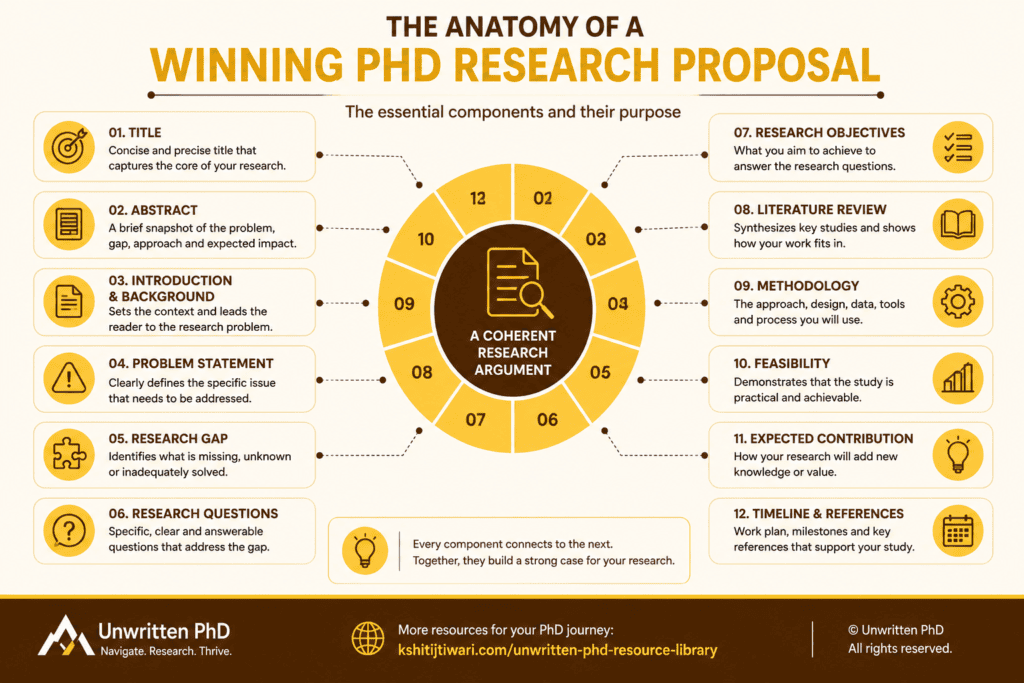
However, a strong technical PhD proposal commonly contains the following components.
Title: Precision Over Poetry
Your title should tell the reader what the research is about.
A useful title often contains some combination of:
- Research problem.
- Core variable.
- Context or application.
- Population/system.
- Methodology, where useful.
Do not force every element into the title.
The objective is clarity, not keyword stuffing.
Abstract: Your Executive Summary
Write the abstract after the rest of the proposal is substantially complete, even though it appears at the beginning.
A useful abstract answers five questions:
- What is the problem?
- Why does it matter?
- What is the research gap?
- What will you do?
- What contribution do you expect?
A simple structure is:
Context → Problem → Gap → Approach → Expected contribution
Do not use the abstract to tell your entire academic biography.
It should summarize the research project.
Introduction and Research Background
The introduction establishes the case for your project.
A strong introduction generally moves from broad context toward the precise research problem.
You might structure it as:
Establishing the Context
Introduce the broader research domain.
Narrowing the Problem
Explain the specific technical or scientific challenge.
Reviewing Existing Approaches
Briefly introduce how researchers currently address it.
Establishing the Limitation
Explain where those approaches remain insufficient.
Introducing the Proposed Research
State what your project intends to investigate.
The introduction should naturally lead the reader toward the research questions.
Problem Statement
The problem statement should be concise and specific.
It should not simply repeat the introduction.
The introduction gives context.
The problem statement identifies the specific problem that requires investigation.
A useful structure is:
Current condition → limitation → consequence → unresolved need
The reader should finish this section understanding exactly what is wrong, missing or insufficient.
Research Gap
The gap should emerge from your literature analysis.
Do not treat it as a decorative sentence inserted near the end of the introduction.
A convincing gap demonstrates:
- What has already been investigated.
- What existing approaches achieve.
- Where they remain limited.
- Why that limitation matters.
- What remains unanswered.
That creates the intellectual justification for your research questions.
Research Questions
The research questions operationalize the gap.
For technical research, they should generally make it possible to identify what evidence you will need to collect.
Ask:
What evidence would allow me to answer this question?
If you cannot answer that, the question may still be too vague.
Research Objectives
Each objective should have a clear relationship to the research questions.
For example:
|
Research Question
|
Research objective
|
|---|---|
|
How does X affect Y under condition Z?
|
Quantify the effect of X on Y under Z.
|
|
Can method A outperform baseline B?
|
Implement and experimentally compare A against B.
|
|
What factors influence outcome X?
|
Identify and evaluate the influence of those factors.
|
This alignment is one of the easiest ways to identify structural weaknesses in a proposal.
Literature Review: Build the Matrix
The literature review is not a summary of everything you have ever read.
It is a strategic positioning exercise.
You are building a map of the existing knowledge so that the reader can understand where your research will sit.
Instead of writing:
Paper A did this.
Paper B did this.
Paper C did this.
organize the literature around:
- Major approaches.
- Current findings.
- Competing approaches.
- Assumptions.
- Limitations.
- Methodological differences.
- Contradictions.
- Unresolved questions.
- Research gaps.
The literature review should eventually make your proposed research feel like a logical consequence of the evidence you have reviewed.
For example:
Existing approaches demonstrate that multi-modal sensing can improve robustness.
However, these approaches may assume that all sensing modalities can remain continuously available.
Other adaptive approaches dynamically select sensing resources.
Yet the interaction between dynamic sensing selection, resource constraints and changing sensor degradation remains insufficiently characterized.
Now the research gap is emerging from the literature rather than being declared without justification.
Your proposal should therefore read as though the literature has led you to the research question.
Phase 3: Design a Credible Research Methodology
This is where the proposal transitions from intellectual argument to execution plan.
A proposal can have a compelling problem and an interesting gap but still fail if the methodology does not provide a credible way to generate evidence.
The central question is:
How will you produce evidence capable of answering your research questions?
This is why methodology should not be treated as a short paragraph at the end of the proposal.
Choose the Research Design
Your research design should follow from the research question.
Depending on the discipline, this could involve:
- Experimental research.
- Simulation.
- Case studies.
- Field studies.
- Surveys.
- Interviews.
- Longitudinal studies.
- Mathematical modeling.
- Computational experiments.
- Hardware-in-the-loop experimentation.
- Mixed methods.
Do not choose a methodology simply because it is fashionable.
“I want to use deep learning” is not a research design.
The question comes first.
The methodology follows from what needs to be known.
Define Your Data or Experimental Setup
Explain what evidence you will actually generate.
For technical research, this may include:
- Datasets.
- Physical hardware.
- Simulation environments.
- Experimental platforms.
- Sensors.
- Computing infrastructure.
- Software frameworks.
- Participants.
- Test environments.
A strong methodology should make it possible for the reader to imagine the research being executed.
For an experimental robotics project, for example, the proposal should make clear:
- What robotic platform is involved.
- What sensing modalities are being evaluated.
- What conditions will be tested.
- What baseline systems will be used.
- What variables will change.
- What measurements will be collected.
Define Variables, Baselines and Evaluation Metrics
This is an area where technical proposals can distinguish themselves from generic applications.
If you are proposing a new method, the committee needs to know:
Compared to what?
A new algorithm without a baseline does not automatically demonstrate improvement.
Likewise, the metric should follow from the research question.
For a robotic navigation study, relevant measures might include:
- Navigation success rate.
- Localization error.
- Computational load.
- Energy consumption.
- Recovery behavior.
- Failure frequency.
- Latency.
The exact metrics depend on the research question.
Do not add metrics simply because they are easy to measure.
Plan Your Validation Strategy
A methodology should explain not only how you will build or test something, but how you will determine whether the research answers the question.
Consider:
- Baseline comparisons.
- Controlled experiments.
- Ablation studies.
- Cross-validation.
- Statistical analysis.
- Sensitivity analysis.
- Edge-case testing.
- Repeated experiments.
- Qualitative validation where appropriate.
- Simulation-to-real validation where applicable.
The more consequential your research claim, the stronger the evidence required to support it.
Identify Risks and Mitigation Strategies
Research rarely proceeds exactly as planned.
Your proposal should demonstrate that you understand this.
For example:
If the primary dataset becomes unavailable, what alternative data source could be used?
If the experimental hardware cannot support the planned configuration, how could the scope be reduced?
If the proposed algorithm does not outperform the baseline, what would the study investigate instead?
If a key assumption fails, what alternative methodology is available?
A concise risk and mitigation section demonstrates research maturity.
Building a production-ready research methodology from day one also prevents technical debt from accumulating later in the doctorate.
Phase 4: Demonstrate Feasibility and Research Fit
An interesting research question is not enough.
A PhD proposal also has to answer:
Can this research actually be completed in this environment?
This is where many ambitious proposals become unrealistic.
Infrastructure and Resources
Identify the infrastructure required to execute the research.
Depending on your field, this might include:
- Laboratory equipment.
- Computing infrastructure.
- Robotics platforms.
- Specialized instruments.
- Clinical facilities.
- Software.
- Databases.
- Field access.
- Experimental environments.
Do not assume that the university has everything you need.
Verify it.
Data and Experimental Access
Data availability can determine whether a project is feasible.
Ask:
- Is the dataset publicly available?
- Does it require permission?
- Is the sample size sufficient?
- Can the data realistically be collected?
- Are there privacy or ethical constraints?
- Will access remain available throughout the research?
A proposal dependent on data that you have no realistic pathway to obtain is structurally weak.
Skills and Technical Requirements
You should also evaluate whether the project requires capabilities that are currently unavailable.
That does not necessarily mean you must already know everything.
A PhD is a training process.
But the proposal should distinguish between:
Skills that can reasonably be developed
and
Dependencies that could prevent the project from being executed.
Funding Requirements
Consider the financial requirements of the research.
Could the project require:
- Specialized equipment?
- Paid datasets?
- Travel?
- Fieldwork?
- Computing?
- Participant compensation?
- Laboratory consumables?
- Software licenses?
If significant resources are required, explain where they are expected to come from.
Supervisor and Laboratory Fit
The proposal should make sense in the research environment where you intend to conduct it.
Consider:
- Does the supervisor work in the relevant research area?
- Does the laboratory have appropriate infrastructure?
- Does the research complement current work?
- Are relevant collaborators available?
- Does the research fit existing funding directions?
Your proposal should demonstrate fit without becoming a sales brochure for the laboratory.
For a deeper treatment of supervisor selection, see Advisor-Advisee Fit: The Red and Green Flags to Look for in a Prospective Ph.D. Advisor.
Scope and Time Constraints
A PhD is already a large research project.
Trying to solve an entire field within one doctorate is usually a sign that the scope has not been sufficiently constrained.
Your proposal should therefore distinguish between:
The larger problem
and
the bounded contribution your PhD will make toward it.
A useful proposal does not promise to solve autonomous robotics.
It might instead investigate one specific mechanism that improves robustness under a defined class of sensing degradation.
That is ambitious enough to matter while bounded enough to investigate.
Risk and Contingency Planning
A strong proposal should contain fallback options.
For example:
If the full experimental platform cannot be deployed, the evaluation could initially be conducted in simulation before transitioning to the available physical platform.
Or:
If the planned 50-node experimental configuration exceeds available computational resources, the scope could be reduced to a smaller but more detailed experimental environment.
The objective is not to demonstrate that everything will go perfectly.
It is to demonstrate that you have thought about what happens when it does not.
Phase 5: Assemble and Write the Complete Proposal
Once the research logic, methodology and feasibility are established, you can assemble the proposal.
This is where many researchers make a mistake.
They think writing the proposal means simply writing each section independently.
It does not.
The sections need to form one connected argument.
From Research Logic to Proposal Narrative
Your complete proposal should roughly follow this intellectual progression:
Context
↓
Problem
↓
Existing knowledge
↓
Limitation
↓
Research gap
↓
Research question
↓
Research objective
↓
Methodology
↓
Evidence
↓
Expected contribution
↓
Feasibility
The proposal should feel like one argument rather than a collection of academic sections.
How the Sections Connect
Consider the following chain:
The problem exists.
↓
Existing approaches address parts of it.
↓
Those approaches have a specific limitation.
↓
That limitation creates a research gap.
↓
The gap creates a research question.
↓
The question determines the objective.
↓
The objective determines the methodology.
↓
The methodology determines the evidence.
↓
The evidence supports the contribution.
If you cannot trace those relationships through your proposal, the document needs structural revision.
How Much Detail Should Each Section Contain?
A 4,000-word proposal is not automatically better than a 2,000-word proposal.
A useful proposal contains enough detail to establish:
- The problem.
- The research gap.
- The research questions.
- The objectives.
- The relevant literature.
- The methodology.
- The feasibility.
- The contribution.
- The research environment fit.
Anything that does not strengthen those elements should be questioned.
Follow the word count and formatting requirements of the target university.
If the university asks for 2,000 words, do not submit 4,000 simply because you believe more detail demonstrates competence.
Precision is competence.
The Plug-and-Play PhD Research Proposal Template
Use the following as a starting framework, then adapt it to the requirements of your target university.
1. Title
[Specific research topic/problem] + [method/context/application if useful]
2. Abstract
Briefly describe:
- Research context.
- Problem.
- Research gap.
- Research question.
- Methodology.
- Expected contribution.
3. Introduction
Explain:
- Broader research context.
- Specific research area.
- Problem.
- Why the problem matters.
- Existing approaches.
- Limitations.
- Research gap.
- Proposed research direction.
4. Research Problem
State precisely:
What problem does this research investigate?
5. Research Gap
Explain:
What does existing research fail to adequately explain, solve, validate or understand?
6. Research Questions
List your primary question and, where necessary, supporting questions.
7. Research Objectives
Map each objective to the research questions.
8. Literature Review
Organize literature around:
- Major approaches.
- Current findings.
- Competing approaches.
- Limitations.
- Unresolved questions.
- Research gap.
9. Methodology
Explain:
- Research design.
- Data.
- Experimental setup.
- Algorithms/models.
- Variables.
- Baselines.
- Evaluation metrics.
- Validation strategy.
- Statistical or analytical methods where relevant.
10. Feasibility
Address:
- Infrastructure.
- Data.
- Skills.
- Funding.
- Time.
- Research environment.
- Potential risks.
11. Expected Contribution
Explain:
- Scientific contribution.
- Methodological contribution.
- Practical contribution.
- Potential applications.
12. Timeline
Provide:
- Major research phases.
- Milestones.
- Dependencies.
- Expected outputs.
13. References
Use the citation style specified by your university or department.
Do not add references merely to make the bibliography look impressive.
Every reference should serve a purpose in the research argument.
A Worked Example of a PhD Research Proposal
Consider the hypothetical topic:
Adaptive Multi-Modal Sensing for Resource-Constrained Mobile Robots in Degraded Environments
The proposal could be constructed as follows.
Research Background
Mobile robots increasingly operate in environments where reliable sensing cannot be guaranteed.
Dust, smoke, darkness, occlusion, environmental clutter, electromagnetic interference, weather or physical damage can degrade individual sensing modalities.
Robotic systems therefore need mechanisms for maintaining situational awareness despite imperfect observations.
Existing approaches may combine multiple sensing modalities, but simply adding sensors increases hardware, computational, energy and integration costs.
For resource-constrained robots, the challenge is therefore not merely obtaining more information.
It is deciding which information is worth obtaining under the current operating conditions.
Research Problem
A resource-constrained robot may have access to multiple sensing modalities but cannot necessarily operate all sensors continuously without exceeding computational, energy, weight or cost constraints.
At the same time, the reliability of individual sensors may change as the environment changes.
This creates a dynamic resource-allocation problem.
Research Gap
Existing multi-modal sensing approaches demonstrate the benefits of sensor fusion, while adaptive systems demonstrate that sensing strategies can respond to environmental conditions.
However, there remains an opportunity to investigate how adaptive sensing can be jointly considered with resource constraints and changing sensor reliability in mobile robotic systems.
Research Question
How can a resource-constrained mobile robot dynamically select sensing modalities to maintain navigation performance under changing sensing degradation?
Research Objectives
- Characterize the relationship between sensing degradation and navigation performance.
- Develop an adaptive sensing strategy based on environmental and system conditions.
- Evaluate the computational and energy implications of dynamic sensing selection.
- Compare the proposed approach against fixed sensing configurations.
- Identify the operating conditions under which adaptive sensing provides meaningful benefits.
Proposed Methodology
The project could begin by establishing baseline navigation performance under nominal sensing conditions.
Controlled degradation would then be introduced into individual sensing modalities.
The proposed adaptive strategy would estimate sensing reliability and select or prioritize modalities according to the current operating state and available resources.
Experiments would compare:
- Fixed sensor configurations.
- Full multi-modal sensing.
- Single-modality baselines.
- Adaptive sensing.
Performance could be evaluated using:
- Navigation success rate.
- Localization error.
- Computational load.
- Energy consumption.
- Recovery behavior under degradation.
Expected Contribution
The research would contribute an experimentally validated framework for adaptive sensing under resource constraints, together with evidence identifying when dynamic sensor selection provides meaningful benefits over static configurations.
Notice what makes this example coherent.
The methodology is not randomly chosen.
It exists because the research question demands comparative evidence.
The metrics are not arbitrary.
They follow from the resource-constrained nature of the problem.
The experiments are not merely demonstrations.
They are designed to test the research claims.
That is what you want your own proposal to achieve.
How to Stress-Test Your PhD Research Proposal Before Submission
Before sending your proposal to a prospective supervisor or submitting it with an application, perform a structured stress test.
Do not only proofread the document.
Interrogate the logic.
The 60-Second Test
Give your proposal to someone familiar with research but not necessarily your exact field.
Ask them:
“What problem am I trying to solve?”
If they cannot answer within a minute or two, your problem statement is probably too vague.
The Gap Test
Ask:
“What specifically is missing from existing research?”
If your answer is:
“There isn’t much research on this.”
you need to go deeper.
Ask:
- What specifically is missing?
- Why does the limitation matter?
- Which existing approaches demonstrate the limitation?
- What evidence supports your claim?
The Question Test
Ask:
“What exactly am I trying to find out?”
Your answer should correspond directly to your research questions.
If your research question is so broad that the answer could become an entire research field, narrow it.
The Method Test
Ask:
“How will I generate evidence that answers those questions?”
If your methodology does not directly answer your research questions, the proposal has a structural problem.
For every research question, you should be able to point to the methodological component that will address it.
The Contribution Test
Ask:
“What will we know or be able to do after this research that we cannot do now?”
If the answer is simply:
“We will develop a system.”
you may need to articulate the scientific contribution more clearly.
The system may be the artifact.
The research contribution is the knowledge generated through developing, evaluating or explaining it.
The Feasibility Test
Ask:
“What could prevent this project from being completed?”
Then identify mitigation strategies.
This is especially important for experimental PhDs.
Your proposal should demonstrate ambition without depending on everything going perfectly.
The Supervisor-Fit Test
Finally, ask:
“Why does this research belong in this particular laboratory?”
Can you explain:
- Why this supervisor?
- Why this department?
- Why this research environment?
- Why this infrastructure?
- Why now?
If the proposal could be copied and sent unchanged to twenty unrelated laboratories, you probably have not demonstrated sufficient research fit.
Common PhD Research Proposal Mistakes
Mistake 1: Starting With a Topic Instead of a Problem
“AI for healthcare,” “robotics for agriculture” and “machine learning for autonomous vehicles” are areas, not necessarily research problems.
A proposal needs a problem that can be investigated.
Mistake 2: Treating a Research Gap as a Keyword
Adding phrases such as “limited research exists” does not create a research gap.
The gap must emerge from your analysis of existing work.
Mistake 3: Making the Proposal Too Broad
A PhD is already a large project.
Trying to solve an entire field within one doctorate is usually a sign that the scope has not been sufficiently constrained.
A PhD is a bounded contribution to a much larger problem.
Mistake 4: Choosing a Method Before Defining the Question
“I want to use deep learning” is not a research question.
The method should follow the research question.
If your proposal starts with the technology rather than the research problem, you may end up forcing a method onto a question it cannot properly answer.
Mistake 5: Using Technology as the Contribution
Using a transformer, reinforcement learning, ROS, computer vision or another modern technology does not automatically create novelty.
The contribution comes from what your research discovers, develops, explains or validates.
Mistake 6: Writing a Literature Catalogue
Listing papers is not synthesis.
Your literature review should reveal relationships between studies, assumptions, methods, findings, contradictions and gaps.
The reader should understand why your proposed research follows from the literature.
Mistake 7: Ignoring Baselines
If you propose a new method, the reader needs to understand what it improves upon.
Without appropriate baselines, claims of improvement become difficult to evaluate.
Mistake 8: Promising an Outcome
You are proposing an investigation.
Do not write your conclusion before conducting your research.
Instead of:
This research will prove that the proposed approach is superior.
write:
This research will evaluate whether the proposed approach provides measurable advantages under the defined operating conditions.
The second statement reflects scientific uncertainty.
Mistake 9: Ignoring Feasibility
A proposal that requires unavailable equipment, proprietary datasets, impossible access or unrealistic timelines is not strengthened by adding more technical detail.
Feasibility is part of research design.
Mistake 10: Writing for the University Instead of the Researcher
The proposal should demonstrate that you understand the research problem and can reason about it independently.
Do not simply repeat terminology from the university website.
You are not trying to prove that you have memorized the department’s research page.
You are demonstrating that you can identify a meaningful research problem and construct a credible plan for investigating it.
PhD Research Proposal Checklist
Before submitting, verify each item.
Research Foundation
- Is the research problem clearly defined?
- Is the problem significant enough to justify doctoral research?
- Is the research scope appropriately constrained?
- Is the research gap supported by relevant literature?
- Is the gap more specific than “more research is needed”?
- Is the research contribution clearly distinguished from the research output?
Research Questions
- Are the questions specific?
- Are they answerable?
- Do they directly address the research gap?
- Are they consistent with the proposed methodology?
- Can you identify what evidence would answer each question?
Research Objectives
- Does every objective map to a research question?
- Are the objectives achievable within the proposed PhD?
- Do the objectives lead logically toward the expected contribution?
Methodology
- Does the methodology answer the research questions?
- Are the data sources or experimental conditions realistic?
- Are appropriate baselines identified?
- Are evaluation metrics defined?
- Is the validation strategy credible?
- Are important assumptions stated?
- Are risks and mitigation strategies identified?
Feasibility
- Do you have access to the required infrastructure?
- Can the research be completed within the expected timeframe?
- Are funding requirements realistic?
- Are technical dependencies understood?
- Are data-access requirements realistic?
- Have major risks been identified?
- Is there a fallback plan for critical dependencies?
Supervisor Fit
- Does the prospective supervisor actually work in a relevant area?
- Have you read their recent work?
- Does the laboratory have relevant infrastructure?
- Does the proposed research complement their research direction?
- Have you assessed the broader advisor-advisee fit?
- Can you clearly explain why this research belongs in this laboratory?
Research Contribution
- Is the expected contribution clearly stated?
- Is it more than simply building a system?
- Is it logically derived from the research gap?
- Can you explain what the field will know or be able to do differently?
Proposal Alignment
- Does the problem lead to the gap?
- Does the gap lead to the research questions?
- Do the research questions lead to the objectives?
- Do the objectives determine the methodology?
- Does the methodology generate evidence capable of answering the questions?
- Does the expected contribution follow from the research?
Writing and Formatting
- Is the proposal logically structured?
- Does every section contribute to the research argument?
- Have unnecessary background sections been removed?
- Are claims supported by appropriate references?
- Are technical terms defined where necessary?
- Has the proposal been proofread?
- Does it follow the university’s formatting requirements?
- Does it meet the required word count?
- Are figures and tables properly labelled?
- Is the reference style consistent?
Key Takeaways
Writing a winning PhD research proposal is not an exercise in creative writing.
It is an exercise in research logic and systems integrity.
You must systematically de-risk your topic, identify a defensible research gap, formulate answerable research questions, align your methodology with those questions, demonstrate feasibility, establish supervisor and research-environment fit, and articulate a contribution that goes beyond simply building a system or producing a dataset.
The strongest proposals create a continuous chain:
Problem → Existing Knowledge → Gap → Research Question → Objective → Methodology → Evidence → Contribution
If that chain is coherent, the proposal becomes much easier to write.
If the chain is broken, adding more pages rarely fixes the underlying problem.
Your Next Steps
1. If your research topic is still uncertain:
Start with The Definitive Guide to Choosing a PhD Research Topic.
2. If you have a topic but have not validated your supervisor:
Use the Advisor-Advisee Fit guide to evaluate the research environment before investing heavily in your proposal.
3. If you are preparing your broader application:
Your proposal should complement, not duplicate, your Strategic PhD Statement of Purpose.
4. If you are ready to contact prospective supervisors:
Use the Cold Email Template for Contacting Professors to build a more targeted outreach strategy.
5. If you want a broader roadmap for your doctoral journey:
Return to the Unwritten PhD Resource Library.
Need Expert Feedback on Your PhD Research Proposal?
A proposal can look polished while still containing a fundamental problem: the research logic does not hold together under scrutiny.
That is particularly difficult to identify when you have spent weeks writing the document yourself.
If you already have a research topic, draft proposal or prospective supervisor in mind, a targeted external review can help you identify weaknesses before they become problems during the application or supervisor-selection process.
I provide strategic PhD mentorship and research advisory services for researchers who want rigorous feedback on their research direction, proposal architecture, methodology, supervisor fit and broader PhD strategy.
If you need more than generic proposal-writing advice, explore my PhD mentorship and advisory services or request a consultation to discuss your specific research situation.
The goal is not to make your proposal sound more academic.
The goal is to make the research behind it more defensible.