Most robotics founders eventually arrive at the same question, although it rarely appears at the beginning of the journey.
During the earliest stages of a startup, technical leadership is often straightforward. The founding team is small, communication is direct, and engineering decisions happen organically. A handful of engineers can move quickly, build prototypes, test ideas, and iterate without formal structures.
As the company grows, however, complexity begins to compound.
The robot that once operated successfully in a controlled demonstration environment must now function reliably in real-world deployments. New customer requirements emerge. Engineering teams expand. Product roadmaps become more ambitious. Investors start asking difficult questions about scalability, technical debt, deployment readiness, and long-term commercialization plans.
Suddenly, the startup no longer needs only engineers.
It needs technical leadership.
This is usually the point where founders begin considering whether they need a Chief Technology Officer (CTO).
The problem is that “hiring a CTO” is often treated as a binary decision. Either you hire one or you don’t.
In reality, there are multiple ways to acquire senior technical leadership, and for many robotics startups, the most expensive option is not necessarily the most effective one.
The decision is not simply about hiring a person. It is about choosing the right leadership model for the current stage of company growth.
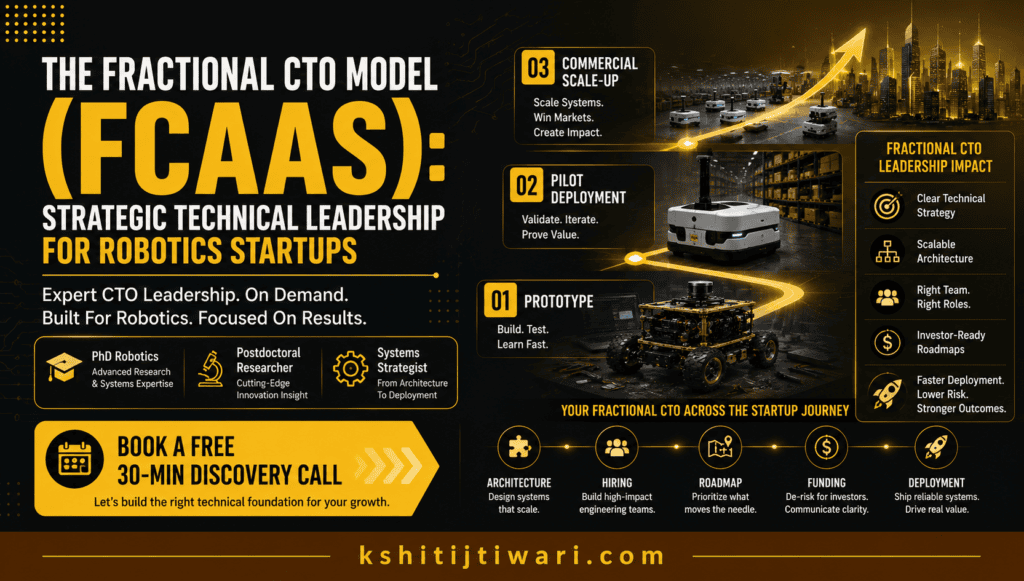
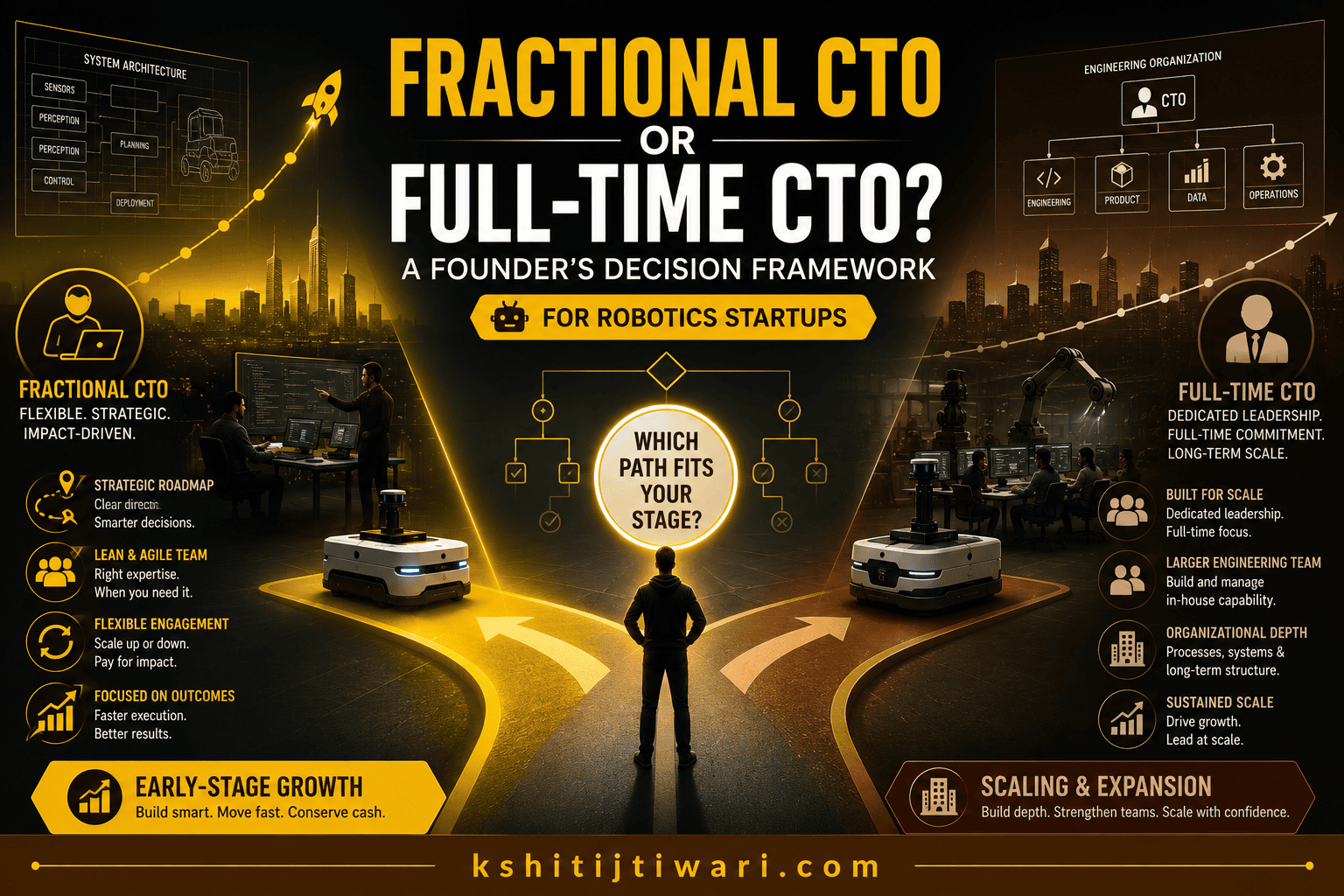
For some organizations, a full-time CTO is essential. For others, a Fractional CTO provides the strategic guidance, architectural oversight, and commercialization expertise needed without the cost and organizational complexity of another executive hire.
This article provides a practical framework for deciding which model makes sense for your robotics startup.
Table of Contents
ToggleThe Real Question Isn't "Do We Need a CTO?"
Many founders ask:
“Do we need a CTO?”
A better question is:
“What problem are we trying to solve?”
This distinction matters because different technical leadership challenges require different solutions.
A startup struggling with software architecture may not need a full-time executive.
A startup preparing for investor diligence may not need another engineering manager.
A startup experiencing deployment failures may not need more developers.
Instead, it may need experienced technical leadership capable of identifying the underlying causes of these issues.
Before deciding between a Fractional CTO and a Full-Time CTO, founders should first identify the actual bottlenecks limiting growth.
Common examples include:
- Technical debt accumulation
- Weak system architecture
- Engineering hiring challenges
- Product roadmap uncertainty
- Customer deployment issues
- Commercialization delays
- Investor diligence concerns
- Engineering process immaturity
These problems often appear long before a company truly requires a full-time executive.
Why Robotics Startups Are Different
Many articles discussing CTO hiring focus on SaaS businesses.
Robotics startups operate under entirely different constraints.
Unlike software products, robotics systems must simultaneously integrate:
- Hardware
- Electronics
- Embedded systems
- Sensors
- Controls
- Middleware
- AI and perception
- Navigation
- Safety systems
- Cloud infrastructure
This complexity creates unique leadership challenges.
A robotics startup may have only eight engineers but still face technical challenges that rival those of much larger software organizations.
A single architectural mistake can impact:
- Reliability
- Scalability
- Manufacturability
- Deployment costs
- Customer satisfaction
This is one reason many robotics companies eventually struggle with the issues discussed in our Robotics Architecture Audit article.
When technical decisions affect every layer of the technology stack, leadership quality becomes increasingly important.
Understanding the Four Stages of Robotics Startup Growth
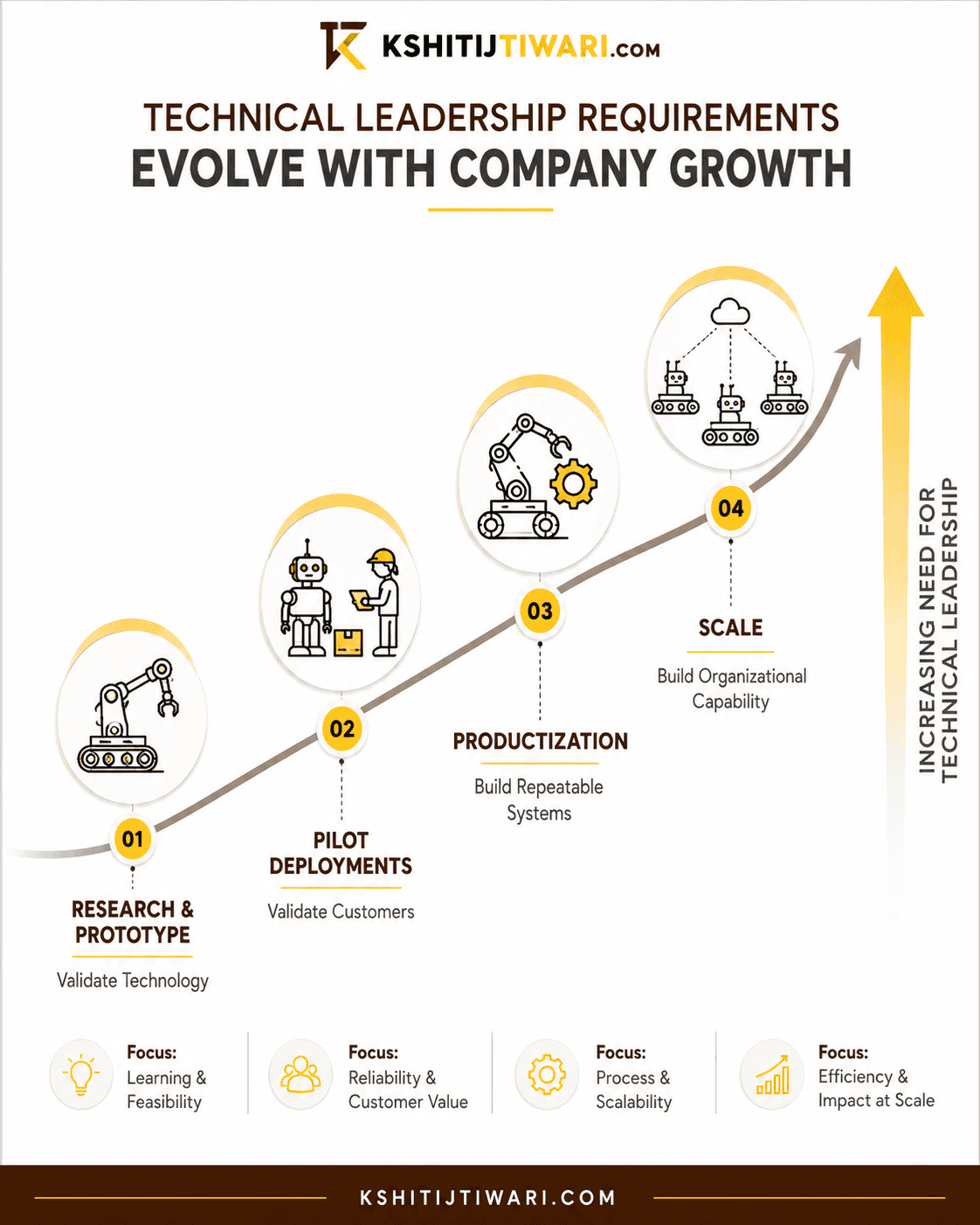
One of the biggest mistakes founders make is hiring for the company they hope to become rather than the company they are today.
Technical leadership requirements change dramatically as startups evolve.
Stage 1: Research and Prototype Development
At this stage, the primary objective is proving technical feasibility.
Questions include:
- Can the robot perform the intended task?
- Can the perception stack function reliably?
- Can the autonomy pipeline work in realistic conditions?
The focus is experimentation.
Processes are informal.
Documentation is limited.
The startup often benefits more from technical mentorship and architecture guidance than from executive management.
For most organizations at this stage, a full-time CTO is unnecessary unless the CTO is also a founding member.
Stage 2: Pilot Deployments
The startup begins interacting with real customers.
The focus shifts from feasibility to reliability.
New questions emerge:
- Why are deployments inconsistent?
- Why are customer integrations taking longer than expected?
- Why is engineering velocity slowing?
This is often where hidden architectural problems begin to surface.
A strategic review such as a Robotics R&D Readiness Audit can help identify risks before they become expensive failures.
Many startups at this stage benefit significantly from Fractional CTO support.
Stage 3: Productization
This is where many robotics startups encounter what we describe as the Robotic Valley of Death.
The technology works.
The business struggles to scale.
Engineering teams discover that building a prototype and building a product are fundamentally different challenges.
Technical debt accumulates.
Documentation gaps emerge.
Deployment costs rise.
Architecture limitations become increasingly visible.
A Fractional CTO can help create the systems, processes, and technical strategy needed to transition from prototype to product.
Stage 4: Scale
At this stage, engineering organizations become larger and more complex.
The company may have:
- Multiple teams
- Multiple products
- Dedicated engineering managers
- Structured hiring pipelines
- Significant customer deployments
Here, a full-time CTO often becomes increasingly valuable because technical leadership is required continuously rather than intermittently.
Choosing the right technical leadership model is only one part of the equation. Before deciding whether your startup needs a Fractional CTO or a full-time technical leader, it is worth understanding the broader robotics R&D strategy required to move from prototype development to reliable product deployment.
What a Fractional CTO Actually Solves
A common misconception is that Fractional CTOs simply provide part-time management.
The best Fractional CTOs provide leverage.
Rather than spending their time managing day-to-day engineering activities, they focus on high-impact decisions that influence company trajectory.
For robotics startups, this often includes:
Technical Strategy
Determining which technologies deserve investment and which do not.
Architecture Reviews
Evaluating whether current systems can support future growth.
Technical Debt Reduction
Identifying risks before they become major obstacles.
Productization Planning
Helping teams move beyond prototype development.
Investor Readiness
Preparing founders for technical diligence discussions.
Team Development
Mentoring engineering leaders and improving technical processes.
These are often the highest-leverage activities in early-stage robotics organizations.
What a Full-Time CTO Actually Solves
A full-time CTO becomes increasingly valuable when technical leadership is required every day.
This includes:
- Managing engineering organizations
- Hiring leadership teams
- Coordinating multiple product groups
- Aligning technology strategy with company objectives
- Building long-term organizational capability
In other words, a full-time CTO is often an organizational scaling solution rather than a purely technical one.
The Financial Reality Founders Often Ignore
Technical leadership should be viewed as a capital allocation decision.
A full-time CTO typically requires:
- Executive-level compensation
- Equity
- Benefits
- Recruiting costs
The total commitment can represent one of the largest expenses within an early-stage startup.
For many robotics companies, this capital may produce a greater return if allocated toward:
- Additional engineers
- Field testing
- Product development
- Customer acquisition
- Manufacturing readiness
The question is not whether a full-time CTO creates value.
The question is whether the company can fully utilize that value today.
Investor Perspective: What VCs Actually Care About
Many founders assume investors want to see a CTO on the executive team.
Investors care about outcomes far more than titles.
During technical diligence, investors typically evaluate:
- Architecture quality
- Engineering maturity
- Product scalability
- Deployment readiness
- Technical debt exposure
- Team capability
These topics are discussed extensively in our article on Robotics Technical Debt.
An investor rarely asks:
“Do you have a CTO?”
Instead, they ask:
“Can this company scale?”
Strong technical leadership matters because it improves the answer to that question.
A Practical Decision Framework
A Fractional CTO is usually the right choice if:
- You have fewer than 20 engineers
- Architecture decisions carry significant risk
- Productization challenges are emerging
- Investor conversations are becoming more technical
- You need strategic guidance rather than daily management
A Full-Time CTO is usually the right choice if:
- Multiple engineering teams exist
- Hiring consumes significant leadership attention
- Daily executive involvement is required
- Product lines are expanding
- Organizational management has become a major challenge
If architecture, productization, deployment readiness and technical debt are becoming recurring problems, start with a broader Robotics R&D Strategy assessment before deciding what leadership model you actually need.
Key Takeaways
The decision between a Fractional CTO and a Full-Time CTO is not about prestige.
It is about matching leadership capability to organizational needs.
For many robotics startups, the greatest challenge is not a lack of technical talent. It is the absence of experienced technical leadership capable of helping the company navigate architecture decisions, technical debt, deployment readiness, productization, and commercialization.
A Fractional CTO can often provide precisely the expertise required during these critical growth stages without the financial burden of a full-time executive hire.
As the organization matures, expands, and develops greater operational complexity, a Full-Time CTO may eventually become the right investment.
The key is recognizing which stage your company occupies today—and selecting the leadership model that accelerates growth rather than simply increasing costs.
Explore Fractional CTO Services
If you’re building a robotics startup and need guidance on architecture, technical debt, deployment readiness, commercialization, engineering leadership, or investor preparation, explore my Fractional CTO and Robotics Consulting Services.