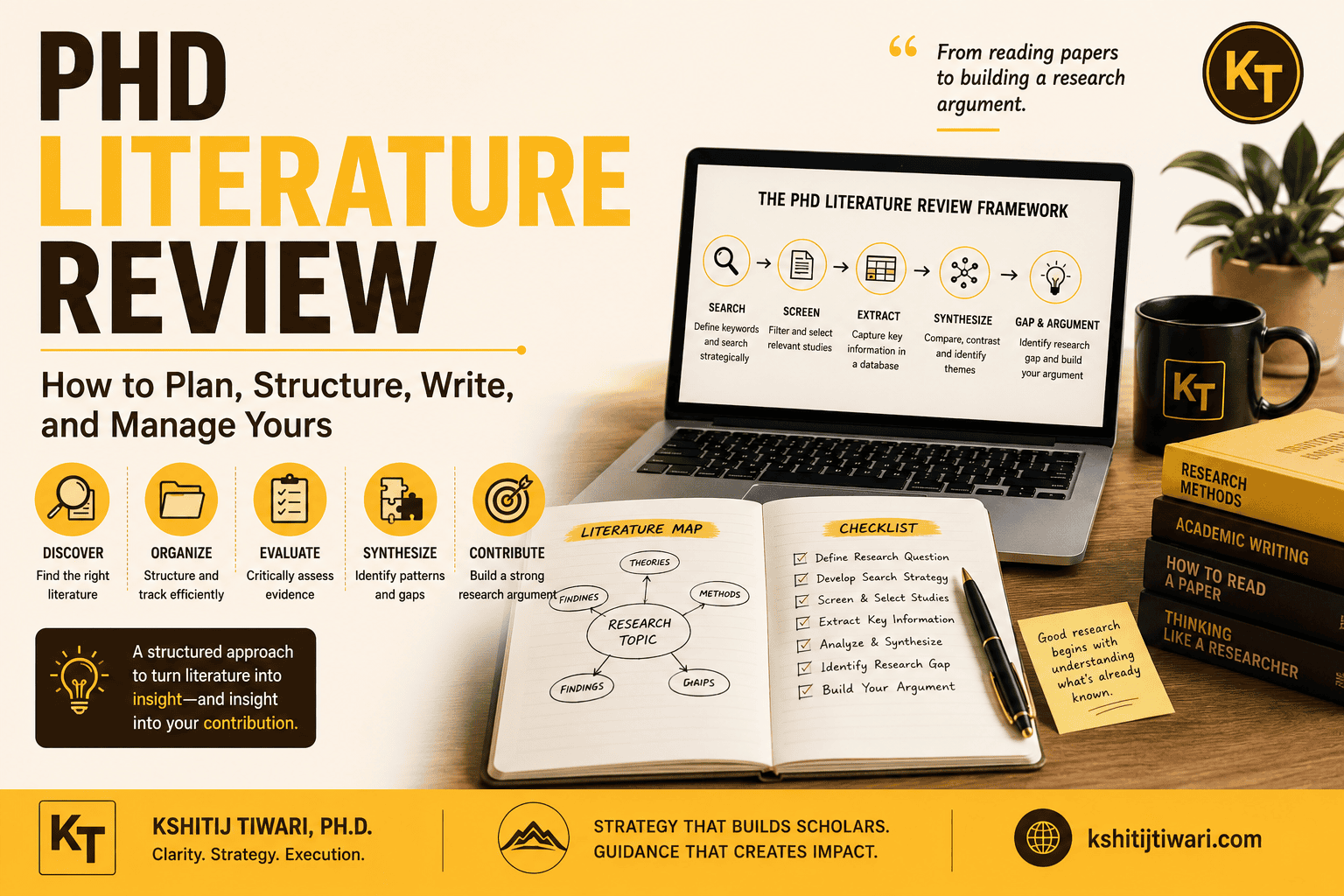
A PhD literature review is not a long list of papers you have read enlisted one after another. It is the process through which you learn what your field already knows, where researchers disagree, what remains uncertain, and where your own research can make a defensible contribution.
That distinction matters.
Many PhD scholars begin by searching Google Scholar, downloading dozens—or hundreds—of papers, highlighting passages, saving PDFs (or staking a pile on the work desk) and building increasingly complicated folders. Months later, they have a large collection of literature but still cannot answer the most important question:
What does all of this literature actually mean for my research?
A strong PhD literature review solves that problem.
It moves you from information collection to intellectual synthesis.
This guide presents a practical framework for conducting a literature review for a PhD—from defining the research question and designing the search strategy to organizing sources, critically evaluating evidence, identifying patterns and contradictions, finding a defensible research gap, and turning that gap into an argument that supports your research proposal or thesis.
If you are still deciding what you want to research, start with the guide to choosing a PhD research topic before treating the literature review as a purely mechanical exercise. Literature management is only one part of the larger challenge of learning to navigate doctoral research independently. The PhD Scholar’s Compass explores the broader decision-making, self-direction and resilience required to keep moving when the path is uncertain.
 Related Resource: This article is part of the Unwritten PhD Resource Library—a comprehensive collection of guides, decision frameworks, and practical resources covering every stage of the PhD journey, from choosing a research topic and applying for a PhD to publishing papers, managing burnout, and planning your career after graduation.
Table of Contents
ToggleWhat Is a Literature Review for a PhD?
A PhD literature review is a structured and critical synthesis of existing scholarship relevant to your research question, problem or field.
It has several jobs simultaneously.
It should help you:
- Understand the existing research landscape.
- Identify the major theories, concepts and debates in your field.
- Understand how researchers have approached the problem methodologically.
- Compare findings rather than simply report them.
- Identify agreements, disagreements and unresolved questions.
- Establish what is known and what remains uncertain.
- Identify a meaningful research gap.
- Position your proposed research within the existing body of knowledge.
- Demonstrate that you understand the intellectual context of your research.
A university literature-review guide from the University of Hawaiʻi, for example, describes a strong PhD literature review as addressing why the area is interesting, its challenges and research questions, known approaches and their strengths and weaknesses, and important open research questions.
That is very different from writing:
Smith (2022) found X.
Jones (2023) found Y.
Patel (2024) found Z.
That is a catalogue.
A literature review is supposed to help the reader understand the relationship between those findings.
The central question is therefore not:
“How many papers have I read?”
It is:
“What does the body of evidence allow me to conclude—and what can it not yet explain?”
Why PhD Literature Reviews Are So Difficult for Scholars
The difficulty is not usually finding papers.
Finding papers is comparatively easy.
The difficulty is knowing:
- which papers matter;
- which papers are foundational;
- which papers are outdated;
- which papers disagree;
- which disagreements are meaningful;
- which methods produce different results;
- which claims are strongly supported;
- which claims are weakly supported;
- what assumptions researchers are making;
- what populations, environments or conditions have been ignored;
- when have you read enough to stop;
- and whether an apparent “research gap” is actually a gap.
This is why a literature review becomes progressively harder as your reading list grows.
At first, 10 papers feel manageable.
Then you have 50.
Then 100.
Then 300.
At that point, the problem is no longer information scarcity.
It is information architecture.
You need a system for converting a growing literature collection into a progressively sharper understanding of the research problem.
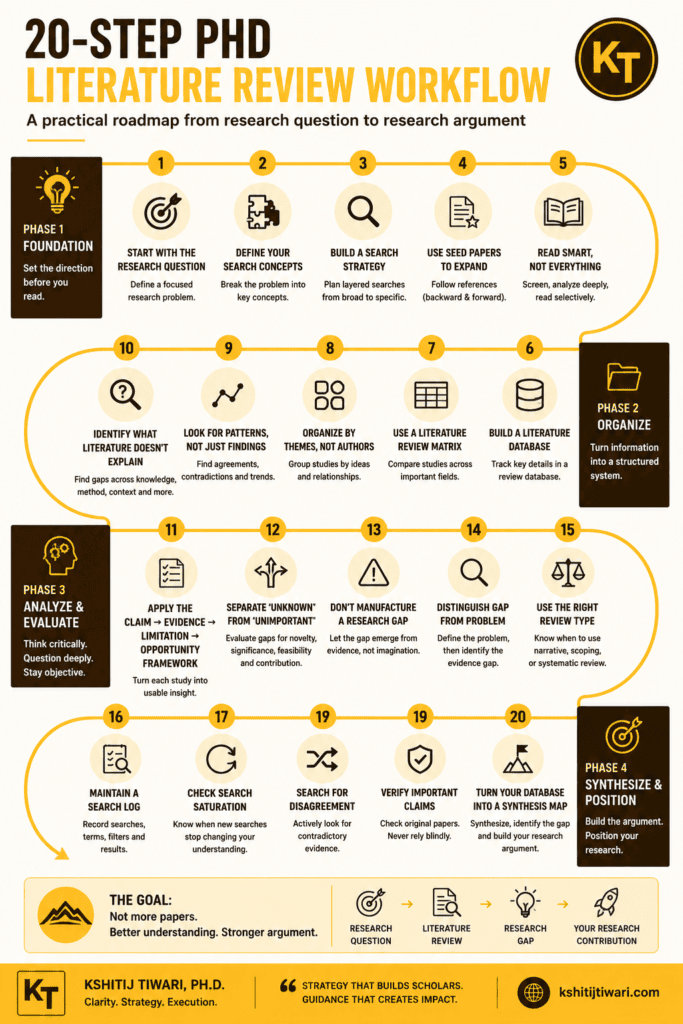
20 Step PhD Literature Review Workflow
A useful way to think about the entire process is:
Research question
↓
Search strategy
↓
Discovery
↓
Screening
↓
Extraction
↓
Comparison
↓
Synthesis
↓
Research gap
↓
Research argument
↓
Research question / objectives / proposal
Your literature review should become more focused as you move down this chain.
If it remains a giant collection of papers until the day you start writing, the workflow has failed.
Step 1: Start With the Research Question, Not the Papers
One of the most common mistakes is beginning the literature review with:
“Let me search my topic.”
The problem is that “topic” is usually too broad.
Suppose your broad area is:
Autonomous mobile robots.
That could produce an enormous literature set covering:
- navigation;
- localization;
- SLAM;
- perception;
- planning;
- manipulation;
- multi-robot systems;
- human-robot interaction;
- reinforcement learning;
- control;
- sensing;
- energy efficiency;
- field robotics;
- agricultural robotics;
- warehouse robotics;
- search and rescue;
- and hundreds of adjacent areas.
You cannot meaningfully review all of that.
Instead, define the research problem you are investigating.
For example:
How can a resource-constrained mobile robot maintain localization when visual sensing becomes unreliable in degraded environments?
Now your literature search has boundaries.
You can identify conceptual dimensions such as:
- resource-constrained robotics;
- localization;
- visual degradation;
- alternative sensing;
- sensor fusion;
- robustness;
- field environments.
The literature review becomes a map of a problem rather than a dump of everything related to a topic.
A useful question before every search
Ask:
What decision will this search help me make?
If you cannot answer that, your search is probably too broad.
Step 2: Define Your Search Concepts
Once the research question is sufficiently focused, break it into conceptual blocks.
For example:
| Concept | Possible terms |
|---|---|
| Robot | mobile robot, UGV, autonomous robot |
| Environment | degraded environment, GPS-denied, low visibility |
| Sensing | visual sensing, tactile sensing, multimodal sensing |
| Problem | localization failure, uncertainty, robustness |
| Approach | sensor fusion, adaptive sensing, resilient localization |
Do not assume that one keyword captures an entire research concept.
Researchers use different terminology for similar ideas.
A paper may never use your preferred phrase even though it is directly relevant.
This is where synonym mapping becomes valuable.
Create a working vocabulary containing:
- synonyms;
- abbreviations;
- alternative spellings;
- technical terminology;
- older terminology;
- disciplinary terminology;
- competing definitions.
Your initial search vocabulary should therefore evolve as you learn the field.
Step 3: Build a Search Strategy Instead of Searching Randomly
Your first search is not supposed to find everything.
It is supposed to teach you how the field describes itself.
Start broad enough to identify:
- landmark papers;
- recent reviews;
- major researchers;
- competing terminology;
- important conferences;
- dominant methods;
- foundational theories.
Then, recursively narrow it down.
A practical layered progression is:
Search Layer 1 — Landscape
broad concept + broad problem
Search Layer 2 — Methods
problem + methodology
Search Layer 3 — Debate
concept + competing approaches
Search Layer 4 — Limitations
approach + limitations
Search Layer 5 — Gap
approach + unresolved problem
This creates a progressively more targeted literature set.
Step 4: Use Seed Papers to Expand the Literature
Once you find a genuinely useful paper, stop treating it as a single source.
Treat it as a node in the literature network.
Two techniques are particularly useful:
Backward citation chaining
Look at the references cited by the paper.
This helps you identify:
- foundational work;
- earlier theories;
- original methods;
- seminal experiments.
Forward citation chaining
Look for later papers that cite the paper.
This helps you identify:
- follow-up studies;
- criticisms;
- extensions;
- competing methods;
- newer findings.
Citation chaining is particularly useful because keyword searches can miss papers that use different terminology. University research guides explicitly recommend backward and forward citation chaining as a literature-search technique.
Your literature review should therefore not be:
Search → Download → Repeat
It should become:
Search → Find seed paper → Follow references → Follow citations → Compare → Discover new concepts → Search again
That is a much more powerful workflow.
Step 5: Do Not Read Every Paper the Same Way
This is one of the biggest productivity traps in doctoral research.
Not every paper deserves the same amount of time.
A useful three-level reading strategy is:
Level 1: Screening
Determine whether the paper is worth deeper attention.
Look at:
- title;
- abstract;
- keywords;
- figures;
- conclusion;
- publication date;
- venue;
- references.
Ask:
Is this actually relevant to my research question?
If not, move on.
Level 2: Analytical reading
For relevant papers, examine:
- research question;
- theoretical framing;
- methodology;
- dataset or population;
- experimental conditions;
- key findings;
- limitations;
- assumptions;
- comparison with previous work.
Level 3: Deep reading
Reserve full, detailed reading for papers that are:
- foundational;
- methodologically central;
- directly related to your proposed contribution;
- highly influential;
- contradictory to your emerging argument;
- or essential for defending a claim.
The objective is not to read every paper from page 1 to page 40.
The objective is to understand the evidence you need to build your argument.
Step 6: Build a Literature Review Database
This is where a structured database becomes dramatically more useful than a folder full of PDFs.
At minimum, track:
| Field | Why it matters |
| Citation | Identifies the source |
| Year | Establishes recency |
| Research question | Shows what the study actually investigated |
| Problem addressed | Connects it to your research |
| Method | Allows methodological comparison |
| Dataset/sample | Identifies contextual boundaries |
| Key findings | Captures the evidence |
| Limitations | Potential gap indicators |
| Research context | Shows where results apply |
| Theoretical framework | Enables conceptual comparison |
| Your interpretation | Records your own analytical thinking |
| Relevance | Helps prioritize later |
| Theme | Enables synthesis |
| Contradiction/debate | Helps identify unresolved questions |
The important field is not simply:
“Summary”
It is:
“What does this paper contribute to my understanding of the research problem?”
That distinction prevents your database from becoming an annotated bibliography.
A Literature Review Matrix Is Not the Literature Review
A literature review matrix is a working tool.
It is not the finished chapter.
This distinction is worth emphasizing because many scholars make the following mistake:
- Create a spreadsheet.
- Add 100 papers.
- Fill in the columns.
- Sort by author.
- Start turning rows into paragraphs.
That usually produces a descriptive literature review.
The matrix exists to help you see relationships between sources.
The final review should be organized around those relationships.
For example:
Several studies demonstrate that approach A performs well under controlled conditions. However, studies conducted in dynamic environments report significantly lower reliability. This divergence appears to be associated with…
That is synthesis.
The papers are supporting evidence for the argument.
They are not the argument itself.
Step 7: Organize Papers by Themes, Not Authors
One of the strongest signals that a literature review is still immature is an author-by-author structure:
Smith found X.
Jones found Y.
Patel found Z.
Kumar found A.
A stronger structure is:
Theme 1: Approach A
Discuss the collective evidence.
Theme 2: Approach B
Compare the alternative.
Theme 3: Conditions Under Which the Approaches Fail
Now the limitations become visible.
Theme 4: Emerging Approaches
This shows the direction of the field.
Theme 5: Unresolved Problem
Now the reader can see where your research enters the conversation.
This is why literature-review guidance commonly recommends organizing the body around ideas, themes or relationships rather than simply listing studies.
Step 8: Look for Patterns, Not Just Findings
Once you have enough papers, stop asking:
“What did each paper find?”
Start asking:
“What pattern emerges across the papers?”
But what do these patterns look like in real life? Well, they can be agreements, contradictions, methodological dependence, gaps, etc. and we have discussed this at length in the self-help book PhD Scholar’s Compass: From Burnout to breakthrough.
Step 9: Identify What the Literature Does Not Yet Explain
This is where the literature review begins producing research value.
A research gap is not simply:
“Nobody has studied X.”
That claim is often difficult to defend.
Instead, look for gaps in Knowledge, methodology, context, theory, application, integration or, even, reproducibility. Again, you can read these at length in the PhD Scholar’s Compass book and implement at your own pace.
A good literature review helps you determine which of these, if any, genuinely exists.
Step 10: Use the “Claim → Evidence → Limitation → Opportunity” Framework
Here is a practical framework you can apply to individual themes.
1. Claim
What does the literature currently suggest?
2. Evidence
Which studies support that claim?
3. Limitation
Under what conditions does that evidence become weaker?
4. Opportunity
What remains unresolved?
For example:
Existing studies demonstrate that visual SLAM can achieve reliable localization in structured environments.
Evidence: Multiple experimental studies report high localization accuracy under controlled illumination and sufficient visual texture.
Limitation: Performance degrades when illumination changes rapidly, visual texture decreases, or the environment contains substantial occlusion.
Opportunity: This creates a need to investigate sensing strategies that remain reliable under degraded visual conditions.
Notice what happened.
The research gap did not appear from imagination.
It emerged from the boundary of existing evidence.
That is what you want your literature review to accomplish.
Step 11: Separate “Unknown” From “Unimportant”
Not every gap deserves a PhD.
This is a crucial distinction.
You can find thousands of unanswered questions.
The existence of an unanswered question does not automatically make it:
- significant;
- novel;
- feasible;
- fundable;
- technically achievable;
- or worthy of doctoral research.
Evaluate a potential gap using at least four dimensions:
| Dimension | Question |
| Novelty | Is the question genuinely unresolved? |
| Significance | Does answering it matter? |
| Feasibility | Can you realistically investigate it? |
| Contribution | What changes if you answer it? |
This is where your literature review connects directly to your research-topic strategy.
If your proposed topic cannot survive this test, the problem may not be your writing.
The problem may be your research direction.
Step 12: Don’t Manufacture a Research Gap
This deserves its own warning.
A weak literature review often contains sentences like:
“Few studies have investigated…”
“There is a lack of research on…”
“No research has examined…”
These claims are dangerous unless you have genuinely established the search boundaries that support them.
Instead, use evidence-based language:
“Within the literature reviewed here…”
“Existing studies predominantly focus on…”
“The evidence remains limited regarding…”
“A consistent limitation across these studies is…”
“The literature provides comparatively little evidence about…”
Your job is not to manufacture novelty.
Your job is to demonstrate where the existing evidence stops being sufficient.
Step 13: Distinguish a Research Gap From a Research Problem
These are related but not identical.
A research problem is the issue that motivates investigation.
A research gap is the deficiency in existing knowledge or evidence concerning that problem.
For example:
Problem
Autonomous robots struggle to maintain reliable localization in degraded environments.
Existing knowledge
Several localization methods work effectively under normal sensing conditions.
Limitation
Their performance decreases when visual information becomes unreliable.
Gap
There is insufficient understanding of how adaptive multimodal sensing can maintain localization robustness under changing sensing conditions.
Research question
How can a mobile robot dynamically select and combine sensing modalities to maintain localization reliability under degraded visual conditions?
This progression is exactly what a good literature review should help you build.
Step 14: Understand the Difference Between a Narrative Review and a Systematic Review
Do not automatically turn your PhD literature review into a systematic review simply because “systematic” sounds more rigorous.
They serve different purposes.
A traditional or narrative literature review may be appropriate when your objective is to:
- understand a field;
- synthesize theories;
- map debates;
- establish conceptual context;
- compare approaches;
- develop an argument.
A systematic review follows a much more explicitly defined methodology for searching, selecting, evaluating and synthesizing evidence.
PRISMA 2020 is a reporting guideline for systematic reviews; it provides structured reporting recommendations, including a checklist and flow diagram. It is not a universal requirement for every literature review in every PhD thesis.
Scoping reviews are another distinct approach and are particularly useful when the purpose is to map the extent, nature or characteristics of literature around a broad or complex area.
Therefore:
First determine what kind of review your research question requires. Then choose the methodology.
Do not choose the methodology because a template told you to.
Step 15: Build a Search Log
Your future self will thank you for this.
Record:
- database searched;
- date searched;
- search string;
- filters used;
- number of results;
- important papers discovered;
- inclusion criteria;
- exclusion criteria;
- notes about terminology.
Why?
Because six months later you may discover a new paper and wonder:
“Why didn’t I find this earlier?”
A search log lets you reconstruct your process.
It also becomes particularly important if your literature review has systematic elements or if you need to explain how your evidence base was assembled.
Step 16: Keep Track of Search Saturation
At some point, additional searches begin returning the same papers.
This is useful information.
Suppose you run five different searches and repeatedly encounter the same:
- seminal papers;
- review articles;
- research groups;
- methodologies;
- datasets.
You are beginning to understand the structure of the field.
This does not necessarily mean you have found everything.
It means your search vocabulary is becoming mature.
Now deliberately search for:
- contradictory evidence;
- criticism;
- alternative terminology;
- negative findings;
- failed approaches;
- recent papers;
- adjacent disciplines.
This is where you prevent confirmation bias.
Step 17: Search for Disagreement on Purpose
A surprisingly effective literature-review strategy is:
Search for evidence that could prove your emerging argument wrong.
If your current interpretation is:
“Method A is the dominant solution.”
Search:
“limitations of Method A”
“Method A failure”
“Method A comparison”
“Method A versus Method B”
“Method A robustness”
“Method A real-world performance”
This creates a more balanced literature review.
A PhD thesis is not supposed to read like a marketing brochure for your preferred hypothesis.
Your credibility comes from demonstrating that you understand the strongest evidence against your own position as well as the evidence supporting it.
Step 18: Use AI Carefully
AI can be useful during literature review.
But it should not replace scholarly judgment.
Useful applications include:
- brainstorming search terms;
- generating synonym lists;
- clustering your own notes;
- identifying recurring themes;
- converting your database into preliminary summaries;
- helping compare methodological descriptions;
- generating questions to investigate;
- checking whether an argument is logically structured.
High-risk applications include:
- asking an AI to invent references;
- trusting AI-generated citations without verification;
- treating summaries as substitutes for reading important papers;
- asking AI to write the entire literature review;
- accepting claims without checking the original source.
A doctoral literature review is ultimately an exercise in human scholarly judgment.
AI can reduce administrative workload.
It cannot outsource responsibility for what you claim the literature says.
Step 19: Verify Every Important Claim Against the Original Paper
Never rely solely on:
- a paper’s abstract;
- another paper’s summary;
- an AI-generated summary;
- a citation database;
- or a review article’s characterization of an original study
when the claim is central to your argument.
For important claims, go back to the original source.
Check:
- what the researchers actually tested;
- under what conditions;
- what data they used;
- what the reported limitations were;
- whether the conclusion supports the interpretation you intend to make.
This is especially important when writing statements such as:
“Previous research has demonstrated…”
The next question should always be:
“Exactly where did it demonstrate that?”
Step 20: Turn Your Database Into a Synthesis Map
Once your database contains enough high-quality sources, stop adding columns indefinitely.
Start mapping relationships.
For each major theme, ask:
What do we know?
What do we disagree about?
What methods dominate?
What assumptions are shared?
What contexts are missing?
What limitations recur?
What findings contradict each other?
What questions remain unanswered?
Which unanswered questions matter?
This produces your synthesis map.
Your final literature-review structure should emerge from this map—not from the order in which you happened to read the papers.
A Practical PhD Literature Review Matrix for PhD Research
A useful matrix might look like this:
| Source | Research question | Method | Context/data | Key finding | Limitation | Theme | Contradiction | Relevance to my research |
| Paper A | X | Method 1 | Dataset A | Finding X | Limitation A | Theme 1 | — | High |
| Paper B | Y | Method 2 | Dataset B | Finding Y | Limitation B | Theme 1 | Contradicts A | High |
| Paper C | Z | Method 1 | Dataset C | Finding Z | Limitation C | Theme 2 | — | Medium |
The most valuable column may be:
Contradiction
because contradictions often reveal where deeper investigation is needed.
Another high-value field is:
Relevance to my research
because it prevents your database from becoming a historical archive of everything you have ever read.
However, it must be noted that this is just a reference matrix. The PhD Scholars must use their own critical thinking to plan and manage their literature review database as this is one of the most fundamental sources of information that shall guide the rest of the PhD journey. Below is a video walkthrough of a PhD literature review database management template that I have created, that scholars can replicate and modify as needed.
When Should You Stop Searching?
This is one of the hardest questions in a PhD.
The answer is not:
“When I have read 100 papers.”
There is no universal number.
Instead, ask whether additional searching is materially changing your understanding.
You can consider slowing down when:
- your core concepts are well established;
- major schools of thought are represented;
- key methodological approaches are understood;
- important disagreements have been investigated;
- recent literature has been checked;
- your major themes are stable;
- new searches mostly return already-known evidence;
- and your research gap is becoming defensible.
But do not interpret this as:
“I am done reading.”
A literature review is usually iterative.
As your research evolves, your literature search evolves with it.
The Literature Review Should Change Your Research Question
This is one of the most important characteristics of doctoral research.
You should not enter the literature review with a perfectly rigid research question and refuse to change it.
The literature may show that your original question is:
- too broad;
- already answered;
- technically infeasible;
- poorly defined;
- insignificant;
- based on an incorrect assumption;
- or actually several different questions.
That is not failure.
That is what the literature review is supposed to reveal.
Your question should become better because of the literature review.
How the PhD Literature Review Connects to Your PhD Research Proposal
A strong research proposal should not suddenly introduce a research problem that the literature review never established.
The logic should flow.
Literature says:
Existing approach A performs well under conditions X.
Literature also says:
Approach A becomes unreliable under conditions Y.
Existing alternatives:
Approaches B and C address parts of the problem but have limitations.
Therefore:
A meaningful unresolved problem remains.
Your proposal:
You propose to investigate that problem using approach D.
This is why the literature review is not a detached chapter.
It is the evidence base for your research proposal.
If you are moving from literature synthesis into proposal development, the next step is to connect your identified gap to your research objectives, methodology and proposed contribution.
How to Structure a PhD Literature Review Chapter
There is no single universal structure, because thesis requirements vary by discipline and university.
However, a useful conceptual structure is:
1. Introduction
Explain:
- the research area;
- scope of the review;
- purpose;
- boundaries;
- organization.
2. Conceptual or Theoretical Background
Define the important concepts, theories and terminology.
3. Major Theme 1
Synthesize the first major body of literature.
4. Major Theme 2
Compare another major body of evidence.
5. Major Theme 3
Explore another dimension, methodology or debate.
6. Cross-Theme Synthesis
Show how the themes interact.
7. Limitations and Unresolved Questions
Identify weaknesses, contradictions and missing evidence.
8. Research Gap
Clearly establish what remains unresolved.
9. Positioning of Your Research
Explain how your work responds to the gap.
10. Summary
Leave the reader with the intellectual logic leading into the next thesis chapter.
Notice that this structure does not require:
Paper 1 → Paper 2 → Paper 3 → Paper 4.
It requires:
Idea → Evidence → Comparison → Synthesis → Gap → Contribution
How to Write a Strong Literature Review Paragraph
A useful paragraph often follows this pattern:
Claim
Introduce the idea.
Evidence
Bring together relevant studies.
Comparison
Explain where they agree or disagree.
Evaluation
Assess the strength or limitations of the evidence.
Implication
Explain what this means for the research problem.
For example:
Existing studies generally demonstrate that multimodal sensing improves localization robustness when individual sensors become unreliable. However, the magnitude of this benefit varies substantially with the environment and sensor combination. Studies using controlled indoor datasets often report stronger performance than studies conducted in dynamic outdoor environments, suggesting that sensor redundancy alone does not guarantee robustness. This indicates that the effectiveness of multimodal sensing may depend not only on the availability of additional sensing modalities but also on the system’s ability to determine when and how those modalities should be used.
That paragraph is doing much more than summarizing four papers.
It is building an argument from the literature.
What your PhD Defense Committee is looking for at your Defense
Requirements vary by discipline, but a strong doctoral literature review should allow a reader to conclude that you:
Understand the field
You know the important concepts, theories and research traditions.
Understand the evidence
You know what researchers have actually demonstrated.
Understand the limitations
You can identify methodological and conceptual weaknesses.
Understand the debate
You know where researchers disagree and why.
Understand the gap
You can explain what remains unresolved.
Understand your position
You can show where your research enters the conversation.
This is why a literature review is fundamentally an argument about the state of knowledge.
10 Common PhD Literature Review Mistakes
Mistake 1: Treating the literature review as a bibliography
A bibliography tells readers what you read.
A literature review explains what the literature means.
Mistake 2: Reading without a research question
This produces an ever-expanding reading list.
Mistake 3: Organizing everything chronologically
Chronology can be useful when the evolution of an idea matters.
It should not automatically become your organizing principle.
Mistake 4: Writing one paragraph per paper
This encourages description rather than synthesis.
Mistake 5: Searching only by your preferred terminology
You will miss relevant work that uses different terminology.
Mistake 6: Treating every paper as equally important
Some papers establish foundational concepts.
Others are peripheral.
Your reading strategy should reflect that.
Mistake 7: Assuming a research gap means “nobody has studied it”
A gap can exist because evidence is contradictory, incomplete, context-dependent or methodologically weak.
Mistake 8: Using old sources without understanding why
Foundational papers can remain essential.
But a PhD literature review should also demonstrate awareness of current developments where relevant.
Mistake 9: Using only papers that support your hypothesis
This creates confirmation bias.
Actively search for contradictory evidence.
Mistake 10: Letting AI write the intellectual argument
AI can assist with organization.
The intellectual synthesis must remain yours.
A 5-Stage PhD Literature Review System
If the entire process feels overwhelming, reduce it to five stages.
Stage 1 — Define
What exactly am I trying to understand?
Stage 2 — Discover
What has already been published?
Stage 3 — Organize
How do these sources relate to each other?
Stage 4 — Synthesize
What patterns, contradictions and limitations emerge?
Stage 5 — Position
What does this mean for my research?
That final stage is the point.
The literature review is not complete when your database is full.
It is complete enough to be useful when you can explain:
What the field knows, what it does not know, why that matters, and where my research fits.
My Recommended PhD Literature Review Database
To make this process manageable, I recommend maintaining a structured database rather than relying exclusively on folders of PDFs.
Your database should allow you to move through three layers:
Layer 1: Source management
- citation;
- DOI;
- URL;
- publication year;
- authors;
- venue.
Layer 2: Research analysis
- research question;
- methodology;
- dataset;
- findings;
- assumptions;
- limitations.
Layer 3: Synthesis
- theme;
- agreement;
- contradiction;
- research gap;
- relevance;
- connection to your research question.
This is also where a structured Notion database can become extremely useful.
Rather than building the system from scratch, you can use my PhD literature review database template as a starting point and adapt the fields to your discipline and research workflow.
A Practical Weekly Literature Review Workflow
You do not need to spend every day reading papers.
Instead, establish a repeatable cycle.
Monday — Discovery
Search for new papers and identify candidates.
Tuesday — Screening
Discard irrelevant papers and prioritize the useful ones.
Wednesday — Analytical reading
Deep-read the highest-value sources.
Thursday — Extraction
Update your literature database.
Friday — Synthesis
Ask:
- What did I learn this week?
- Did my understanding of the field change?
- Did I discover a contradiction?
- Did my research question become narrower?
- Did I identify a potential gap?
- Did any assumption behind my proposed research become questionable?
This last step is critical.
Otherwise, literature review becomes a perpetual consumption activity.
The “One-Sentence Test”
Here is one of the simplest ways to test whether you actually understand a paper.
After reading it, complete:
“This paper matters to my research because…”
If you cannot finish that sentence, ask yourself whether the paper deserves to remain in your core literature set.
You can make the test harder:
“This paper changes my understanding of the research problem because…”
That forces you to move from summary to interpretation. But don’t stop there. Ask yourself, now that you understand this paper- so, what?
The “So What?” Test
For every major section of your literature review, ask:
So what?
For example:
“Several studies have used reinforcement learning for autonomous navigation.”
So what?
“These studies demonstrate improved performance under simulated conditions.”
So what?
“However, the performance advantage is less established under constrained onboard computation and changing environmental conditions.”
So what?
“Therefore, the literature leaves an unresolved question regarding whether the observed gains survive realistic resource constraints.”
Now you have a research argument.
Your Literature Review Is a Decision System
This is perhaps the most useful mental model.
Don’t think of your literature review as:
A chapter I have to write.
Think of it as:
A decision system that helps me decide what research is worth doing.
It should help you make decisions about:
- what problem to investigate;
- what has already been solved;
- which approaches are promising;
- which approaches are weak;
- what methods to use;
- what assumptions to challenge;
- what data you need;
- what experiments matter;
- what your contribution could be;
- and what you should not spend three years investigating.
That is why the literature review belongs near the center of your PhD research strategy.
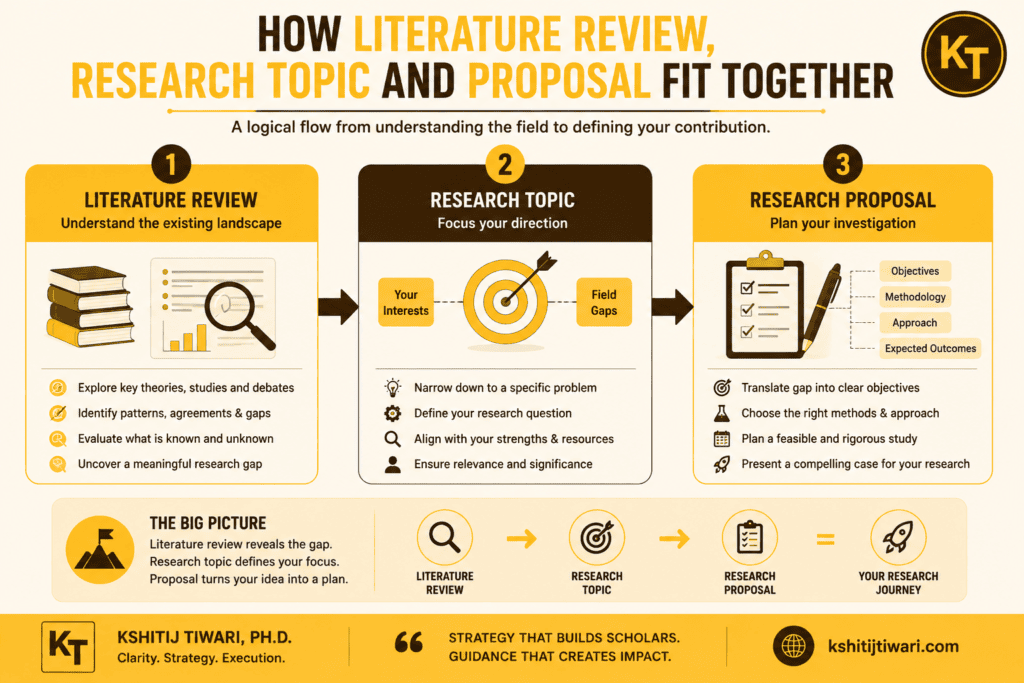
How Literature Review, Research Topic and Proposal Fit Together
Think of the early research process as a funnel.
Broad research interest
↓
Candidate research topic
↓
Literature exploration
↓
Research landscape
↓
Research gap
↓
Research question
↓
Research objectives
↓
Methodology
↓
Research proposal
Your research topic should therefore evolve as your literature review becomes stronger.
Your literature review should then make your proposal stronger.
And your proposal should make your contribution explicit.
If these three elements are disconnected, you have a structural problem.
If they reinforce one another, your research becomes much easier to defend.
What a Strong Literature Review Ultimately Produces
At the end of the process, you should be able to answer six questions.
1. What do we know?
Summarize the established knowledge.
2. How do we know it?
Understand the methods and evidence behind those conclusions.
3. Where do researchers disagree?
Identify competing explanations and findings.
4. What don’t we know?
Identify genuine limitations and unanswered questions.
5. Why does that matter?
Establish the significance of the unresolved problem.
6. What should happen next?
Position your proposed research contribution.
If your literature review can answer these six questions convincingly, you are doing far more than collecting citations.
You are building the intellectual foundation of your PhD.
Key Takeaways
The biggest shift you can make as a PhD researcher is to stop measuring literature-review progress by the number of papers you have downloaded.
You are not trying to build the world’s largest collection of PDFs.
You are trying to build an increasingly accurate model of your research field.
The progression should look like this:
Read
→ Understand
→ Compare
→ Question
→ Synthesize
→ Identify the gap
→ Define the contribution
→ Design the research
That is the real purpose of a literature review for a PhD.
Your literature database is only the infrastructure.
The actual output is research judgment.
And once your literature review can clearly establish why the existing body of knowledge is insufficient—and exactly how your research intends to move it forward—you have something much more valuable than a completed chapter.
You have the intellectual foundation of your PhD.
The literature review sits inside a larger research-development workflow.
If you are still deciding what to investigate, start with the guide to choosing a PhD research topic.
Once you have a defensible research gap, the next step is translating it into a research proposal.
If you are applying for doctoral positions, you can then connect that research direction to your search for funded PhD opportunities and your cold email outreach strategy.
And if you want an independent perspective on whether your proposed direction, research environment or application strategy makes sense before committing significant time, explore the independent PhD guidance service.
The goal is not simply to get into a PhD.
It is to enter the right PhD with a research direction you can defend.
Ready for a Strategic Discussion?
Your robotics project or academic career deserves a strategic roadmap built on international, Ph.D.-level expertise. Let’s map out your path to accelerated results.