A PhD can begin with excitement and gradually become a cycle of unfinished experiments, unread papers, unanswered emails, unclear priorities and the persistent feeling that you should be doing more.
Eventually, even work you once cared deeply about can start to feel exhausting.
That experience is commonly described as PhD burnout.
But burnout during a doctorate is not simply a matter of poor time management, weak discipline or not being passionate enough about research. The structure of doctoral work itself can create conditions in which stress accumulates: the goals are ambiguous, progress is difficult to measure, feedback can be intermittent, research frequently fails, and the boundary between “work” and “life” can become surprisingly difficult to maintain.
Research supports the seriousness of the problem. A large study of 3,659 PhD students in Flanders found substantial psychological distress and identified organizational factors—including job demands, job control, supervisor leadership and work-family interaction—as important factors associated with mental-health outcomes.
A later systematic review of 56 studies similarly concluded that doctoral student well-being is shaped by interacting individual, academic, interpersonal, organizational and environmental factors rather than by a single personal characteristic.
So if your PhD feels increasingly difficult to manage, the first question should not be:
“What’s wrong with me?”
A better question is:
“What exactly is creating the overload—and which parts can I change?”
Burnout is rarely an isolated productivity problem. It can reveal weaknesses in how your entire PhD is being navigated. The PhD Scholar’s Compass explores that broader operating system.
Table of Contents
ToggleWhat Is PhD Burnout?
The World Health Organization classifies burnout as an occupational phenomenon resulting from chronic workplace stress that has not been successfully managed. It is characterized by exhaustion, increased mental distance or cynicism toward one’s work, and reduced professional efficacy. Importantly, WHO does not classify burnout itself as a medical condition.
That distinction matters for PhD scholars.
Feeling tired after a difficult week is not automatically burnout.
Being frustrated after a failed experiment is not automatically burnout.
Wanting a weekend away from your thesis is not automatically burnout.
The concern arises when exhaustion, detachment and declining effectiveness become persistent patterns rather than temporary responses to a demanding period.
And because doctoral research is work-like in many respects, the conditions that contribute to occupational stress can become particularly difficult to recognize when your “workplace” is simultaneously your university, laboratory, home office and intellectual identity.
If you are experiencing significant or persistent psychological distress, burnout should not be treated as something you simply need to “productivity hack.” Professional mental-health support may be appropriate.
Why PhD Burnout Is Different From Ordinary Academic Stress
A difficult semester is not necessarily a dysfunctional PhD.
Doctoral research contains a degree of uncertainty by design.
You are expected to investigate questions whose answers are not already known. Experiments fail. Papers get rejected. Hypotheses change. Your literature review reveals another hundred papers you did not know existed.
The problem is that these normal features of research can become psychologically damaging when they are combined with low visibility of progress.
Consider the difference.
In a conventional course
You have:
syllabus → assignments → exams → grades → completion
In a PhD
You may have:
question → exploration → dead end → revision → experiment → failure → new question → more literature → partial result → revision → uncertainty
The second system requires considerably more self-direction.
This is one reason doctoral work can feel as though you are working constantly without necessarily feeling that you are moving forward.
The Four Conditions That Make PhD Burnout More Likely
Although every doctoral experience is different, four recurring characteristics deserve particular attention.
1. Ambiguity
The PhD rarely comes with a perfectly defined daily task list.
Your supervisor may tell you:
“Explore this direction.”
That sounds simple until you have to determine what “explore” actually means.
Which papers?
Which experiments?
How much evidence?
When is the investigation sufficient?
What counts as progress?
When these questions remain unanswered for long periods, work expands indefinitely.
Ambiguity is not necessarily a problem. Research requires exploration.
Unmanaged ambiguity is the problem.
2. Invisible Progress
One of the strangest aspects of doctoral research is that enormous amounts of work can produce little visible output.
You may spend three weeks:
- reading papers,
- debugging code,
- collecting failed measurements,
- redesigning an experiment,
- learning a new method,
- or discovering that an assumption was wrong.
From the outside, it can look as though nothing happened.
That creates a dangerous psychological loop:
Low visible output → perception of low progress → guilt → longer working hours → fatigue → lower-quality work → even less progress.
Breaking this loop requires a different definition of progress.
Progress cannot always mean “I finished a paper.”
Sometimes progress is:
- eliminating a hypothesis,
- validating an assumption,
- narrowing the research question,
- identifying a methodological limitation,
- completing a reproducible experiment,
- or determining what not to do next.
3. Intellectual Isolation
A PhD can be socially busy while remaining intellectually lonely.
You may spend most of your time surrounded by other researchers and still feel that nobody understands the specific problem you are trying to solve.
This becomes particularly difficult when you believe everyone else is progressing faster than you.
Research on doctoral students has repeatedly highlighted the importance of organizational and interpersonal conditions, including supervisory relationships and the broader research environment.
The solution is not necessarily “socialize more.”
It is to build an environment in which you have access to:
- technical feedback,
- supervisory guidance,
- peer discussion,
- career perspective,
- and someone who can help you distinguish a genuine problem from a temporary research setback.
4. The Absence of a Clear Finish Line
A PhD is unusual because the objective is simultaneously clear and unclear.
You know you need to complete a dissertation.
But there is rarely a universal answer to:
“How much work is enough?”
There is always another paper.
Another experiment.
Another improvement.
Another analysis.
Another conference.
Another possible research question.
Without deliberate boundaries, a PhD can consume whatever amount of time you allow it to consume.
That is why burnout prevention cannot simply mean “work less.”
You need a system for deciding:
What deserves my effort? What constitutes enough? And what can wait?
PhD Burnout Warning Signs You Should Not Ignore
Burnout does not necessarily arrive dramatically.
It can develop gradually.
Watch for persistent patterns such as:
Exhaustion
You are tired even after periods of rest and increasingly dread starting research.
Cynicism or detachment
You stop caring about work that previously mattered to you.
Reduced professional efficacy
You increasingly believe that you are incapable of doing good research, even when there is objective evidence that you are making progress.
Avoidance
You repeatedly postpone the work because beginning it feels overwhelming.
Loss of research identity
Instead of thinking:
“I am investigating an interesting problem.”
you increasingly think:
“I just need to survive this.”
Distorted time perception
Weeks disappear without a clear sense of what you accomplished.
Constant guilt
You feel guilty when working because you are not doing enough—and guilty when resting because you are not working.
These signs do not constitute a diagnosis.
They are signals that your current way of operating may not be sustainable.
The PhD Burnout Trap: Working Harder Can Make the Problem Worse
One of the most counterintuitive aspects of PhD burnout is that the obvious solution can reinforce the problem.
You feel behind.
So you work longer.
Longer hours produce fatigue.
Fatigue reduces concentration and decision quality.
Lower-quality work creates more rework.
More rework makes you feel further behind.
So you work even longer.
The cycle becomes:
Overwhelm → overwork → fatigue → poor decisions → rework → more overwhelm
Breaking that cycle requires changing the operating system rather than simply increasing effort.
A Practical PhD Burnout Recovery Framework
The objective is not to create a perfect productivity system.
The objective is to restore clarity, control and visible progress.
I recommend thinking about recovery through five layers.
Layer 1: Stabilize
Before optimizing your research, stabilize the basics.
Ask:
- Am I sleeping adequately?
- Am I taking meaningful breaks?
- Have I taken any genuine time away from research recently?
- Am I eating and exercising reasonably?
- Am I spending every waking hour thinking about my PhD?
If the answer to several of these is “no,” productivity optimization is probably not your first problem.
You cannot build a sustainable research system on top of chronic exhaustion.
Layer 2: Diagnose the Source
“PhD burnout” is a description of an experience, not necessarily an explanation.
Ask what is actually driving the overload.
Is it:
Research ambiguity?
You don’t know what research topic to work on.
Advisor conflict?
You cannot get the feedback or direction you need.
Workload?
You are carrying too many projects, teaching responsibilities or administrative tasks.
Literature overload?
There is so much literature to survey and audit that you have lost track of time, you are unsure if you have even read enough and when do you even stop reading and start implementing.
Research failure?
Your experiments repeatedly produce disappointing results.
Communication overload?
Email, meetings and requests constantly interrupt deep work.
Career uncertainty?
You no longer know what the PhD is preparing you for.
Funding uncertainty?
You are unsure whether you have financial sponsorship in the weeks and months to come.
Perfectionism?
Nothing feels finished because everything can theoretically be improved.
Loss of motivation?
The research no longer feels meaningful.
Different causes require different interventions.
Layer 3: Reduce the Research Surface Area
A common response to feeling behind is to create a larger to-do list.
Do the opposite.
Create a short list of the few research outcomes that actually matter right now.
For example:
This week
One meaningful research outcome.
This month
One tangible research milestone.
This quarter
One significant advancement toward the thesis contribution.
The exact system you use can vary by discipline.
The important principle is that your PhD needs visible intermediate milestones between “today” and “defense.”
A five-year thesis is psychologically overwhelming.
A meaningful task for this week is manageable.
Layer 4: Separate Progress From Productivity
This distinction is crucial.
You can be highly productive without making meaningful research progress.
You can answer 47 emails.
Attend three meetings.
Format references.
Read twelve papers.
Reorganize your folders.
And still make no meaningful progress toward your contribution.
Ask yourself at the end of each week:
What changed in my research because of the work I did this week?
The answer might be:
- a stronger research question,
- a validated method,
- a rejected hypothesis,
- a completed experiment,
- a new dataset,
- a draft section,
- a conference submission,
- or a clearer decision.
If you cannot identify anything, do not automatically conclude that you were unproductive.
Instead investigate where your effort went.
Layer 5: Build a Personal PhD Operating System
This is where long-term recovery becomes different from taking a vacation.
Rest can reduce immediate exhaustion.
But if you return to exactly the same dysfunctional research system, the problem can return.
You therefore need a repeatable way to manage:
- research priorities,
- time,
- milestones,
- uncertainty,
- communication,
- setbacks,
- advisor interactions,
- career decisions,
- and your own expectations.
Your supervisor is an important part of this system—but they cannot be your entire operating system.
Your supervisor may guide your research.
You still need to manage yourself.
What Your Supervisor Can—and Cannot—Solve
Supervisor quality matters enormously.
Research has found associations between doctoral students’ mental health and factors such as supervisor leadership style, job demands, job control and organizational culture.
That makes supervisor selection and relationship management important parts of PhD risk management.
If you are still choosing a supervisor, evaluate the relationship before committing. Our guide to PhD advisor-advisee fit examines compatibility beyond simply matching research keywords.
But even an excellent supervisor cannot:
- decide your priorities every morning,
- monitor every hour you work,
- define every research decision,
- manage your inbox,
- determine when you should stop polishing something,
- or provide a complete operating manual for your entire doctoral life.
The goal is therefore not dependence.
It is supported independence.
When PhD Burnout Means You Need More Than Better Productivity
There are situations where a planner, milestone system or productivity framework is not enough.
If your distress is persistent, severe or affecting your ability to function, speak with an appropriate qualified professional or use the mental-health resources available through your institution.
Likewise, if your environment involves harassment, discrimination, bullying, unsafe working conditions or serious supervisory misconduct, the answer should not simply be “manage your time better.”
Those are structural problems.
Your university may have formal processes, graduate representatives, ombudspersons, counseling services or other support mechanisms that are more appropriate.
A personal operating system is not a substitute for institutional accountability.
The Goal Is Not to Become Better at Surviving a Broken PhD
This is the distinction I care about most.
There is a dangerous version of PhD resilience that says:
Work harder. Become tougher. Sleep less. Push through.
That is not resilience.
A sustainable PhD requires something more sophisticated:
Knowing what matters.
Knowing what does not.
Knowing when to persist.
Knowing when to change direction.
Knowing how to measure progress.
Knowing when to ask for help.
The objective is not to eliminate uncertainty.
Research cannot work that way.
The objective is to become better at navigating uncertainty without allowing it to consume your entire life.
Where The PhD Scholar's Compass Fits
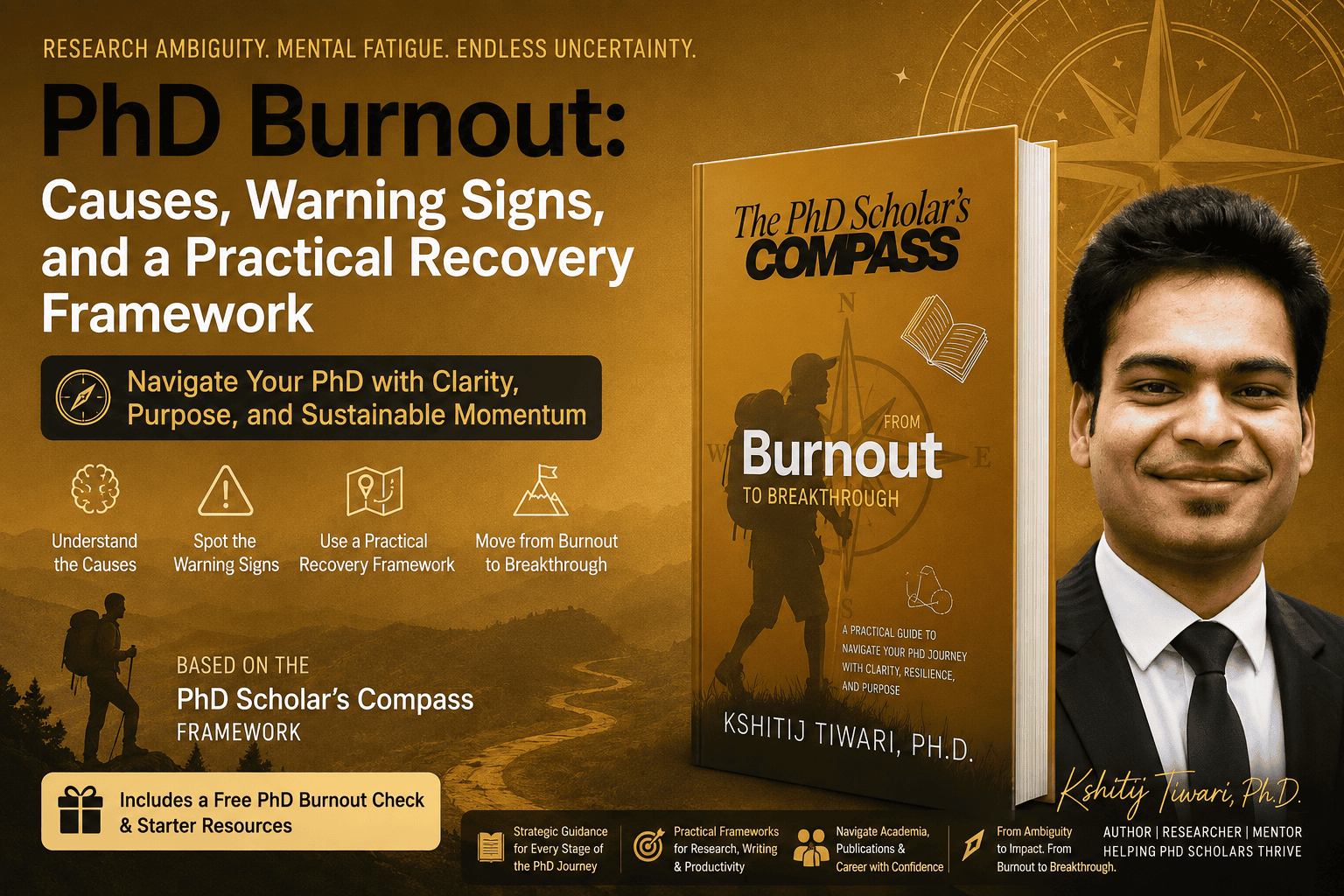
This philosophy is the reason I wrote The PhD Scholar’s Compass: From Burnout to Breakthrough.
The book is not intended to replace your university, supervisor, counselor or research training.
It is a self-help book designed to address a different gap:
the lack of an operating manual for the scholar navigating the PhD itself.
The book takes the ideas discussed here further, turning them into a broader framework for managing the ambiguity, self-direction and strategic demands of doctoral research.
Think of this article as the diagnosis.
The book is the deeper operating guide.
If you are an early-stage PhD scholar who repeatedly feels that you are working hard without knowing whether you are moving in the right direction, that distinction matters.
A Simple PhD Burnout Reset
If you need somewhere to start today, do not redesign your entire PhD.
Write down five things:
1. What is currently exhausting me?
Be specific.
2. What research outcome actually matters next?
Not ten outcomes. One.
3. What am I doing that looks productive but is not moving the research forward?
Be brutally honest.
4. What decision have I been avoiding?
Uncertainty often consumes more energy than a difficult decision.
5. Who can help me with the part I cannot solve alone?
That person might be your supervisor, committee member, peer, institutional support service, mentor or qualified professional.
The purpose of this exercise is not to solve your PhD in one afternoon.
It is to replace an undifferentiated feeling of “everything is going wrong” with a smaller number of problems you can actually act on.
Key Takeaways
A PhD is supposed to be difficult.
It is supposed to contain unanswered questions, failed experiments and intellectual uncertainty.
But difficulty does not have to mean permanent chaos.
If your PhD currently feels like an endless sequence of things you should be doing but cannot clearly prioritize, the answer may not be to work harder.
It may be to build a better way of navigating the work.
That is the idea behind The PhD Scholar’s Compass.
And it is also the principle behind everything else in this PhD resource library: helping scholars make better decisions, build greater independence and navigate the parts of doctoral education that rarely come with an instruction manual.
Ready for a Strategic Discussion?
Your robotics project or academic career deserves a strategic roadmap built on international, Ph.D.-level expertise. Let’s map out your path to accelerated results.