Most robotics startups assume their biggest challenge is building a working prototype.
In reality, building a prototype is often the easiest part of the journey.
The real challenge begins when that prototype must evolve into a reliable, maintainable, scalable product capable of operating in unpredictable real-world environments.
This transition is where many robotics companies encounter what I often call the Robotic Valley of Death—the difficult gap between a successful demonstration and a commercially deployable system.
The root cause is rarely a lack of talent.
It is rarely a lack of funding.
And surprisingly, it is often not even a lack of technology.
More often than not, the underlying issue is architecture.
Poor architectural decisions made during the early stages of development gradually accumulate until engineering progress slows, deployment timelines slip, and technical teams spend more time fighting the system than improving it.
A robot may appear functional today while silently accumulating architectural debt that will become painfully expensive six months later.
The purpose of a Robotics Architecture Audit is not to criticize engineering teams.
Its purpose is to identify risks before they become crises.
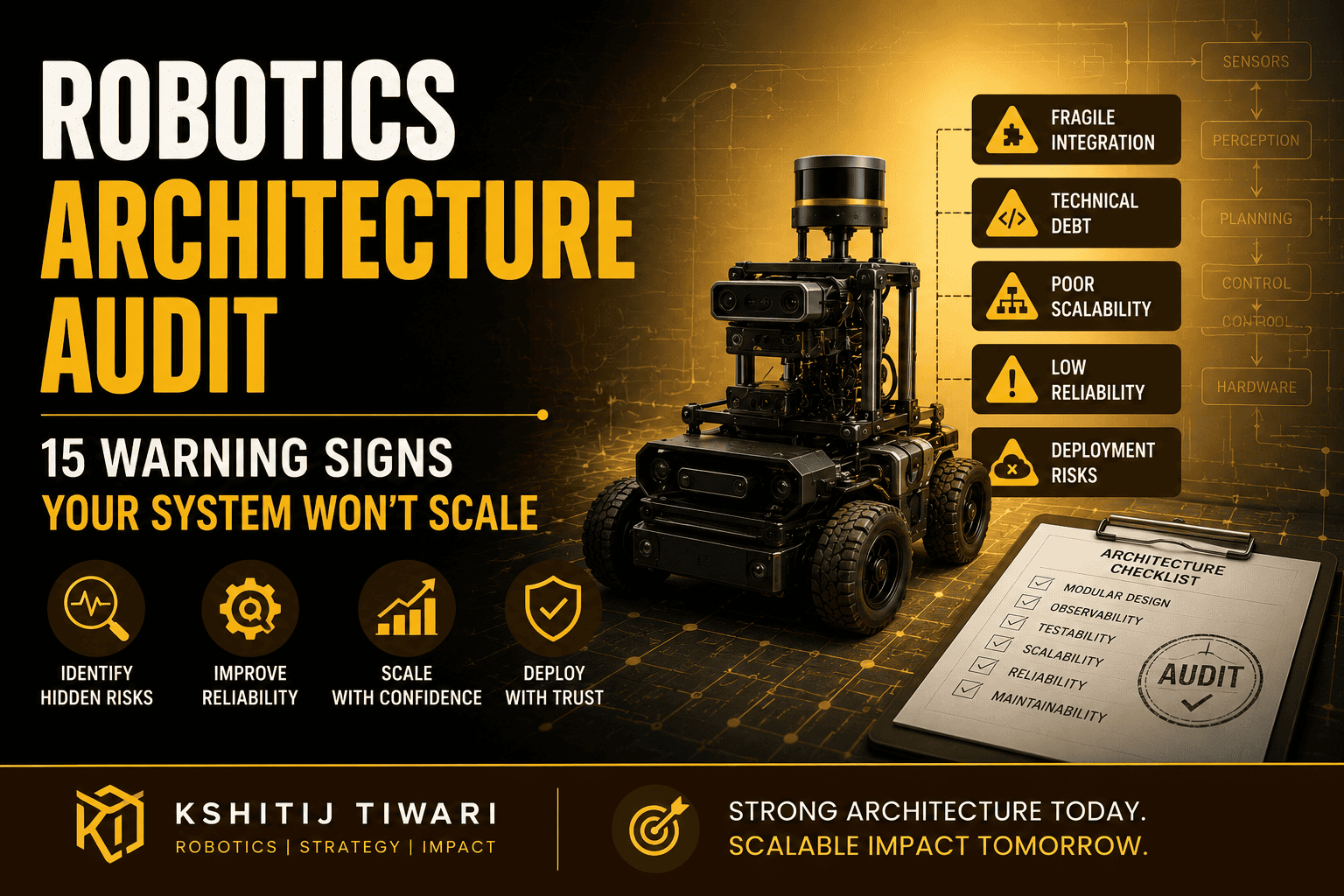
In this guide, we’ll examine fifteen warning signs that indicate your robotics architecture may not be capable of supporting long-term growth, reliability, or commercialization.
Table of Contents
ToggleWhat Is a Robotics Architecture Audit?
A Robotics Architecture Audit is a structured evaluation of the technical foundation upon which a robotic system is built.
It examines how hardware, software, sensors, controls, middleware, networking, deployment infrastructure, and engineering workflows interact as a complete system.
Unlike traditional code reviews, an architecture audit focuses on system-level questions:
- Can this architecture scale?
- Can new engineers onboard efficiently?
- Can the system survive hardware changes?
- Can new capabilities be integrated without destabilizing existing functionality?
- Can the robot operate reliably outside controlled environments?
- Can the company realistically support future deployments?
An architecture audit often reveals hidden weaknesses long before they appear in field testing or customer deployments.
Architecture is only one layer of a larger robotics product-development problem. If you are evaluating the technology roadmap, engineering organization, deployment risks and commercialization path together, start with this broader guide to robotics R&D strategy.
Why Robotics Startups Struggle With Architecture
Software startups can sometimes survive poor architecture for years.
Robotics startups rarely enjoy that luxury.
A robotics product combines:
- Mechanical systems
- Embedded electronics
- Sensors
- Middleware
- Networking
- Controls
- Perception
- Planning
- Safety systems
- Cloud infrastructure
A weakness in any layer can cascade throughout the entire stack.
The complexity compounds rapidly as teams add:
- New sensors
- New autonomy features
- New deployment environments
- Additional engineers
- Customer-specific modifications
Without architectural discipline, complexity eventually overwhelms velocity.
Warning Sign #1: Every New Feature Breaks Existing Functionality
One of the clearest signs of architectural fragility is when adding a new feature consistently introduces unexpected regressions.
Engineers begin saying things like:
“Don’t touch that module.”
Or:
“Nobody really knows what happens if we change that.”
Healthy architectures isolate complexity.
Fragile architectures spread it.
If seemingly unrelated components break whenever new capabilities are introduced, the system likely suffers from excessive coupling.
Warning Sign #1: Every New Feature Breaks Existing Functionality
One of the clearest signs of architectural fragility is when adding a new feature consistently introduces unexpected regressions.
Engineers begin saying things like:
“Don’t touch that module.”
Or:
“Nobody really knows what happens if we change that.”
Healthy architectures isolate complexity.
Fragile architectures spread it.
If seemingly unrelated components break whenever new capabilities are introduced, the system likely suffers from excessive coupling.
Warning Sign #2: The Robot Works Only Under Demo Conditions
Many startups build robots optimized for demonstrations.
Demo environments are predictable.
Customers are not.
If your robot performs well:
- In the lab
- During investor demos
- During scripted workflows
But struggles in real-world conditions, your architecture may lack the robustness required for deployment.
This often indicates insufficient consideration of:
- Failure modes
- Environmental variability
- Sensor degradation
- Network interruptions
- Edge-case behaviors
A scalable architecture assumes the world will behave unpredictably.
Warning Sign #3: One Engineer Understands Everything
This is among the most dangerous architectural risks.
Many robotics startups unknowingly create a “hero engineer.”
This individual becomes:
- System architect
- Debugging expert
- Documentation source
- Integration specialist
The company effectively develops a single point of failure.
If that engineer leaves, productivity can collapse overnight.
Architecture should distribute knowledge.
No mission-critical subsystem should depend entirely on one person.
Warning Sign #4: Documentation Is Outdated or Nonexistent
Documentation often becomes a casualty of startup speed.
However, lack of documentation creates significant scaling problems.
New engineers spend months deciphering:
- ROS nodes
- Communication patterns
- Hardware interfaces
- Deployment procedures
- Configuration files
Every undocumented component increases onboarding friction.
Documentation is not bureaucracy.
Documentation is scalability.
Warning Sign #5: Sensor Integration Feels Fragile
Modern robots rely heavily on sensor fusion.
Common sensors include:
- LiDAR
- Cameras
- IMUs
- GPS
- Radar
- Ultrasonic sensors
Poorly designed architectures often create hidden dependencies between sensor pipelines.
Symptoms include:
- Synchronization issues
- Calibration instability
- Timestamp mismatches
- Intermittent failures
If engineers are afraid to modify sensor configurations, architecture may be the underlying problem.
Warning Sign #6: Testing Is Mostly Manual
Ask yourself:
How does your team validate new software releases?
If the answer involves:
- Manual checklists
- Trial-and-error testing
- Ad hoc validation
then scalability becomes difficult.
Robotics systems require structured validation strategies:
- Unit testing
- Integration testing
- Simulation testing
- Hardware-in-the-loop testing
- Field testing
Manual testing alone cannot sustain long-term growth.
Warning Sign #7: Simulation and Reality Diverge Constantly
A healthy simulation environment accelerates development.
An unhealthy simulation environment creates false confidence.
If engineers repeatedly hear:
“It worked in simulation.”
Then discover:
“It fails in reality.”
the architecture likely contains gaps in system modeling or validation.
The larger the simulation-to-reality gap becomes, the higher the deployment risk.
Related Reading:
Operational Range Estimation: A Critical Hurdle in Mobile Robot Deployment
Warning Sign #8: Your ROS Architecture Has Become Unmanageable
ROS and ROS 2 enable rapid development.
However, many startups gradually accumulate:
- Excessive nodes
- Unclear communication pathways
- Inconsistent message definitions
- Poor namespace management
Over time, debugging becomes increasingly difficult.
If engineers struggle to explain:
- Data flow
- Node interactions
- System dependencies
your middleware architecture may require restructuring.
Related Reading:
The ROS Dilemma: Should You Build Commercial Products on ROS?
Warning Sign #9: Field Failures Are Difficult to Reproduce
When a robot fails:
Can your team determine why?
Can they reproduce the failure?
Can they identify the root cause?
If not, observability may be insufficient.
Architectures should support:
- Logging
- Telemetry
- Diagnostics
- Event tracing
- Failure analysis
Without observability, every failure becomes a mystery.
Warning Sign #10: Deployment Requires Tribal Knowledge
Some robotics deployments resemble rituals.
A deployment engineer performs dozens of undocumented steps accumulated through experience.
Nobody fully understands the process.
Everyone simply knows:
“That’s how we’ve always done it.”
This creates enormous operational risk.
Scalable architectures support repeatable deployment workflows.
Deployment should be predictable.
Not magical.
Warning Sign #11: Technical Debt Is Slowing Development
Technical debt accumulates gradually.
Symptoms include:
- Increasing bug counts
- Slower feature delivery
- Rising integration complexity
- Growing maintenance effort
Technical debt becomes particularly dangerous when engineering teams begin spending more time maintaining existing functionality than building new capabilities.
At that point, architecture is actively limiting business growth.
Related Reading:
Warning Sign #12: Customer Requirements Trigger Major Rewrites
Customer-specific requirements are inevitable.
However, if every customization demands significant architectural changes, scalability suffers.
Healthy systems accommodate variation.
Fragile systems require reinvention.
Ask:
Can the architecture support:
- New sensors?
- New payloads?
- New environments?
- New workflows?
Without extensive redesign?
If not, flexibility may be limited.
Warning Sign #13: Integration Consumes More Time Than Innovation
As systems mature, integration naturally becomes more complex.
However, when engineers spend most of their time:
- Fixing interfaces
- Resolving compatibility issues
- Synchronizing subsystems
instead of building new functionality, architecture may have become the bottleneck.
This is one of the strongest indicators that a structured audit is needed.
Warning Sign #14: Reliability Metrics Are Undefined
Many startups claim:
“The robot is reliable.”
But reliability without metrics is merely an opinion.
Architecture reviews should evaluate:
- Mean Time Between Failures (MTBF)
- Mission success rate
- Recovery performance
- System uptime
- Sensor availability
What gets measured gets improved.
What remains unmeasured remains uncertain.
Warning Sign #15: Your Roadmap Depends on Architectural Assumptions
Many technical roadmaps quietly assume:
- Current architecture will scale
- Current middleware will survive
- Current deployment workflows will remain viable
Often these assumptions go untested.
Before committing to major investments, companies should verify that architectural foundations support future objectives.
Otherwise, growth initiatives may eventually trigger expensive redesigns.
The Cost of Ignoring Architecture Problems
Architecture problems rarely remain isolated.
Over time they affect:
Engineering Velocity
Development slows.
Hiring
New engineers struggle to contribute.
Reliability
Field failures increase.
Customer Confidence
Trust erodes.
Fundraising
Technical due diligence becomes more challenging.
Commercialization
Deployment timelines slip.
The cumulative business impact often exceeds the technical impact.
What a Robotics Architecture Audit Should Evaluate
A comprehensive architecture review typically examines:
System Architecture
- Data flow
- Modularity
- Interfaces
Middleware
- ROS structure
- Communication patterns
- Scalability
Software Engineering
- Code organization
- Testing
- Version control
Sensor Systems
- Fusion architecture
- Synchronization
- Calibration
Controls
- Stability
- Robustness
- Maintainability
Deployment Infrastructure
- Automation
- Monitoring
- Recovery
Documentation
- Completeness
- Accessibility
- Accuracy
Team Scalability
- Knowledge distribution
- Onboarding efficiency
- Process maturity
A Simple Self-Assessment
Give yourself one point for every “Yes.”
Architecture
- Can every subsystem be explained clearly?
- Are interfaces documented?
- Are dependencies well understood?
Reliability
- Do you track reliability metrics?
- Can failures be reproduced consistently?
- Is telemetry available?
Team
- Can new engineers onboard within weeks?
- Is knowledge distributed?
- Is documentation current?
Deployment
- Are deployments repeatable?
- Is testing automated?
- Is simulation representative of reality?
Scalability
- Can new sensors be integrated easily?
- Can customer requirements be accommodated?
- Can the architecture support future growth?
Score Interpretation
0–5
High architectural risk.
6–10
Moderate risk.
11–15
Strong foundation but improvement opportunities exist.
When Should You Conduct an Robotics Architecture Audit?
The best time is before problems become expensive.
Particularly:
- Before fundraising
- Before scaling engineering teams
- Before customer deployments
- Before expanding product lines
- Before major architecture migrations
Waiting until failures occur usually increases remediation costs. If the audit reveals problems that require strategic technical leadership rather than isolated engineering fixes, the next question is whether your company needs a Fractional CTO or Full-Time CTO.
Key Takeaways
Most robotics startups do not fail because they lack innovation.
They fail because complexity eventually outpaces architecture.
A robot that works today is not necessarily a robot that can scale tomorrow.
Strong architecture provides:
- Reliability
- Velocity
- Maintainability
- Scalability
- Commercial viability
An architecture audit is not about finding faults.
It is about identifying hidden risks before they consume months of engineering effort, delay deployments, or undermine investor confidence.
The earlier those risks are identified, the cheaper they are to fix.
Need an Independent Robotics Architecture Review?
Whether you’re preparing for deployment, scaling an engineering team, integrating new autonomy capabilities, or evaluating long-term technical risks, a structured architecture review can reveal bottlenecks that are difficult to see from inside the organization.
I work with robotics startups, research labs, and engineering teams to evaluate:
- System architecture
- Technical debt
- Deployment readiness
- Engineering workflows
- Scalability risks
- Product roadmaps