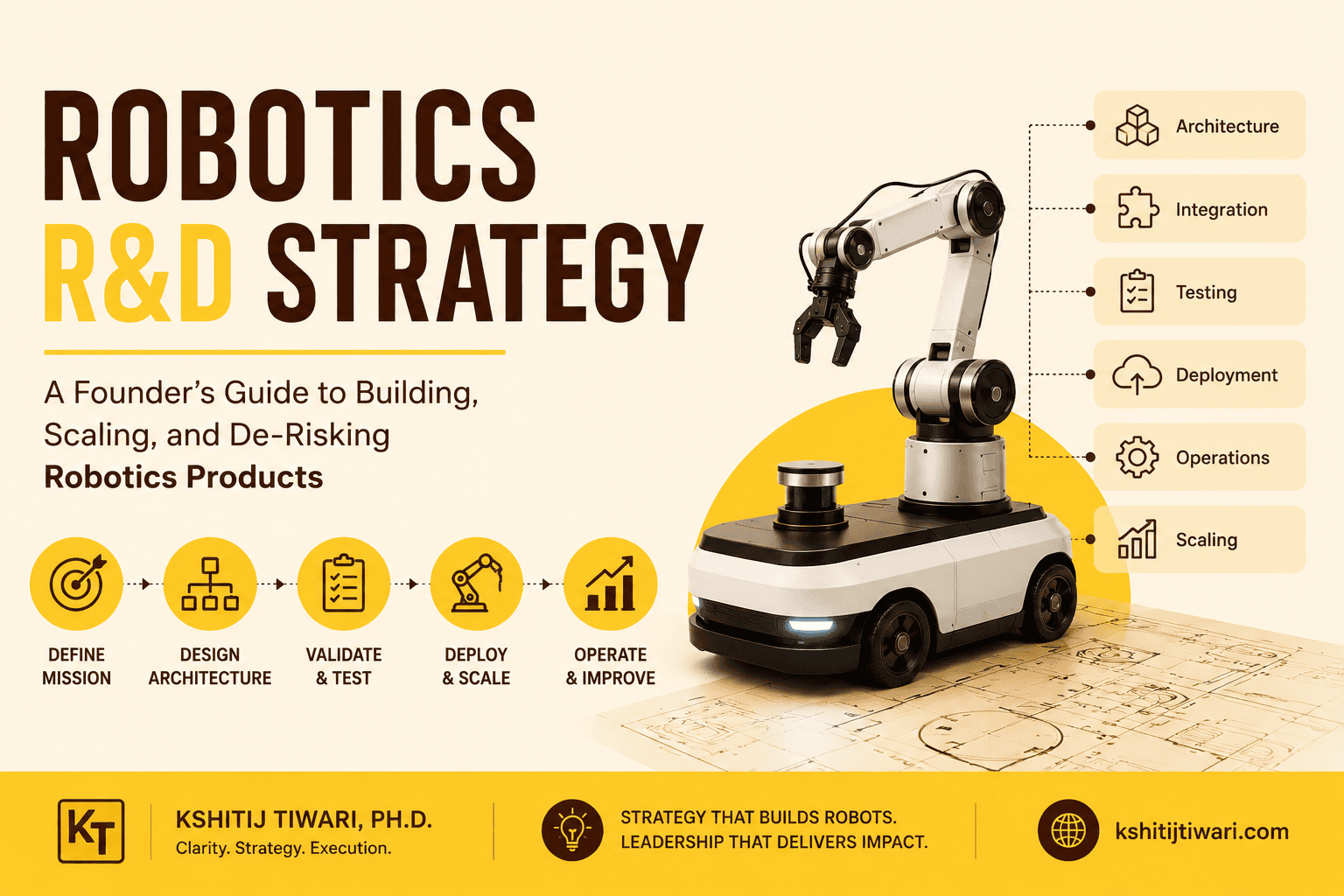
Building a robotics company is not simply a matter of putting together good hardware, writing sophisticated software, and demonstrating that the robot works.
The difficult part is turning a technically impressive prototype into a repeatable, reliable, economically viable product that can survive real-world deployment.
That distinction is where many robotics startups struggle.
A robot can work beautifully in a controlled laboratory environment and still fail when it encounters changing lighting, uneven terrain, network interruptions, sensor degradation, unexpected human behavior, component variability, battery constraints, maintenance requirements, or integration requirements imposed by a real customer. A team can also have excellent researchers and engineers while lacking the technical architecture, testing strategy, documentation, hiring plan, deployment process, and technical leadership required to turn research into a scalable product.
This is why robotics R&D strategy has to extend beyond algorithm selection or prototype development. It must connect research, system architecture, engineering execution, testing, deployment, technical hiring, technical risk, and commercial objectives into one coherent roadmap.
The robotics market itself is expanding. According to the International Federation of Robotics, 542,000 industrial robots were installed globally in 2024, more than twice the number installed a decade earlier. But growing demand does not eliminate the fundamental engineering challenge: robotics products operate at the intersection of physical hardware, software, sensing, computation, autonomy, humans, and unpredictable environments.
For a robotics startup, therefore, the central question is not:
“Can we build this robot?”
It is:
“Can we build, validate, deploy, maintain, and scale this robotic system reliably enough for someone to pay for it?”
This guide explains how to approach that problem systematically.
It is written primarily for robotics founders, CTOs, technical leaders, R&D heads, and investors evaluating the technical maturity of robotics companies. It covers the full journey from technical concept to deployment, including architecture, system integration, technical debt, software hiring, ROS 2, testing, readiness assessment, operational constraints, and technical leadership.
If you are looking for a robotics technical advisor or fractional CTO who can help translate these principles into an actual R&D roadmap, you can learn more about my Fractional CTO consulting for robotics startups.
Table of Contents
ToggleWhy Robotics R&D Is Different From Conventional Software Product Development
A robotics startup inherits many of the problems of a software startup, but it also inherits an additional class of problems: the physical world is part of the system.
A conventional SaaS product can often be upgraded by deploying new software to a controlled computing environment. A robot cannot always be treated that way.
Its performance may depend on:
- sensor placement;
- mechanical tolerances;
- battery condition;
- compute availability;
- thermal constraints;
- network connectivity;
- environmental lighting;
- terrain;
- payload;
- actuator characteristics;
- calibration;
- localization quality;
- human interaction;
- electromagnetic interference;
- weather;
- physical wear;
- component availability;
- maintenance procedures; and
- the assumptions made by every subsystem upstream and downstream.
This creates a fundamental systems-engineering problem.
A perception algorithm may achieve excellent benchmark accuracy but still be unsuitable for deployment because it consumes too much compute. A navigation stack may work in simulation but fail on slippery flooring. A manipulator may achieve excellent laboratory repeatability but become unreliable when object presentation varies.
The startup therefore needs to optimize system-level performance, not isolated component performance.
This is one reason standards organizations and research institutions increasingly emphasize reproducible robot performance measurement rather than demonstrations alone. NIST, for example, has developed test methods covering capabilities such as mobility, manipulation, sensing, communications, energy, human-system interaction, logistics, and safety.
A mature robotics R&D organization asks:
What must the complete system accomplish, under what conditions, with what measurable reliability, at what cost?
Only then should it decide which technologies to build.
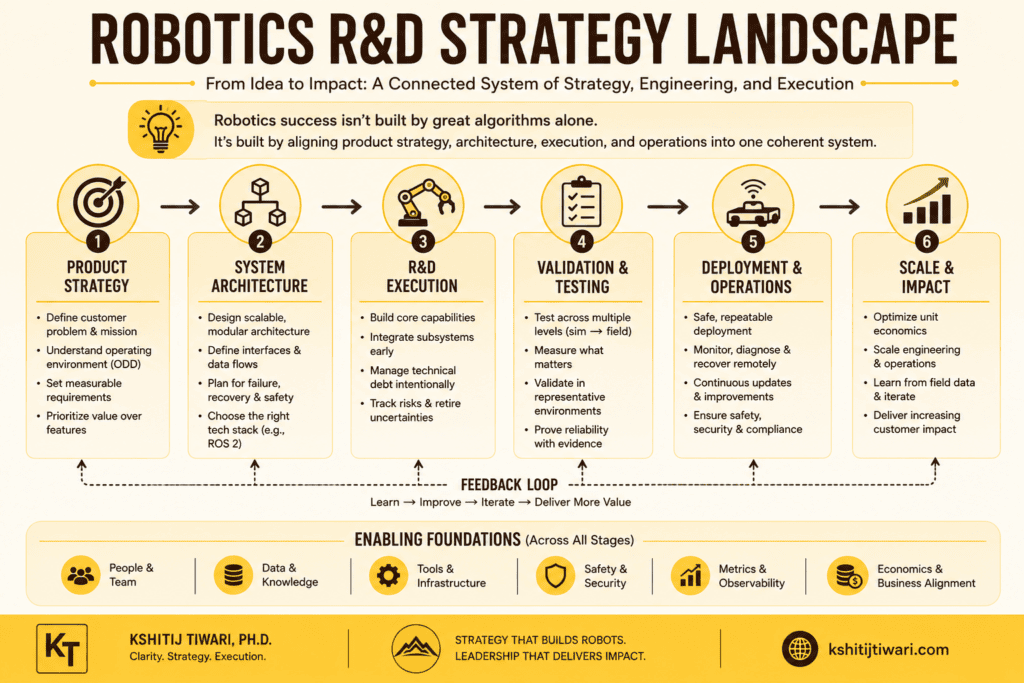
The Robotics Startup Technology Stack Is a System, Not a Collection of Features
A common mistake is to organize a robotics roadmap around features:
- add autonomous navigation;
- add computer vision;
- add obstacle avoidance;
- add manipulation;
- add fleet management;
- add remote monitoring;
- add AI.
That sounds productive, but it does not necessarily produce a coherent product.
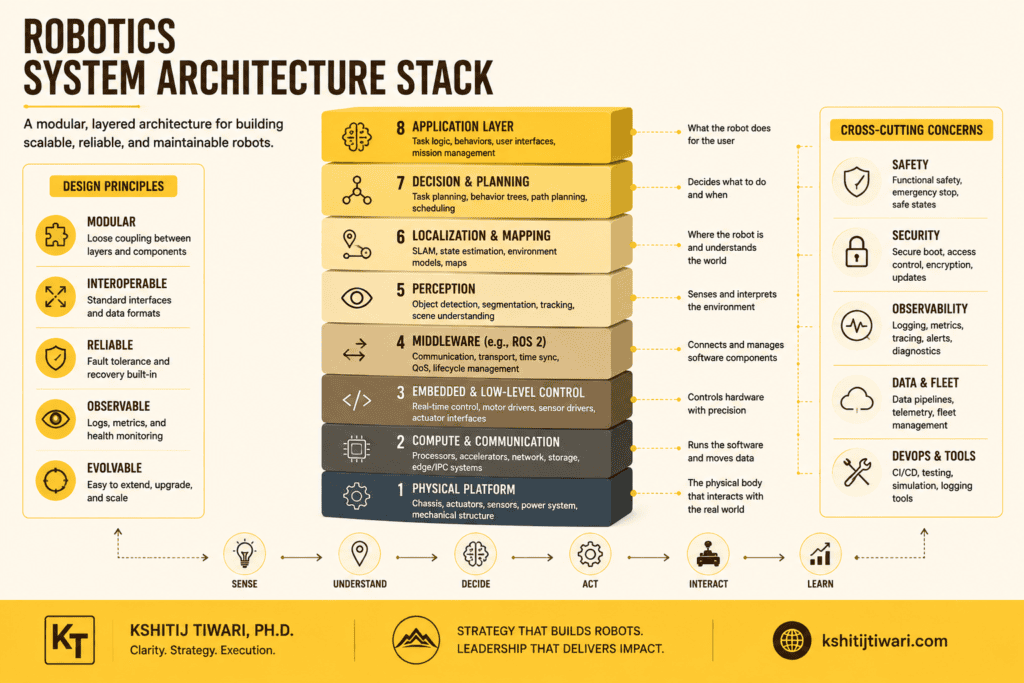
A robotics product is better understood as a stack of interacting layers.
Mechanical and physical platform
This includes the chassis, actuators, drivetrain, manipulator, end-effector, payload mechanisms, mounting structures, enclosures, thermal management, and physical interfaces.
Electrical and power architecture
This includes batteries, power distribution, charging, voltage regulation, motor controllers, protection systems, emergency stops, wiring, connectors, and power budgeting.
Sensor layer
This includes cameras, LiDAR, IMUs, encoders, force/torque sensors, tactile sensors, GPS/GNSS, microphones, proximity sensors, and other application-specific sensing systems.
Embedded and low-level control
This layer handles deterministic or near-real-time interaction with motors, actuators, sensors, and hardware interfaces.
Robotics middleware
Middleware provides the communication and software infrastructure connecting different components.
ROS 2 is one important example. The current ROS 2 ecosystem includes modular nodes, topics, services, actions, lifecycle management, introspection tools, simulation support, and configurable communication behavior. ROS 2 Lyrical Luth, released in May 2026, is an LTS release supported until May 2031.
Perception
This layer converts raw sensor data into useful representations of the world.
Localization and mapping
This layer determines where the robot is and, depending on the application, builds or consumes representations of its environment.
Planning and decision-making
This layer determines what the robot should do next.
Control
Control translates desired behavior into physical actions.
Application layer
This is where the actual customer-facing capability lives.
Fleet, cloud, and operational infrastructure
For many commercial deployments, the robot is only one component of a larger system involving telemetry, fleet management, remote support, data pipelines, dashboards, OTA updates, monitoring, and customer integrations.
Safety and compliance
Safety cannot be treated as an afterthought. Depending on the robot and operating environment, different standards and regulatory requirements may apply. For example, ISO 10218-1:2025 covers safety requirements for industrial robots, while ISO 10218-2:2025 covers industrial robot applications and robot cells. ISO 3691-4:2023 addresses safety requirements and verification for driverless industrial trucks, including many autonomous mobile robot applications.
The important point is that these layers are coupled.
Changing one can affect several others.
That is why robotics architecture must be designed at the system level.
Start With the Mission, Not the Technology
Before selecting sensors, frameworks, algorithms, compute platforms, or middleware, define what the robot actually needs to accomplish.
A useful robotics product requirement should describe the operational mission.
For example:
The robot must transport a 25 kg payload between designated locations in an active warehouse, operate for eight hours between charging cycles, maintain specified localization performance, safely interact with human workers, and recover from defined navigation and communication failures.
That is considerably more useful than:
Build an autonomous warehouse robot.
The first statement creates engineering constraints.
The second creates an aspiration.
A strong technical strategy translates the customer problem into measurable system requirements.
These requirements should address at least:
- task success rate;
- operating environment;
- speed;
- payload;
- endurance;
- accuracy;
- localization performance;
- obstacle-handling capability;
- acceptable failure rate;
- recovery behavior;
- communication requirements;
- latency;
- environmental limits;
- maintenance requirements;
- safety requirements;
- deployment time;
- cost per unit;
- serviceability;
- scalability; and
- target operating economics.
This is where technical leadership creates disproportionate value.
The job is not merely to ask engineers to build components. It is to determine which engineering problems actually matter to the business.
Define the Operational Design Domain Before You Promise Autonomy
One of the most dangerous phrases in robotics is simply:
“The robot is autonomous.”
Autonomy is not binary.
A robot may operate autonomously under a narrow set of environmental conditions and fail outside them. That does not necessarily mean the technology is bad. It means the operational design domain has not been defined properly.
An Operational Design Domain, or ODD, describes the conditions under which the system is expected to operate.
Depending on the application, this can include:
- indoor versus outdoor operation;
- lighting conditions;
- floor or terrain type;
- weather;
- temperature;
- maximum slope;
- network availability;
- human density;
- object types;
- payload range;
- speed;
- operating hours;
- geographic boundaries;
- infrastructure requirements; and
- known environmental constraints.
This is strategically important because reliability is meaningless without context.
A robot with a 99.9% task-success rate under controlled laboratory conditions may be commercially inferior to one achieving 99% in the customer’s actual environment.
Your engineering team should therefore measure performance against representative operating conditions rather than optimizing only for laboratory benchmarks.
Use Technology Readiness to Separate Research Risk From Product Risk
Robotics founders often confuse technical novelty with product readiness.
A technology may be scientifically impressive while still being commercially immature.
Technology Readiness Levels provide one useful vocabulary for describing maturity. NASA’s framework runs from TRL 1, where basic principles are observed, through TRL 9, where the technology has been proven through successful operation in its intended environment.
The exact interpretation of TRL should be adapted to the product and industry, but the underlying idea is valuable.
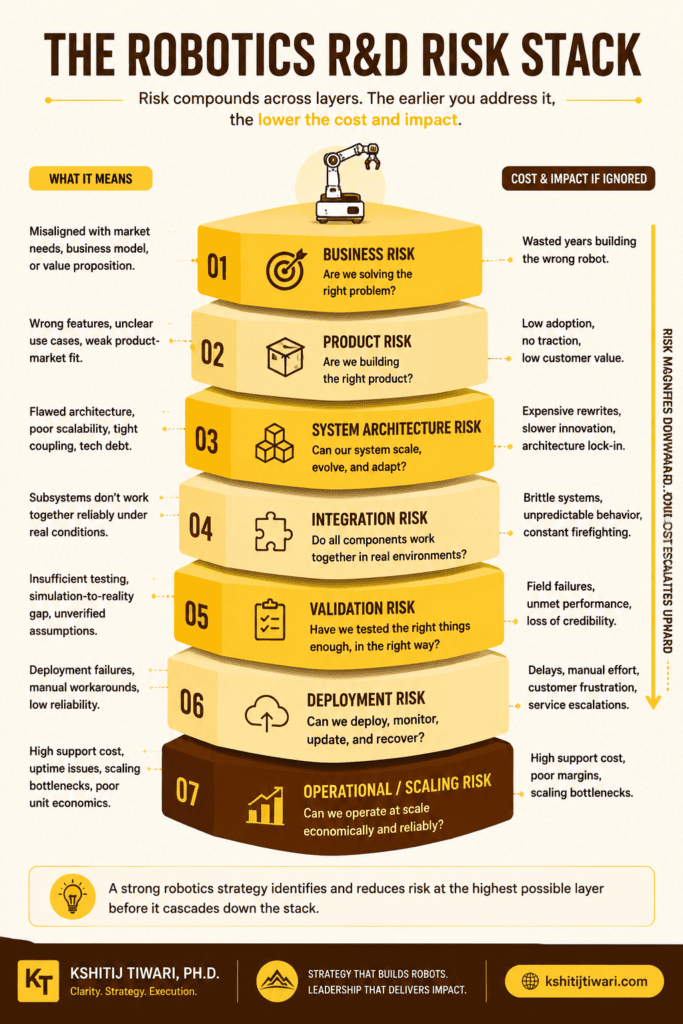
You should distinguish between:
Research risk:
Can this technology work at all?
Engineering risk:
Can we make it work reliably and repeatably?
Integration risk:
Can it work with the rest of our system?
Deployment risk:
Can it work in the customer’s environment?
Operational risk:
Can we maintain it economically?
Commercial risk:
Will customers pay for the resulting capability?
A prototype may have reduced research risk while retaining substantial integration and deployment risk.
That is why a successful demo is not the same thing as a product milestone.
Prototype Success Is Not Product Success
A robotics prototype answers:
“Can we demonstrate the concept?”
A product answers:
“Can we repeatedly deliver the intended outcome?”
These are fundamentally different questions.
A prototype can succeed because:
- the environment was controlled;
- an engineer was present;
- the system was manually reset between runs;
- the dataset was curated;
- failed runs were excluded from the demo;
- the battery was fully charged;
- the network was stable;
- calibration was perfect;
- an expert operator intervened when necessary.
Those conditions may be acceptable during early R&D.
They become dangerous when they remain hidden inside a supposed product.
A useful progression is:
Concept → Prototype → Integrated prototype → Representative environment → Pilot deployment → Production candidate → Repeatable deployment → Scaled product
Each transition should reduce a different category of uncertainty.
Robotics Architecture: Design for the System You Expect to Become
One of the highest-leverage technical decisions in an early robotics company is its architecture.
Architecture determines how easily the system can:
- add sensors;
- replace hardware;
- upgrade algorithms;
- support multiple robot configurations;
- test components independently;
- recover from failures;
- deploy software updates;
- diagnose problems;
- scale development across engineers; and
- maintain the product after deployment.
Poor architecture tends to hide complexity until the company reaches a scale where changing it becomes expensive.
This is the problem addressed in my detailed guide, Robotics Architecture Audit: 15 Warning Signs Your System Won’t Scale.
The central architectural principle is simple:
A robotics architecture should make expected change easier, not merely make today’s demo possible.
That does not mean building an elaborate enterprise architecture before the first prototype.
It means identifying which interfaces are likely to remain stable and designing around them.
Avoid the Two Opposite Architecture Failures
Early robotics companies commonly fall into one of two extremes.
The prototype architecture
Everything is optimized for speed.
Hardware drivers, perception, planning, control, configuration, logging, and application logic may become tightly coupled because doing so is convenient.
This can be perfectly rational during early exploration.
The problem occurs when the prototype architecture becomes the product architecture without deliberate refactoring.
The premature enterprise architecture
The opposite mistake is building an enormous architecture before the team understands the product.
This produces unnecessary abstraction, infrastructure, interfaces, documentation, and operational complexity.
The right approach is neither “architect everything” nor “never architect.”
It is:
Architect around the risks and changes you already know are coming.
Define Clear Interfaces Between Robotics Subsystems
A scalable robotics architecture should make subsystem boundaries explicit.
For example:
Sensors → perception
Perception → world model
Localization → navigation
Navigation → planning
Planning → control
Control → actuators
At every interface, define:
- data format;
- frequency;
- latency expectations;
- coordinate frames;
- timestamp behavior;
- failure behavior;
- ownership;
- quality expectations;
- configuration;
- observability.
This becomes particularly important in distributed robotics systems.
ROS 2, for example, explicitly distinguishes communication patterns such as topics for continuous data streams, services for short request/response interactions, and actions for longer-running behaviors that provide feedback and support preemption.
These are architectural decisions, not merely API choices.
Design for Failure, Not Just the Happy Path
A robot that only works when every subsystem behaves correctly is not robust.
The architecture should define what happens when:
- a camera stops publishing;
- LiDAR becomes unavailable;
- localization confidence drops;
- the battery reaches a threshold;
- network connectivity disappears;
- a motor overheats;
- a sensor produces invalid data;
- a navigation goal becomes unreachable;
- the robot becomes physically stuck;
- a software node crashes;
- an actuator does not respond;
- the robot encounters an unknown object.
This is where concepts such as lifecycle management, watchdogs, health monitoring, degraded modes, safe stopping, recovery behaviors, and remote diagnostics become valuable.
ROS 2’s lifecycle-node model, for example, provides managed states and transitions that can be used to structure component startup, activation, deactivation, and shutdown behavior.
The specific implementation will vary by product, but the principle is universal:
Failure behavior should be designed, tested, and documented rather than discovered during deployment.
Robotics System Integration Is Where Many Startups Break
The individual components of a robotics system can all work correctly while the complete robot fails.
That is the integration problem.
Consider a mobile robot with:
- a camera;
- LiDAR;
- IMU;
- wheel encoders;
- SLAM;
- navigation;
- obstacle avoidance;
- motor controllers;
- battery management;
- ROS 2;
- cloud telemetry.
Every component may pass its own tests.
Yet the complete system can still fail because of:
- timestamp mismatch;
- coordinate-frame errors;
- sensor calibration;
- communication latency;
- CPU contention;
- GPU memory pressure;
- QoS incompatibility;
- electromagnetic interference;
- thermal throttling;
- timing jitter;
- mechanical vibration;
- network congestion;
- incorrect assumptions between teams.
This is why system integration deserves its own engineering discipline.
My article The Robotic Valley of Death: Why Great Prototypes Fail at System Integration goes deeper into this transition.
The strategic lesson is important:
The integration milestone should happen much earlier than many robotics startups expect.
Do not wait until every subsystem is “finished.”
Integrate early enough that the interactions between subsystems become visible while there is still time to change the architecture.
Build a Verification and Validation Strategy Before You Need One
Testing in robotics is more complicated than testing a conventional software product because the physical environment introduces variability.
A mature robotics testing strategy operates across multiple levels.
Unit testing
Tests individual functions or components.
Component testing
Tests subsystems such as perception, localization, planning, or control.
Integration testing
Tests interactions between multiple subsystems.
Simulation testing
Tests behavior in virtual environments.
Hardware-in-the-loop testing
Tests software against representative hardware interfaces or physical components.
System testing
Tests the complete robot.
Field testing
Tests the robot under representative operating conditions.
Operational testing
Tests the complete deployment process, including maintenance, recovery, monitoring, and human interaction.
The goal is not to eliminate every failure.
The goal is to understand:
Which failures can happen, how often they happen, how severe they are, and what the system does when they occur.
NIST’s work on robot performance measurement illustrates why standardized, repeatable test methods matter. Its mobile robotics work includes test methods for navigation, docking, communications impairments, configuration recording, and other system-level performance dimensions.
Define Metrics That Reflect the Customer Outcome
A common robotics KPI is something like:
“Our navigation accuracy is 95%.”
But what does that mean commercially?
A stronger metric might be:
“The robot completes 98% of assigned transport missions within the specified operating environment without human intervention.”
That metric connects technology to customer value.
Useful robotics product metrics can include:
- task success rate;
- intervention rate;
- mission completion rate;
- mean time between failures;
- recovery success rate;
- localization failure rate;
- navigation failure rate;
- collision or near-collision rate;
- uptime;
- battery endurance;
- charging cycle time;
- deployment time;
- maintenance hours per operating hour;
- remote resolution rate;
- fleet utilization;
- cost per mission;
- throughput;
- payload performance;
- environmental tolerance.
A strong CTO or technical leader should continually ask:
Which metric predicts whether customers will renew, expand, or reject the product?
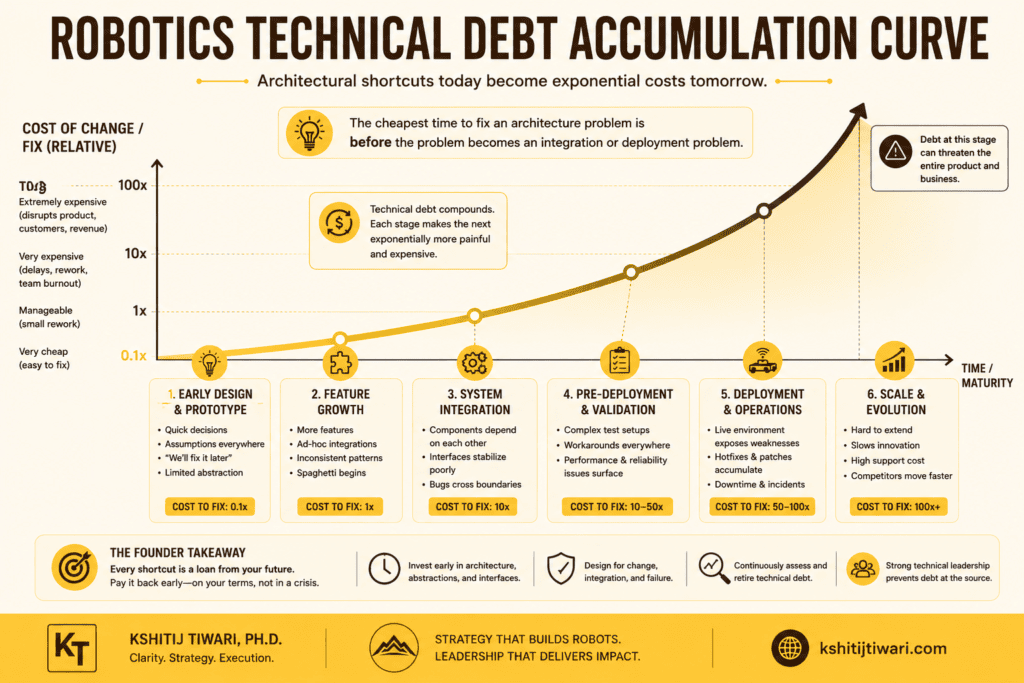
Robotics Technical Debt Is More Dangerous Than It Looks
Technical debt exists in robotics just as it does in software, but the consequences can be amplified because software interacts with physical systems.
Technical debt can accumulate in:
- architecture;
- testing;
- documentation;
- calibration;
- hardware interfaces;
- deployment tooling;
- simulation;
- CI/CD;
- observability;
- dependency management;
- safety processes;
- data management;
- configuration management.
A shortcut that saves two weeks during prototyping may later create months of integration work.
My Robotics Technical Debt: Why Your Robot Still Isn’t Ready for Deployment examines this problem specifically.
Research on technical debt in startups also suggests that startup teams can accumulate significant debt in areas such as testing and that team growth can introduce additional challenges in maintaining engineering practices.
The answer is not to eliminate technical debt completely.
That is unrealistic.
The answer is to make technical debt visible and intentional.
A useful technical debt register should record:
|
Technical Debt
|
Cause
|
Impact
|
Trigger
|
Onus
|
|---|---|---|---|---|
|
Manual deployment
|
Early prototype
|
High
|
First external deployment
|
Engineering
|
|
Missing regression tests
|
Fast iteration
|
High
|
Before production pilot
|
Software / QA
|
|
Hard-coded sensor configuration
|
Prototype convenience
|
Medium
|
Second robot variant
|
Robotics / QC
|
|
Limited diagnostics
|
Time constraint
|
High
|
First paid pilot
|
QA/QC
|
|
Outdated dependency
|
Legacy prototype
|
Medium
|
Next major release
|
Software
|
This transforms technical debt from an abstract engineering complaint into a management tool.
Technical Debt Can Become a Fundraising Problem
Investors do not necessarily expect an early robotics startup to have perfect engineering.
They do expect the company to understand its technical risks.
Suppose a founder says:
“The prototype works.”
That is not enough.
A sophisticated technical diligence process may ask:
- How reproducible is the performance?
- How many prototypes have been built?
- How different are they?
- What happens when components change?
- How much of the system depends on individual engineers?
- How much code is tested?
- How quickly can a new robot be deployed?
- What technical risks remain?
- Which dependencies are proprietary?
- How difficult is manufacturing integration?
- What happens when the robot fails in the field?
- How much human intervention is required?
The more mature answer is not “there are no risks.”
It is:
“Here are our five largest technical risks, here is the evidence behind each one, here is the mitigation plan, and here are the milestones that will tell us whether the risk is decreasing.”
That demonstrates technical control.
Hiring the Robotics Team: Add Capability, Not Just Headcount
One of the most expensive mistakes a robotics startup can make is hiring based on job titles rather than system needs.
“Robotics engineer” can mean dramatically different things.
You may need expertise in:
- embedded systems;
- controls;
- perception;
- SLAM;
- navigation;
- manipulation;
- mechanical design;
- electrical engineering;
- ROS 2;
- simulation;
- cloud infrastructure;
- fleet management;
- safety;
- testing;
- manufacturing;
- data engineering;
- machine learning.
The correct question is:
Which technical bottleneck is preventing the company from reaching its next milestone?
If system integration is the bottleneck, hiring another perception researcher may not help.
If perception is the bottleneck, adding another infrastructure engineer may not help.
If the architecture itself is unclear, hiring five more developers can actually make the situation worse.
My article Robotics Software Hiring: Why Your R&D is Stalled (and the Fix) explores this problem in greater detail.
When Should a Robotics Startup Hire a CTO?
The answer is not simply “when you have enough employees.”
Technical leadership becomes important when the company starts making decisions whose consequences extend across multiple engineering cycles.
Examples include:
- selecting the core architecture;
- deciding whether to build or buy;
- choosing the robotics middleware strategy;
- defining technical milestones;
- building the first engineering organization;
- deciding what should remain proprietary;
- managing technical debt;
- preparing for technical diligence;
- establishing deployment standards;
- managing external engineering vendors;
- deciding when a prototype is ready for customer deployment.
However, hiring a full-time CTO is not always the optimal first move.
Some startups need strategic technical leadership before they need a full-time executive.
That is precisely the distinction explored in Should Your Robotics Startup Hire a Fractional CTO vs Full-Time CTO? A Founder’s Decision Framework.
Fractional CTO vs Full-Time CTO: The Real Decision
The decision should be based on the technical leadership workload, not prestige.
A full-time CTO becomes compelling when the company requires sustained executive-level technical ownership across:
- a growing engineering organization;
- product strategy;
- hiring;
- architecture;
- technical execution;
- customer commitments;
- fundraising;
- partnerships;
- manufacturing;
- regulatory and safety considerations.
A fractional CTO can be valuable when the company needs high-level technical leadership but does not yet need that leadership full time.
Typical situations include:
- prototype-to-product transition;
- architecture audit;
- technical roadmap development;
- R&D team restructuring;
- technical hiring strategy;
- vendor evaluation;
- technical due diligence preparation;
- system integration problems;
- technical debt reduction;
- deployment readiness;
- preparation for fundraising.
The objective is not to permanently outsource technical leadership.
It is to obtain the right level of technical leadership for the company’s current stage.
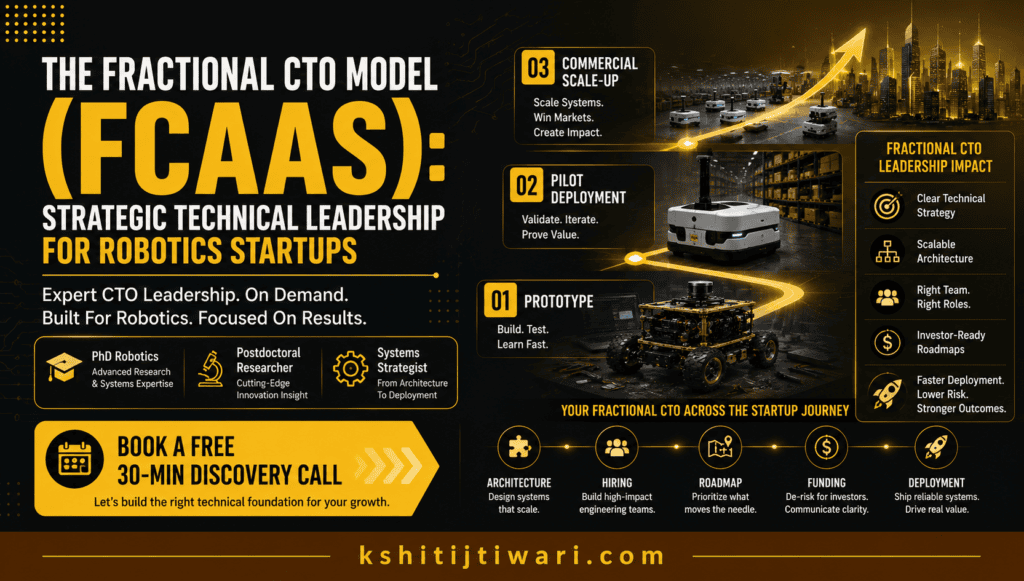
My The Fractional CTO Model for Robotics Startups explains how this model can work in practice.
When You Need Strategic Technical Leadership
A robotics R&D strategy is only useful if someone can translate it into engineering decisions, architecture priorities and an executable roadmap. If your team has strong engineers but lacks senior technical leadership, a Fractional CTO for robotics startups can provide that strategic layer without requiring an immediate full-time executive hire.
Explore the Fractional CTO vs Full-Time CTO decision framework to determine which model fits your company’s current stage.
ROS 2: Strategic Infrastructure, Not a Checkbox
ROS 2 has become a major part of modern robotics development, but using ROS 2 does not automatically create a good robotics architecture.
The current ROS 2 ecosystem provides a mature set of tools and abstractions for developing robotic applications. ROS 2 Lyrical Luth is the current LTS release, with support planned through May 2031.
However, founders should avoid asking:
“Should we use ROS 2?”
as if this were the complete architectural decision.
Better questions are:
- Which components should communicate through ROS 2?
- Which components require deterministic behavior?
- Which parts should remain outside the ROS graph?
- How will configuration be managed?
- How will deployments be versioned?
- How will logs and diagnostics be collected?
- What QoS policies are appropriate?
- How will nodes recover?
- How will hardware interfaces be abstracted?
- What happens when ROS 2 is unavailable?
- How will the system evolve over several hardware generations?
ROS 2’s communication model provides explicit QoS policies because robotics systems may operate over networks with different reliability and latency characteristics.
This is why middleware selection should be treated as an architectural decision rather than a technology fashion decision.
Do Not Confuse ROS 2 Expertise With Robotics Architecture Expertise
Someone can be excellent at writing ROS 2 nodes and still lack experience designing a scalable robotics product.
Conversely, a strong systems architect may need experienced ROS 2 engineers to implement the architecture.
The two capabilities are complementary.
A mature robotics organization therefore separates:
Technology implementation
from
System-level technical ownership.
This distinction becomes increasingly important as teams grow.
Simulation Is a Risk-Reduction Tool, Not a Replacement for Reality
Simulation is powerful because physical robotics testing is expensive.
It can help with:
- algorithm development;
- regression testing;
- scenario generation;
- rare-event testing;
- navigation testing;
- perception pipelines;
- planning;
- reinforcement learning;
- integration;
- operator training.
ROS 2’s documentation includes simulation workflows using environments such as Gazebo and Webots.
But simulation has a fundamental limitation:
The simulator is a model of reality, not reality itself.
If your simulator does not accurately represent:
- sensor noise;
- latency;
- actuator dynamics;
- mechanical tolerances;
- terrain;
- lighting;
- network behavior;
- object variability;
- battery characteristics;
then the resulting confidence can be misleading.
The right strategy is therefore not:
“Simulate everything.”
It is:
Use simulation to eliminate as much uncertainty as possible before spending physical testing resources.
Build a Digital Thread Across Research, Engineering, and Deployment
One of the strongest signs of a mature robotics organization is traceability.
A requirement should eventually connect to:
Customer need → system requirement → technical design → implementation → test → field evidence
For example:
Customer needs 95% mission completion
↓
System requirement: mission success ≥ 95% within defined ODD
↓
Navigation requirement: localization failure below defined threshold
↓
Architecture: redundant sensing and recovery behavior
↓
Implementation
↓
Simulation tests
↓
Hardware tests
↓
Pilot data
↓
Production acceptance criteria
This creates organizational memory.
Without it, companies repeatedly rediscover why decisions were made.
Build an R&D Roadmap Around Risk Reduction
A weak roadmap says:
Q1: navigation
Q2: perception
Q3: fleet management
Q4: deployment
A stronger roadmap asks:
What are the largest uncertainties preventing commercial deployment?
Then sequence work around those uncertainties.
For example:
Risk: navigation fails on real customer terrain
Test representative terrain early.
Risk: compute cannot support required algorithms
Benchmark hardware before finalizing the platform.
Risk: battery endurance is insufficient
Run realistic energy budgets before committing to hardware.
Risk: the system cannot recover from failures
Build fault-injection and recovery tests.
Risk: engineering team cannot maintain the codebase
Address architecture and testing before scaling headcount.
Risk: customers require integration with existing systems
Prototype interfaces early.
This changes the purpose of R&D.
You are no longer simply building features.
You are buying down uncertainty.
Build vs Buy: Not Every Component Should Be Proprietary
Robotics startups frequently attempt to build too much.
Proprietary technology may be a competitive advantage when it directly contributes to differentiated customer value.
But building commodity infrastructure can consume engineering resources without creating defensibility.
Potential candidates for buying or adopting existing solutions include:
- commodity compute;
- operating systems;
- standard networking;
- common middleware;
- standard sensors;
- generic cloud infrastructure;
- established monitoring tools;
- common developer tooling.
Potential candidates for proprietary development include:
- differentiated perception;
- proprietary control algorithms;
- unique manipulation;
- application-specific autonomy;
- novel hardware;
- domain-specific datasets;
- specialized human-robot interaction;
- unique system integration capabilities.
The decision should consider:
Differentiation + performance + cost + control + strategic dependency + time-to-market.
The question is not:
“Can we build it?”
It is:
“Should we own this capability?”
Hardware Strategy Is Part of Software Strategy
A robotics company cannot treat hardware as something separate from software.
A change in:
- camera;
- processor;
- motor;
- battery;
- IMU;
- LiDAR;
- actuator;
- network interface;
can change software behavior.
This creates a critical architectural requirement:
Hardware abstraction and configuration management must be intentional.
If every hardware revision requires rewriting large portions of the software stack, the company will struggle to scale.
This is particularly important when moving from one prototype to ten, fifty, or several hundred units.
Design for Reproducibility Across Robots
A single successful prototype can hide enormous variability.
When a company builds multiple robots, questions emerge:
- Are all sensors calibrated identically?
- Are all actuators behaving within tolerance?
- Are software versions identical?
- Are configuration files version-controlled?
- Are hardware serial numbers tracked?
- Are calibration parameters stored centrally?
- Can a failed unit be reproduced?
- Can an engineer compare robot A with robot B?
- Can a new robot be commissioned quickly?
A production-oriented robotics organization treats configuration as data.
Every deployed unit should have a known state.
That state should include, where relevant:
- hardware revision;
- firmware;
- software version;
- calibration;
- parameters;
- sensor configuration;
- network configuration;
- safety configuration;
- deployment date;
- known issues.
Without this, field debugging becomes archaeology.
Observability Is a Product Capability
If a robot fails in a customer’s facility, the question is not simply:
“Why did it fail?”
The question becomes:
“Can we determine why it failed without physically sending an engineer?”
That requires observability.
Depending on the application, useful telemetry can include:
- CPU utilization;
- GPU utilization;
- memory;
- temperature;
- battery state;
- sensor health;
- localization confidence;
- navigation status;
- network quality;
- error codes;
- node states;
- actuator status;
- mission status;
- recovery attempts.
A robot without observability can become extremely expensive to operate.
This is particularly important for fleets.
At one robot, manual debugging may be tolerable.
At one hundred robots, it becomes a business-model problem.
Remote Operations Should Be Designed Early
Many robotics startups assume the robot will operate autonomously and therefore underestimate remote support.
Real deployments often require:
- remote diagnostics;
- remote restart;
- teleoperation;
- mission cancellation;
- software updates;
- configuration updates;
- health monitoring;
- log collection;
- incident analysis.
The objective is not to hide poor autonomy behind humans.
The objective is to provide a safe and economically viable recovery mechanism when autonomy encounters an edge case.
A mature system therefore asks:
What happens when autonomy fails?
before asking:
How do we achieve 100% autonomy?
Safety Must Be an Engineering Requirement
Safety should not appear as a final checklist immediately before deployment.
It should influence architecture from the beginning.
The appropriate safety framework depends on the robot and application, but industrial robotics provides a useful example. ISO 10218-1:2025 addresses the robot itself, while ISO 10218-2:2025 addresses industrial robot applications and robot cells.
For driverless industrial vehicles and certain AMR applications, ISO 3691-4:2023 provides safety requirements and verification methods.
The important strategic lesson is:
Do not wait until certification or customer deployment to discover what safety engineering requires.
Safety constraints can influence:
- hardware architecture;
- emergency-stop design;
- sensing;
- control;
- software states;
- operational boundaries;
- human interaction;
- failure handling;
- testing.
Security Is Also Part of Robotics Architecture
Connected robots create cybersecurity considerations that do not exist in the same way for isolated prototypes.
Potential attack surfaces include:
- wireless communication;
- cloud interfaces;
- remote control;
- OTA updates;
- developer access;
- APIs;
- network infrastructure;
- physical ports;
- third-party dependencies.
ROS 2 itself includes security tooling and concepts within the broader ecosystem, while platform and network configuration remain important engineering considerations. ROS 2’s distributed discovery model, for example, means network topology and domain configuration matter operationally.
A commercial robotics architecture should therefore define:
- authentication;
- authorization;
- secure updates;
- secrets management;
- network segmentation;
- access control;
- logging;
- incident response.
The Robotics R&D Readiness Audit
Before scaling a robotics product, evaluate readiness across several dimensions.
My Robotics R&D Readiness Audit: Your 3-Week Plan to De-Risk Deployment provides a more focused framework for doing this.
At a high level, assess:
Product definition
Is the customer problem clearly defined?
Technical requirements
Are system-level requirements measurable?
Architecture
Can the system evolve without major rewrites?
Integration
Have subsystem interactions been validated?
Testing
Are failures reproducible and measurable?
Deployment
Can the robot be installed and commissioned reliably?
Operations
Can the system be monitored and supported remotely?
Safety
Are applicable requirements understood?
Technical team
Does the team possess the capabilities required for the next milestone?
Technical debt
Are major engineering liabilities known and prioritized?
Commercial readiness
Does technical performance translate into customer value?
A company does not need to score perfectly in every category.
It needs to know where it is weak.
The Three-Week R&D Readiness Mindset
A useful way to structure a readiness review is:
Week 1: Discover
Understand architecture, codebase, hardware, roadmap, deployment history, team structure, technical debt, and customer requirements.
Week 2: Diagnose
Identify critical technical risks, architectural bottlenecks, missing capabilities, integration weaknesses, and deployment blockers.
Week 3: Prioritize
Turn those findings into an actionable roadmap with owners, milestones, dependencies, and measurable exit criteria.
The output should not be a 100-page report that nobody reads.
It should answer:
- Where are we now?
- What is blocking us?
- What needs to change?
- What should we not build yet?
- What should we hire for?
- What should we buy?
- What technical risks must be retired before the next commercial milestone?
What a Strong Robotics R&D Roadmap Looks Like
A useful roadmap connects technical work to business milestones.
For example:
|
Business milestone
|
Technical objective
|
Evidence
|
|---|---|---|
|
First prototype
|
Demonstrate core concept
|
Repeatable lab demo
|
|
Integrated prototype
|
Validate architecture
|
End-to-end system tests
|
|
Customer pilot
|
Validate Operational Design Domain (ODD)
|
Representative field data
|
|
Paid deployment
|
Demonstrate reliability
|
Defined acceptance metrics
|
|
Multiple deployments
|
Validate reproducibility
|
Consistent commissioning
|
|
Field deployment
|
Validate operations
|
Remote monitoring and recovery
|
|
Scale
|
Reduce unit economics and maintenance burden
|
Production metrics
|
This prevents the engineering roadmap from becoming detached from the company’s commercial roadmap.
What Founders Should Ask Their Technical Team Every Month
A founder does not need to understand every line of robotics code.
But they should understand the technical trajectory.
Useful questions include:
What is our biggest technical risk right now?
If the answer changes every week, the company may lack strategic prioritization.
What evidence do we have that the system works outside the lab?
This distinguishes demonstration from validation.
Which subsystem currently limits system performance?
This identifies the bottleneck.
What technical debt are we consciously carrying?
This reveals whether the organization understands its liabilities.
What would break if we deployed ten robots tomorrow?
This exposes scalability problems.
What happens when the robot fails?
This tests operational maturity.
What can only one engineer currently fix?
This exposes key-person risk.
What technical assumption could invalidate our roadmap?
This identifies hidden strategic risk.
Which capability should we stop building ourselves?
This tests build-vs-buy discipline.
What evidence would make us change our architecture?
This tests whether the organization is learning.
These questions are often more valuable than asking for another feature demo.
The Most Common Robotics Startup R&D Mistakes
Optimizing for the demo
A demo proves that something can happen once.
A product must prove that it can happen repeatedly.
Building before defining requirements
Without requirements, teams optimize whatever is easiest to measure.
Treating architecture as an afterthought
Architecture debt becomes increasingly expensive as the system grows.
Hiring before identifying bottlenecks
More engineers do not automatically produce more progress.
Ignoring integration until late
Subsystem success does not guarantee system success.
Measuring benchmark performance instead of customer outcomes
A benchmark may not represent the operating environment.
Underinvesting in testing
Manual validation does not scale.
Ignoring deployment operations
A robot that requires an engineer onsite for every failure may not have viable unit economics.
Treating technical debt as someone else’s problem
Debt eventually becomes a product problem.
Overengineering too early
Not every prototype needs production infrastructure.
Underengineering too late
Not every deployed product can remain a prototype.
Assuming autonomy eliminates human operations
Commercial systems need recovery mechanisms.
Building everything internally
Engineering resources should be concentrated on differentiated capabilities.
Ignoring safety until deployment
Safety constraints can affect fundamental architecture.
Failing to document technical decisions
Teams grow, people leave, and assumptions disappear.
How to Know When Your Robotics Startup Needs External Technical Leadership
You probably do not need external technical leadership merely because robotics is difficult.
You should consider it when the technical complexity has become a business constraint.
Typical signals include:
- the roadmap keeps slipping;
- multiple teams are blocked by integration;
- architecture decisions are inconsistent;
- technical debt is increasing faster than it is being repaid;
- hiring is not solving the bottleneck;
- founders are becoming the technical integration layer;
- the prototype works but the product does not;
- customers are finding failures the lab never discovered;
- technical diligence is approaching;
- fundraising depends on demonstrating technical maturity;
- the team is debating architecture without clear decision ownership;
- deployment requires too much manual intervention;
- the company has engineers but no senior technical direction.
At that point, the question is not:
“Do we need more developers?”
It is:
“Do we have enough technical leadership to make the right decisions?”
What a Fractional CTO Can Actually Do for a Robotics Startup
A fractional CTO should not simply attend engineering meetings and offer opinions.
The engagement should produce concrete outcomes.
Depending on the startup’s stage, this may include:
Technical strategy
Define the technology roadmap against business milestones.
Architecture
Review the current system and identify scalability and integration risks.
R&D prioritization
Determine which technical problems deserve engineering resources.
Technical due diligence
Prepare the company for investors, strategic partners, or acquisition discussions.
Hiring strategy
Define the capabilities required and sequence technical hiring.
Vendor and technology evaluation
Determine what should be built, bought, licensed, or outsourced.
Technical debt management
Prioritize engineering liabilities based on business impact.
Deployment readiness
Identify what must change before customer deployment.
Engineering operating model
Introduce appropriate development, testing, documentation, and release processes.
Founder support
Give non-technical or technically stretched founders an independent technical decision-making partner.
The engagement should ultimately make the startup less dependent on external intervention, not more.
When a Fractional CTO Is the Wrong Choice
A fractional CTO is not a universal solution.
A full-time CTO may be more appropriate when:
- the engineering organization is already substantial;
- technical leadership is a daily executive responsibility;
- recruiting and retaining engineering talent requires full-time ownership;
- the company is scaling rapidly;
- product and technical strategy are inseparable;
- manufacturing and technical operations are expanding significantly;
- the organization needs continuous executive-level technical management.
Likewise, if the company only needs a narrowly defined technical task, hiring a specialist may be more appropriate than engaging a fractional CTO.
The correct question is:
What level of technical leadership does the business require at this stage?
A Practical Robotics R&D Strategy Framework
ou can reduce the entire approach in this guide to eight questions.
Mission
What must the robot accomplish for the customer?
Environment
Under what conditions must it operate?
Requirements
How will success and failure be measured?
Architecture
Can the system evolve without disproportionate engineering cost?
Integration
Have the subsystems been validated together?
Readiness
What evidence demonstrates that the technology is ready for the next environment?
Operations
Can the robot be deployed, monitored, maintained, and recovered economically?
Leadership
Does the team have the technical leadership required for the next stage?
If any one of these is unclear, the company has a technical risk that should be addressed.
A Robotics Startup Technical Maturity Model
One way to think about the journey is through five broad maturity stages.
Research
The primary question is:
Can this technology work?
Evidence consists largely of experiments, simulations, prototypes, and technical demonstrations.
Prototype
The question becomes:
Can we integrate the technology into a functioning system?
The focus shifts toward architecture and subsystem integration.
Pilot
The question becomes:
Does it work in the customer’s environment?
Field data, ODD definition, reliability, and human interaction become critical.
Product
The question becomes:
Can we repeatedly deliver the intended outcome?
Testing, manufacturing, deployment, observability, maintenance, and safety become increasingly important.
Scale
The question becomes:
Can we operate many units economically?
Fleet management, unit economics, supply chain, remote operations, software deployment, support infrastructure, and organizational scaling become central.
A startup can move quickly through these stages, but it cannot permanently skip the underlying problems.
The Strategic Difference Between a Robotics Company and a Robotics Project
A robotics project asks:
“Can we build a robot that performs task X?”
A robotics company must answer:
“Can we repeatedly build, deploy, support, upgrade, and sell a system that performs task X profitably?”
That requires a fundamentally different mindset.
The project optimizes for technical success.
The company optimizes for repeatable system performance.
This is why robotics R&D strategy must eventually include:
- architecture;
- product requirements;
- testing;
- deployment;
- operations;
- technical hiring;
- technical debt;
- safety;
- security;
- manufacturing;
- customer feedback;
- unit economics.
Technical excellence remains essential.
But technical excellence without product discipline can produce impressive prototypes that never become businesses.
How to Build a Robotics R&D Strategy From Scratch
If you are starting with an existing robotics prototype, do not immediately rewrite the system.
Start with an evidence-based assessment.
Map the system
Document hardware, software, interfaces, dependencies, data flows, deployment processes, and known limitations.
Map the customer mission
Define exactly what the robot must accomplish and where.
Identify the ODD
Document environmental and operational boundaries.
Define the critical metrics
Translate customer requirements into measurable technical outcomes.
Identify the top technical risks
Rank them by probability, impact, and time to resolution.
Audit the architecture
Determine whether current architecture supports the next product milestone.
Assess technical debt
Identify shortcuts that are becoming blockers.
Evaluate the team
Map current skills against upcoming technical requirements.
Define the next evidence milestone
Do not simply define the next feature.
Define the evidence required to prove that a major risk has been reduced.
Build the roadmap
Sequence work around risk reduction and commercial milestones.
Establish governance
Decide who owns technical decisions, architecture, releases, safety, and deployment.
This creates the foundation for an R&D organization that can scale.
The Robotics R&D Strategy Checklist
Before claiming that a robotics product is ready for its next stage, ask:
Product
- Is the customer problem clearly defined?
- Is the operating environment documented?
- Are requirements measurable?
- Are customer acceptance criteria understood?
Technology
- Is the core technology sufficiently mature?
- Have major technical assumptions been validated?
- Are performance metrics defined?
- Is the technology readiness appropriate for the next milestone?
Architecture
- Are subsystem interfaces explicit?
- Can hardware components be replaced without major rewrites?
- Can software components evolve independently?
- Are failure states defined?
- Is configuration version-controlled?
Integration
- Have subsystems been tested together?
- Are timing and synchronization validated?
- Have network and communication failures been tested?
- Are calibration procedures repeatable?
Testing
- Are unit tests available where appropriate?
- Are integration tests automated?
- Is simulation part of the validation strategy?
- Are physical tests representative?
- Are failures reproducible?
Deployment
- Can a new robot be commissioned reliably?
- Can software be updated safely?
- Can the system be monitored remotely?
- Can failures be diagnosed remotely?
- Is there a recovery procedure?
Safety
- Have applicable standards been identified?
- Are safety requirements reflected in architecture?
- Have failure modes been evaluated?
- Are safety-critical behaviors tested?
Organization
- Does the team have the necessary capabilities?
- Are technical decisions clearly owned?
- Are critical dependencies on individual engineers identified?
- Is technical hiring aligned with the roadmap?
Technical debt
- Is technical debt documented?
- Which debt threatens deployment?
- Which debt threatens scalability?
- Which debt can safely remain?
Business
- Does technical performance translate into customer value?
- Can the system be deployed economically?
- Can the company support multiple units?
- Does the roadmap support the next fundraising or commercial milestone?
If these questions cannot be answered confidently, the company may not need another feature.
It may need a technical strategy.
Key Takeaways
The hardest transition in robotics is rarely going from zero to one demo.
It is going from:
“We built a robot that works.”
to:
“We have a robotic system that works predictably, safely, repeatedly, and economically in the environments where customers need it.”
That transition requires a different kind of engineering discipline.
You need a system architecture that can evolve. You need integration testing before integration becomes a crisis. You need technical debt that is visible rather than hidden. You need measurable deployment criteria. You need observability and recovery mechanisms. You need a technical hiring strategy based on bottlenecks rather than titles. You need safety and operational constraints to influence engineering decisions early. And you need technical leadership capable of connecting all of these decisions to the company’s commercial strategy.
The robotics companies that scale successfully are not necessarily the ones with the most sophisticated individual algorithms.
They are the ones that can repeatedly convert technical capability into reliable customer outcomes.
That is the real purpose of robotics R&D strategy.
Frequently Asked Questions (FAQs)
Robotics R&D strategy is the structured process of aligning robotics research and engineering work with product requirements, technical risks, customer needs, deployment constraints, and business milestones. It determines what a robotics company should build, buy, test, prioritize, and defer as it moves from research to commercial deployment.
Robotics products combine hardware, software, sensing, computation, physical environments, and human interaction. A failure in one subsystem can affect the entire system. Strategic R&D management helps startups prioritize system-level risks instead of optimizing isolated components.
There is no universal single challenge, but many startups struggle with the transition from prototype to reliable integrated system. A robot that works under controlled conditions may behave very differently in real environments. Integration, testing, reliability, deployment, and operational support therefore become major challenges as the company matures.
A prototype is ready for deployment when it has demonstrated the required system-level performance under representative operating conditions, with defined failure behavior, appropriate safety controls, sufficient observability, and a repeatable deployment process. A successful demonstration alone is not enough.
Useful metrics can include task success rate, intervention rate, uptime, recovery success, failure frequency, localization performance, navigation performance, battery endurance, maintenance requirements, deployment time, and cost per mission. The correct metrics depend on the customer's actual operational requirements.
System integration is critical because individual components can work correctly while the complete robot fails. Timing, calibration, communication, coordinate frames, compute constraints, network behavior, and hardware interactions can create failures that are invisible when components are tested independently.
No. ROS 2 is a powerful robotics middleware ecosystem, but the decision should be based on the product's requirements, architecture, hardware, performance constraints, team capabilities, and long-term maintenance strategy. ROS 2 should be selected because it supports the system's needs, not simply because it is popular.
ROS 2 can be used as part of commercial robotics systems, but commercial suitability depends on architecture, implementation quality, testing, security, deployment processes, hardware interfaces, and operational requirements. Using ROS 2 does not automatically make a system production-ready.
Robotics technical debt is the future engineering cost created by shortcuts, outdated architecture, insufficient testing, poor documentation, fragile integrations, manual processes, or other engineering decisions made to achieve short-term progress.
Start by identifying technical debt explicitly, estimating its business impact, and prioritizing it according to upcoming milestones. High-risk debt that can block deployment, safety, scalability, or customer commitments should generally be addressed before lower-impact cleanup.
A startup should consider a CTO when technical strategy, architecture, engineering leadership, hiring, product direction, and technical risk have become significant executive responsibilities. The timing depends more on technical complexity and organizational needs than on a particular employee count.
A fractional CTO can be appropriate when a startup needs senior technical strategy and decision-making but does not yet require a full-time CTO. Common situations include prototype-to-product transitions, architecture audits, technical roadmap development, technical hiring, deployment readiness, technical due diligence, and technical debt management.
A consultant is often engaged to solve a defined technical problem or provide specialized expertise. A fractional CTO typically operates at a broader strategic level, helping the company make technical decisions across architecture, R&D priorities, engineering organization, hiring, technical risk, and product strategy.
If the primary problem is insufficient implementation capacity, additional engineers may help. If engineers are repeatedly blocked by architecture decisions, unclear priorities, integration problems, technical debt, or inconsistent technical direction, the company may have a leadership problem rather than simply a headcount problem.
Commodity infrastructure, specialized short-term expertise, certain manufacturing activities, and non-differentiated components can often be outsourced or purchased. Strategic decisions should consider whether outsourcing creates unacceptable dependency or weakens the company's competitive advantage.
Capabilities that directly create differentiated customer value or form a critical part of the company's competitive advantage are stronger candidates for internal development. Examples can include proprietary algorithms, application-specific autonomy, unique hardware, specialized data, or distinctive system integration capabilities.
Simulation can significantly reduce development and testing costs, particularly for algorithm development, regression testing, scenario generation, and rare-event testing. However, simulation should complement physical validation because simulation models cannot perfectly reproduce all real-world conditions.
An Operational Design Domain defines the environmental and operational conditions under which a robotic system is expected to function. It can include terrain, weather, lighting, speed, human density, connectivity, payload, geographic boundaries, and other conditions relevant to the application.
A prototype demonstrates that a technical concept can work. A product must deliver the intended customer outcome repeatedly, safely, economically, and maintainably. The transition requires system integration, testing, deployment processes, observability, support, and operational discipline.
Investors can examine architecture, technical risks, prototype reproducibility, deployment evidence, testing practices, team capability, technical debt, intellectual property, safety considerations, manufacturing readiness, and the evidence supporting the company's technical milestones. The key question is whether technical claims are supported by reproducible evidence.
Need Technical Leadership for Your Robotics Startup?
If your robotics startup has a working prototype but is struggling with architecture, system integration, technical debt, R&D prioritization, hiring, deployment readiness, or the transition from research to a scalable product, this is exactly where senior technical leadership can create leverage.
I work with robotics startups as a Fractional CTO, helping founders make high-consequence technical decisions without immediately committing to the cost and organizational structure of a full-time CTO.
If you are unsure whether you need a fractional CTO, a full-time CTO, or simply a focused technical audit, start with the Fractional CTO vs Full-Time CTO decision framework for robotics startups.
If the problem is already clear and you need strategic technical leadership, you can Explore Fractional CTO consulting for robotics startups.
The goal is not to add another consultant to your engineering organization. It is to give the company the technical decision-making capacity required for its next stage of growth.