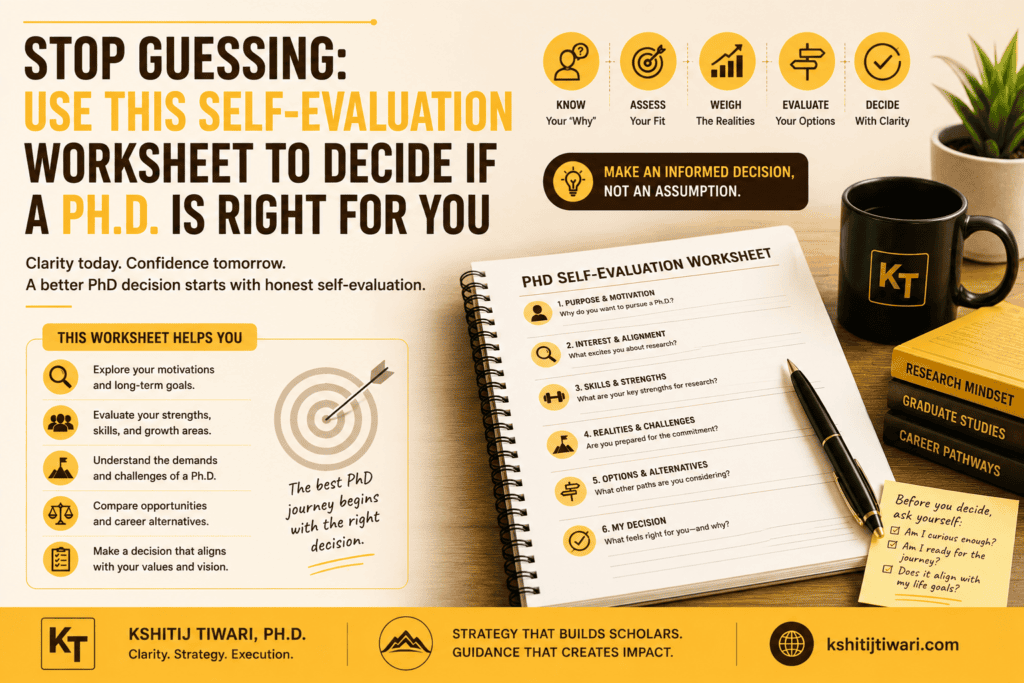

Finding a funded PhD is about much more than searching for universities with open doctoral positions. If you are trying to find funded PhD opportunities, the real challenge is identifying positions that offer strong research fit, reliable funding, effective supervision, and a realistic path toward your academic or professional goals.
A PhD position can look attractive on paper and still be a poor choice. A generous stipend may not compensate for an unsuitable research project. A prestigious university may not offer the right supervisor. A position described as “fully funded” may cover tuition and provide a stipend but leave substantial costs or funding conditions unexplained. And an exciting research topic can become a difficult PhD if the research environment or supervision is weak.
This is why finding a PhD position should be treated as a decision-making process rather than a search exercise.
In this guide, you will learn how to find funded PhD positions, where to search for them, how to determine whether an opportunity is genuinely fully funded, how to evaluate the research project and prospective supervisor, and how to build a systematic pipeline of opportunities rather than applying randomly to dozens of universities.
The guide also addresses the decision that comes after the search: what to do when you receive multiple PhD offers. You will learn how to compare opportunities across countries, evaluate funding and cost of living, identify red flags, and determine which offer provides the strongest overall foundation for your doctoral journey.
Whether you are just beginning your PhD search or already have offers on the table, the objective is the same: choose a PhD opportunity based on evidence, fit, and long-term value—not simply university prestige or the size of the stipend.
 Related Resource: This article is part of the Unwritten PhD Resource Library—a comprehensive collection of guides, decision frameworks, and practical resources covering every stage of the PhD journey, from choosing a research topic and applying for a PhD to publishing papers, managing burnout, and planning your career after graduation.
Table of Contents
ToggleWhat Makes a PhD Position Worth Pursuing?
The first mistake many applicants make is treating a PhD position as a university-selection problem.
It is not.
A PhD is fundamentally a research environment decision.
The university is only one component of that environment.
Your actual doctoral experience will be shaped by the interaction between your research problem, supervisor, research group, funding, infrastructure, institutional environment, geographic location, and career objectives.
This is why two PhD positions at equally prestigious universities can produce radically different outcomes.
One might give you:
- A well-funded research project
- A highly engaged supervisor
- Access to specialized infrastructure
- Strong industry collaboration
- A clearly defined research problem
- Opportunities to publish
- A realistic graduation timeline
- A strong professional network
Another might give you a prestigious university name but:
- An uncertain funding situation
- An overloaded supervisor
- Poor laboratory infrastructure
- A vague research direction
- Limited publication opportunities
- Weak supervision
- Little connection to your intended career
The second option may look better on paper.
It may not be better for your career.
That is why your objective should not be:
“How do I get into the best university?”
It should be:
“How do I find the research environment in which I can produce my best work and build the strongest career capital?”
That distinction should guide everything that follows.
Start With the Research Problem, Not the University
Before searching for positions, define the type of research environment you are looking for.
This does not mean that you need a perfectly formulated PhD research question.
In fact, expecting yourself to have a completely developed thesis before approaching potential supervisors can be counterproductive.
Instead, you need a sufficiently clear research direction.
For example, an applicant interested in robotics might identify a direction such as:
Multi-agent robotic systems for autonomous operation in degraded sensing environments.
That direction is broad enough to evolve but specific enough to identify relevant laboratories, supervisors, funding programs, and research projects.
From there, you can investigate:
- Which universities have active research in this area?
- Which professors publish consistently in this field?
- Which laboratories have the required infrastructure?
- Which projects are currently funded?
- Which professors are recruiting?
- Which countries have strong research ecosystems for this area?
- Which positions are structured as employment contracts?
- Which opportunities provide access to industry collaboration?
This approach is significantly more efficient than starting with a ranking list and trying to force your interests into whatever programs appear at the top.
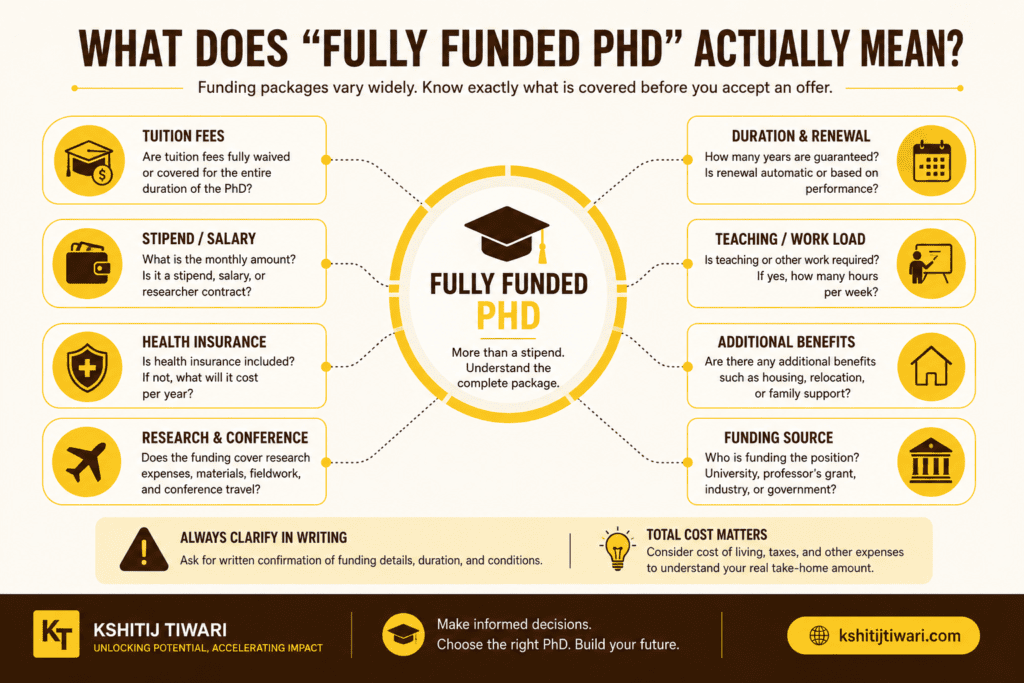
What Does “Fully Funded PhD” Actually Mean?
Before searching for funded PhD positions, you need to define what you are actually looking for.
The phrase “fully funded PhD” is not a universal financial specification.
In general, a funded doctoral offer may combine some or all of the following:
- tuition coverage or a tuition waiver;
- a living stipend or salary;
- research or teaching assistantship funding;
- health insurance;
- student fees;
- research expenses;
- conference or travel funding;
- relocation support;
- summer funding;
- pension or employment benefits where the PhD is structured as an employment contract.
The exact combination varies.
For example, Cornell describes doctoral funding as potentially combining fellowships, research and teaching assistantships, tuition, fees, health insurance, and a stipend. Princeton similarly describes its PhD financial support as combining tuition, health-plan coverage, and a base stipend, with funding sources varying by division and year. MIT notes that the meaning and form of “fully funded” support can vary by program and may include assistantships, fellowships, traineeships, scholarships, grants, or employment.
This distinction matters because two offers can both be advertised as “fully funded” while producing very different financial realities.
A better definition
For decision-making purposes, I recommend thinking about a funded PhD as:
A doctoral position where the documented funding package is sufficient to cover the defined academic costs and provide the agreed financial support for the specified period, subject to the conditions stated in the offer.
That definition forces you to ask better questions.
Don’t ask only:
“Is this PhD fully funded?”
Ask:
“Exactly what does the funding cover, for how long, under what conditions, and what remains my responsibility?”
That is the question that protects you from unpleasant surprises.
The Two Types of PhD Search You Need to Understand
Not every PhD opportunity is created in the same way.
Broadly, you will encounter two different search models.
Model 1 — Apply to an Advertised PhD Position
In this model, the research project already exists.
A professor, department, research centre, university, government agency, or industry partner has funding for a defined research project and is recruiting a doctoral researcher.
You are essentially applying for a research position.
The project may already specify:
- the research problem;
- research objectives;
- methodology;
- required academic background;
- technical skills;
- supervisor;
- funding source;
- project duration;
- expected start date;
- application deadline.
This model is particularly common in parts of Europe and in project-funded research environments.
For example, Wageningen University explicitly describes one route as applying for an already funded position through a vacancy, while the University of Groningen describes PhD positions funded through research organisations or industry partners as positions that are advertised when available.
FindAPhD similarly distinguishes funded projects from projects where funding is competitive rather than guaranteed.
Why this model is attractive
You do not necessarily have to invent an entire research programme from scratch.
The supervisor and research group may already have:
- funding;
- equipment;
- datasets;
- collaborators;
- infrastructure;
- preliminary research;
- publications;
- a defined technical problem.
That can substantially reduce some of the uncertainty associated with creating your own project.
But there is a trade-off
You may have less freedom to define the research question.
If the position exists to solve a specific funded research problem, your intellectual contribution needs to fit within that project.
That is not inherently bad. In fact, for many candidates it is an advantage.
But you need to understand the distinction before applying.
Model 2 — Propose Your Own Research Direction
The second model starts with you.
You identify:
- a research area;
- a research problem;
- a research gap;
- a potential research question;
- a supervisor or research group;
- a funding mechanism.
This is more common in systems where students are admitted to doctoral programs and then supported through fellowships, assistantships, scholarships, grants, or other funding mechanisms.
It can also happen when a professor is interested in your research direction but does not have an already-advertised position.
This route gives you potentially greater intellectual flexibility, but it also puts more responsibility on you.
You must establish:
- whether the research problem is genuinely worthwhile;
- whether the supervisor is interested;
- whether the project is feasible;
- whether appropriate infrastructure exists;
- how the research will be funded;
- whether you are eligible for that funding;
- whether the research can realistically be completed within the program structure.
This is why choosing your research topic and writing your proposal are not separate administrative exercises.
They are part of the risk assessment.
If you are at this stage, read my guide to choosing a PhD research topic before approaching potential supervisors.
And if you need to turn that research direction into a formal proposal, use the PhD research proposal guide alongside it.
Where to Find Funded PhD Positions
There is no single database containing every funded PhD opportunity.
Instead, funded positions are distributed across several different ecosystems.
University and Department Websites
University websites remain one of the most important sources.
However, searching only the university’s central admissions portal can cause you to miss opportunities.
Look specifically at:
- Department websites
- Research group pages
- Individual professor websites
- Laboratory recruitment pages
- Graduate school funding pages
- Research institute vacancy pages
A professor may advertise a funded PhD position on their laboratory website without prominently featuring it on the university’s main admissions page.
This is particularly common for project-funded doctoral positions.
Professor and Laboratory Websites
For research-intensive PhDs, this can be one of the highest-value search strategies.
Identify researchers whose recent publications align with your interests and examine their websites.
Look for phrases such as:
- PhD position
- PhD student wanted
- Doctoral researcher
- Research assistant
- Fully funded PhD
- Funded doctoral position
- Research fellow
- Scholarship available
- Open positions
- Join our group
- PhD opportunities
Also examine the professor’s recent grants and projects.
A professor who has recently received a substantial research grant may have doctoral recruitment opportunities that have not yet appeared on large job boards.
Academic Job and Research Portals
Some countries treat doctoral positions much more like employment vacancies than traditional student admissions.
This means that PhD opportunities can appear on academic employment portals alongside postdoctoral and research positions.
Search using combinations of:
PhD + your research area + country
and:
doctoral researcher + your research area
rather than searching only for “PhD admission.”
This distinction is especially important in countries where doctoral researchers are hired into funded research projects.
Research Institutes
Do not restrict your search to universities.
Research institutes can provide some of the most interesting doctoral opportunities, particularly in engineering, robotics, artificial intelligence, materials science, autonomous systems, and applied research.
A PhD hosted through a research institute or industry-linked laboratory may offer access to:
- Specialized equipment
- Large-scale datasets
- Industrial partners
- Government-funded research
- Applied research problems
- Cross-disciplinary teams
For a candidate interested in an R&D career, these factors can sometimes matter more than institutional prestige alone.
How to Search for Funded PhD Positions Efficiently
A common mistake is to search randomly.
You open ten university websites, bookmark five projects, read three scholarship pages, send two emails, and eventually lose track of everything.
Instead, build a pipeline.
Use a PhD Opportunity Pipeline
Create a spreadsheet with at least these columns:
|
Field
|
What to record
|
|---|---|
|
University
|
Institution
|
|
Department
|
Academic unit
|
|
Country
|
Location
|
|
Research group
|
Lab / center
|
|
Supervisor
|
PI / Supervisor
|
|
Research topic
|
Project area
|
|
Funding type
|
Scholarship/RA/TA/employment/project
|
|
Funding amount
|
Stipend/salary if published
|
|
Tuition coverage
|
Full/partial/unclear
|
|
Funding duration
|
Number of years/months
|
|
International eligibility
|
Yes / No / Unclear
|
|
Deadline
|
Application deadline
|
|
Funding start date
|
Proposed start date
|
|
Research fit
|
Your assessment
|
|
Supervisor fit
|
Your assessment
|
|
Career fit
|
Your assessment
|
|
Application status
|
Researching/Contacted/Applied/Interview/Offer/Rejected
|
This turns the PhD search from an emotional activity into a decision system.
How to Evaluate a PhD Position Before Applying
Finding an interesting project is not enough.
Before investing hours in an application, run a basic pre-application due diligence check.
I recommend assessing at least six dimensions.
1. Research Fit
Ask:
- Does the problem genuinely interest me?
- Does it build on my existing technical background?
- Will I have enough intellectual ownership?
- Does the project contain a meaningful research question?
- Is the expected contribution scientifically interesting?
- Is the scope realistic for a PhD?
A famous university cannot compensate for a research project that you fundamentally dislike.
You are going to live with this problem for years.
2. Supervisor Fit
Your supervisor may matter more to your day-to-day PhD experience than the university’s overall ranking.
Look for evidence of:
- regular student supervision;
- successful PhD completions;
- relevant publications;
- current research activity;
- stable funding;
- reasonable lab size;
- student career outcomes;
- responsiveness;
- intellectual independence.
My detailed Advisor–Advisee Fit guide provides a framework for identifying supervisor red and green flags, including absentee supervision, unstable lab culture, vague funding, career-focused mentorship, and evidence of successful student outcomes.
The important point is that you should evaluate the supervisor as carefully as you evaluate the university.
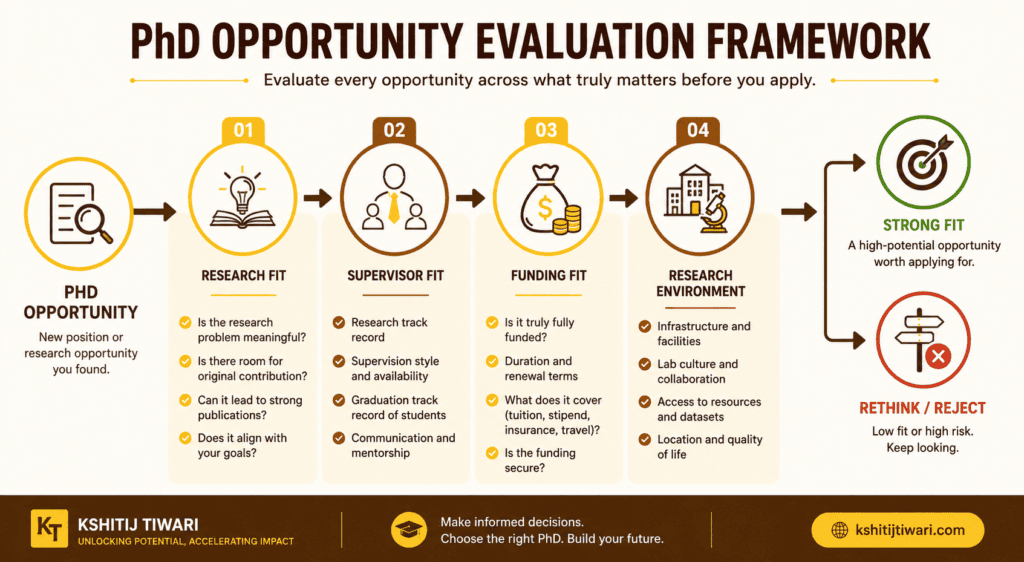
How to Identify Whether a PhD Is Actually Fully Funded
The phrase “fully funded PhD” is used very loosely.
You should never assume that the phrase means the same thing across countries or universities.
Before accepting an offer, determine exactly what the funding covers.
At minimum, investigate:
|
Funding aspect
|
What you need to know
|
|---|---|
|
Tuition
|
Is tuition fully waived or covered?
|
|
Stipend
|
How much will you actually receive?
|
|
Duration
|
How many years are guaranteed?
|
|
Renewal/extension
|
Is funding automatically renewed?
|
|
Research expenses
|
Who pays for experiments, equipment and travel?
|
|
Health insurance
|
Is it included?
|
|
Conference travel
|
Is funding available?
|
|
Teaching
|
Is teaching required?
|
|
Employment status
|
Are you a student, employee, or both?
|
|
Project dependency
|
Does your funding depend on one grant?
|
|
Funding source
|
Government, university, professor, industry, fellowship?
|
This is where the distinction between a funded student and a funded research employee becomes important.
In some doctoral systems, particularly across parts of Europe, a PhD researcher may effectively be employed by a university or research institution.
In other systems, the candidate may receive a stipend while remaining classified primarily as a student.
The financial implications can be substantially different.
The label “funded” is therefore not enough.
You need to understand the actual financial and contractual arrangement.
Funding Is More Than Your Monthly Stipend
A common mistake is comparing PhD offers exclusively based on the amount deposited into your bank account each month.
That is not enough.
Consider the complete financial structure.
Suppose Offer A provides a higher nominal stipend but is located in a city with extremely high housing costs.
Offer B provides a lower stipend but includes subsidized housing, stronger healthcare coverage, conference funding, and a more secure employment arrangement.
The nominal difference may disappear once the complete cost structure is considered.
Your comparison should therefore include:
Net financial position = income − essential living costs − uncovered academic costs
You should also investigate whether your funding allows you to focus on research.
A position that requires extensive teaching or unrelated employment to cover living expenses may provide less effective research capacity than a slightly lower-paying position with better financial security.
For a four-to-seven-year research journey, these differences accumulate.
The real advantage of a funded PhD
Funding is not valuable simply because it reduces your financial burden.
Its strategic value is that it can protect your research time.
A financially secure PhD candidate can spend more time reading existing literature as a part of your literature review exercise, designing experiments, conducting research, writing papers, attending conferences, collaborating with researchers, developing technical expertise, and building an international network.
Financial insecurity introduces competing priorities.
You may need additional employment, excessive teaching, or other commitments simply to maintain your standard of living.
For a multi-year research journey, those trade-offs accumulate.
This is why funding should be evaluated as a research-productivity variable, not merely as a financial benefit.
How to Evaluate the Research Project
Once you find a funded position, the next question is whether the actual project is worth pursuing.
Do not be seduced by a compelling title.
Read the project description carefully.
Ask:
- What problem is the project actually solving?
- Why does the problem matter?
- What is already known?
- What remains uncertain?
- What technical contribution is expected?
- What data or infrastructure already exists?
- What would I actually be responsible for?
- Is the project sufficiently scoped for a PhD?
- Can the project generate multiple publications?
- What happens if the initial approach fails?
A good PhD project should contain enough uncertainty to create original research while remaining sufficiently bounded that you can make meaningful progress.
That balance is critical.
A project that is too broad can become impossible to complete.
A project that is too narrow can leave you with insufficient intellectual contribution.
A project that is essentially engineering implementation may produce useful technology but insufficient scientific novelty.
The central question is therefore:
Can this funded project evolve into a defensible body of original doctoral research?
How to Verify a Prospective PhD Supervisor
Do not rely solely on the professor’s official biography.
Look for:
Recent publications
Has the supervisor published consistently in your research area?
Current students
Who is currently working in the group?
Former students
Where did they go after graduation?
Graduation record
Are students actually completing?
Funding
Where does the lab’s funding come from?
Research infrastructure
Does the lab have what your project requires?
Collaboration
Does the group interact with other labs, institutes, or industry?
Supervision style
Ask current or former students what working with the supervisor is actually like.
Your goal isn’t to find a perfect professor.
Your goal is to identify evidence that the research environment is likely to support the PhD you want to complete.
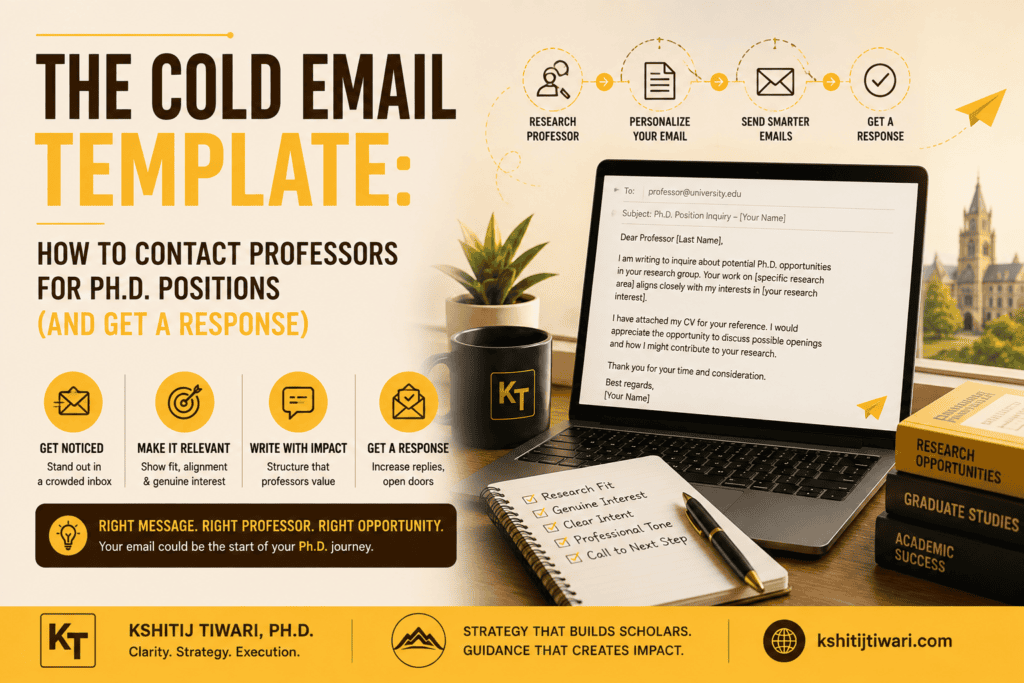
How to Contact Professors About PhD Positions (Cold Email outreach)
If you are applying to a position that requires contacting a prospective supervisor, don’t send a generic email.
Your outreach should demonstrate:
- why you selected that professor;
- why their research is relevant;
- what you have already done;
- where your technical experience overlaps;
- what you are interested in researching;
- what opportunity you are asking about.
My PhD cold email guide covers the structure in detail, including how to research the professor’s recent publications, demonstrate research alignment, verify funding/availability, and avoid generic outreach.
The goal of the email isn’t:
“Please give me a PhD.”
It is:
“I have researched your work, I understand the problem your group is working on, and I have evidence that my background could contribute to it. Is there a potential research opportunity worth discussing?”
That difference matters.
How to Write the Application for a Funded PhD
Once you identify a suitable position, your application should reinforce the same story.
Your CV, SOP, research proposal, email, references, and interview should not appear to have been created independently.
They should collectively answer:
Why are you a particularly good candidate for this specific research environment and problem?
That is why a generic “I have always been passionate about research” narrative is weak.
A stronger application establishes:
Your background → your technical competence → the research problem → the supervisor’s work → the proposed contribution → your career direction.
For the SOP component, see my Strategic PhD Statement of Purpose guide, which explains why technical PhD applications require more than generic document polishing.
Now Comes the More Important Question: How Do You Choose Between PhD Offers?
Suppose your strategy works.
You applied to several positions.
You receive:
- Offer A from a highly ranked university.
- Offer B from a lower-ranked but highly specialized research group.
- Offer C from a different country with a significantly better funding package.
Which one do you choose?
This is where many applicants fall back on simplistic rules:
“Choose the highest-ranked university.”
or:
“Choose the highest stipend.”
or:
“Choose the professor with the most citations.”
All three can produce the wrong decision.
A PhD is a multi-year research commitment. The correct choice depends on the interaction between research, supervision, funding, environment, career and personal constraints.
The PhD Offer Decision Framework
I recommend scoring each offer against ten dimensions.
|
Decision factor
|
Suggested weight (%)
|
|---|---|
|
Research/project fit
|
20
|
|
Supervisor fit
|
20
|
|
Funding & financial sustainability
|
15
|
|
Research infrastructure
|
10
|
|
Career alignment
|
10
|
|
Research environment
|
8
|
|
University/ department reputation
|
5
|
|
Location & quality of life
|
5
|
|
Collaboration/network
|
4
|
|
Program structure & completion risk
|
3
|
These weights are a decision framework, not a universal law.
Your priorities may legitimately differ.
For example, if your primary objective is an academic career in a very specific field, research environment and publication opportunities may deserve greater weight. If you are supporting a family, financial sustainability and location may deserve considerably greater weight.
The point is not to manufacture a mathematically perfect answer.
The point is to make your assumptions explicit.
How to Compare PhD Offers in Different Countries
Country comparison introduces additional complexity.
You may have offers from the United States, Germany, the Netherlands, the United Kingdom, Canada, Australia, Japan, or elsewhere.
Do not ask simply:
“Which country is best for a PhD?”
Instead ask:
“Which doctoral system best fits the type of research career I want?”
Different systems can vary substantially in:
- Program duration
- Coursework requirements
- Funding structure
- Employment status
- Teaching requirements
- Supervisor relationships
- Thesis format
- Publication expectations
- Immigration rules
- Post-PhD employment opportunities
For example, a project-funded doctoral researcher position can feel very different from a program where the student enters coursework first and identifies a research direction later.
Neither model is inherently superior.
The fit depends on your goals.
Your existing PhD Abroad vs. Staying Home guide provides a broader framework for evaluating the financial, infrastructure, and career dimensions of that decision.
Questions to Ask Before Accepting a PhD Offer
Do not rely entirely on the information provided in the admission letter.
Ask the supervisor or department direct questions.
Questions About the Research
- What is the central research problem?
- How much of the project is already defined?
- How much freedom will I have to modify the research direction?
- What are the expected research contributions?
- What infrastructure is already available?
- What would the first year look like?
- What would constitute successful progress?
- What happens if the initial research approach fails?
Questions About Supervision
- How frequently do you meet PhD students?
- How do you provide feedback?
- How much independence do students typically have?
- How many PhD students do you currently supervise?
- Who supervises students when you are unavailable?
- How are disagreements about research direction handled?
Questions About Funding
- What is the funding source?
- How long is funding guaranteed?
- Does funding cover tuition?
- Is summer funding included?
- Are conference expenses covered?
- Is teaching required?
- What happens if the underlying grant ends?
Questions About Career Development
- Where have recent graduates gone?
- Are students encouraged to collaborate with industry?
- Can students attend conferences?
- Are internships permitted?
- Are there opportunities to work with external research partners?
- How are students supported when preparing for academic or industry careers?
The quality of the answers is itself useful information.
Red Flags When Evaluating a PhD Offer
Some warning signs should trigger additional investigation before you accept.
Unclear Funding
If nobody can clearly explain how your PhD will be funded, stop and investigate.
You should know:
- Who pays you?
- How long?
- How much?
- Under what conditions?
- What happens if funding ends?
A Vague Research Project
“Work on AI for healthcare” is not enough information.
You need to understand the actual research problem and what contribution you are expected to make.
An Overloaded Supervisor
If a professor has an enormous group and limited interaction with students, determine who will actually supervise you.
High Student Turnover
If students routinely leave the group or take unusually long to graduate, investigate why.
No Clear Research Infrastructure
If your project requires expensive equipment that the laboratory does not possess, ask how experiments will be conducted.
Pressure to Accept Immediately
A legitimate opportunity should allow you enough time to understand what you are accepting.
Funding That Depends on Uncertain Future Grants
If your entire PhD depends on a grant that has not yet been secured, that is materially different from having guaranteed funding.
A Project With No Obvious PhD-Level Contribution
A funded project can still be poorly suited to doctoral research.
If the work is primarily implementation, routine data collection, or engineering integration without a clear path to original scientific contribution, investigate carefully.
How to Decide When Two Offers Are Both Excellent
Sometimes the problem is not that one offer is clearly bad.
The problem is that both are genuinely strong.
In that situation, focus on differentiation.
Ask which offer gives you the strongest combination of:
Research direction + supervisor + resources + career trajectory.
Then ask a second question:
“Which opportunity would be harder to recreate later?”
This is an underrated decision criterion.
You might be able to obtain a strong university credential later, but a particular supervisor, research facility, industrial collaboration, dataset, or project opportunity may be unique.
Scarcity matters.
What If You Cannot Find a Funded PhD Position?
Do not immediately conclude that funded PhDs do not exist in your field.
The problem may be your search strategy.
Try changing:
- Search terms
- Countries
- Research keywords
- Universities
- Research institutes
- Professor-level searches
- Job portals
- Funding databases
- Research project terminology
For example, instead of searching:
“Fully funded PhD in robotics”
try:
“doctoral researcher autonomous systems”
or:
“PhD position mobile robotics”
or:
“doctoral researcher multi-agent systems”
or:
“research assistant robotics PhD”
The terminology used by universities and research institutions varies significantly.
Also investigate whether your target professors have active grants.
A professor may not advertise a position under the exact phrase “fully funded PhD” even though a funded doctoral opportunity exists within their research group.
Do You Need to Apply to Dozens of Universities?
Not necessarily.
Application volume should not be your primary metric.
Ten strategically selected applications can be more valuable than fifty generic applications.
For each target, ask:
Would I genuinely accept this PhD if it were offered to me?
If the answer is no, why are you applying?
A high-volume application strategy can make sense in highly competitive admissions systems, but even then your shortlist should be built around genuine fit.
Your goal is not to maximize acceptance letters.
Your goal is to maximize the probability of receiving a small number of genuinely excellent offers.
When Should You Reject a PhD Offer?
A funded offer is not automatically a good offer.
You should seriously reconsider an opportunity when several major risks appear simultaneously.
For example:
- Weak research fit
- Unclear funding
- Poor supervisor availability
- Inadequate infrastructure
- High student attrition
- No credible publication pathway
- Poor career alignment
One weakness may be manageable.
Several interacting weaknesses can create systemic risk.
Remember that declining an unsuitable PhD is not failure.
A PhD offer is an opportunity, not an obligation.
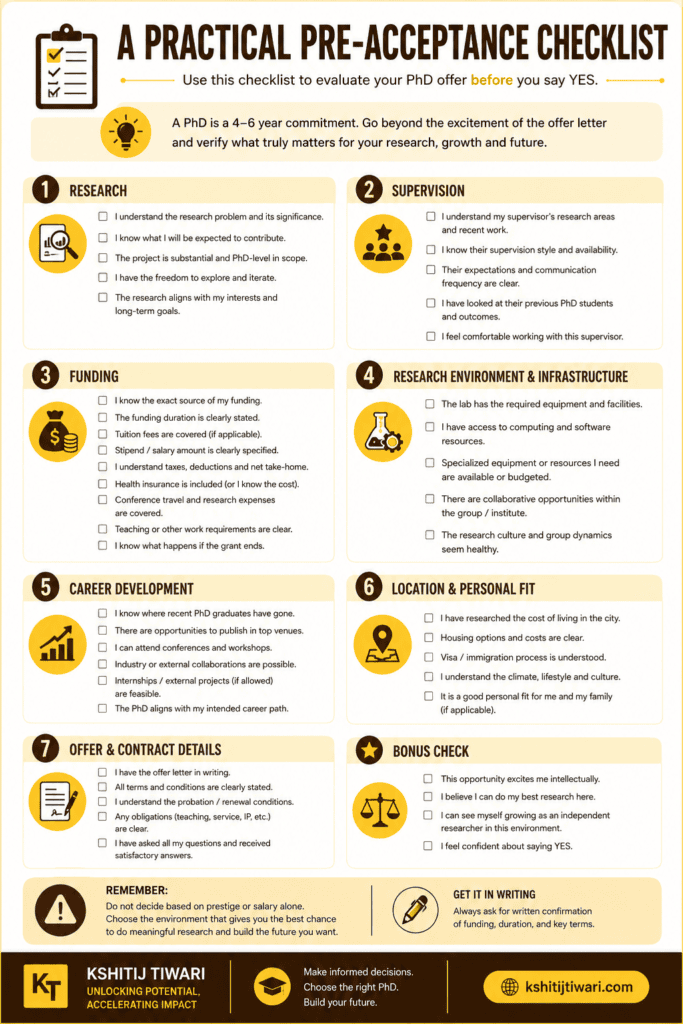
A Practical Pre-Acceptance Checklist
Before accepting your final offer, you should be able to answer all of the following with reasonable confidence.
Research
- I understand the research problem.
- I understand why the problem matters.
- I can identify the likely research gap.
- I understand what contribution I may be expected to make.
- The project is sufficiently substantial for a PhD.
- The research aligns with my interests and career direction.
Supervisor
- I have investigated the supervisor’s recent research.
- I understand their supervision style.
- I know how frequently students interact with them.
- I have investigated their previous PhD students.
- I have looked for potential red flags.
- I understand how much intellectual independence I am likely to have.
Funding
- I know exactly who funds my PhD.
- I know how long the funding is guaranteed.
- I know whether tuition is covered.
- I understand the stipend or salary.
- I understand taxes and major deductions.
- I know whether healthcare is included.
- I know whether conference travel is funded.
- I understand teaching requirements.
- I know what happens if the underlying grant ends.
Infrastructure
- The laboratory has the equipment required for my research.
- I understand what resources I will have access to.
- I know whether specialized equipment needs to be purchased.
- I understand the computing and experimental resources available.
- I know which external collaborators may be involved.
Career
- I know where previous students have gone.
- I understand how the PhD will contribute to my intended career.
- I understand the publication opportunities.
- I know whether industry collaboration is possible.
- I know whether internships or external collaborations are permitted.
Personal and geographic fit
- I have calculated realistic living costs.
- I understand the visa or immigration implications.
- I have considered healthcare and insurance.
- I have considered housing.
- I understand the likely lifestyle.
- I have considered the impact on family or personal commitments.
If several of these boxes remain unanswered, you are not finished evaluating the offer.
The Most Common Mistakes PhD Applicants Make
Choosing the University Before the Research
A famous university does not automatically produce a successful PhD.
Treating Funding as the Only Decision Variable
Money matters, but funding without research or supervisor fit can still produce a poor outcome.
Ignoring the Supervisor
Your supervisor can influence your research direction, publication trajectory, intellectual independence, and graduation experience.
Failing to Investigate Current Students
Current students can provide information that is impossible to obtain from official university websites.
Comparing Stipends Without Comparing Cost of Living
Nominal salary is not disposable income.
Assuming “Fully Funded” Means Everything Is Covered
Read the actual funding conditions.
Applying Without a Research Direction
A generic application is difficult to make compelling to a research supervisor.
Accepting an Offer Because It Is Prestigious
Prestige is useful, but it should not replace strategic evaluation.
Failing to Think About the Exit
A PhD is a means to an end. If you do not know what the degree is supposed to enable, it becomes much harder to evaluate whether an opportunity is actually good.
The PhD Decision Framework
The entire process can be viewed as a sequence of increasingly difficult decisions:
Should I do a PhD?
↓
What should I research?
↓
Where is the strongest research environment?
↓
Which supervisor should I work with?
↓
Is the position properly funded?
↓
Is the project viable as a PhD?
↓
Is the application worth pursuing?
↓
Which offer should I accept?
↓
What career should this PhD enable?
This is why the search for a funded PhD should not be treated as an isolated Google search.
It is one component of a much larger doctoral decision system.
The Unwritten PhD Resource Library is designed around this broader journey, bringing these decisions together rather than treating every PhD problem as an isolated question.
Key Takeaways
Finding a funded PhD position is only the first decision.
Choosing the right funded PhD position is the more important one.
A strong doctoral opportunity sits at the intersection of several factors: meaningful research, capable supervision, secure funding, appropriate infrastructure, healthy research culture, publication potential, and alignment with your long-term career.
When you have multiple offers, resist the temptation to ask:
“Which university is best?”
Instead ask:
“Which research environment gives me the strongest opportunity to produce valuable work, develop into an independent researcher, and reach the career I actually want?”
That question changes the entire decision.
It shifts the objective from getting admitted to building a strategically valuable PhD.
And that is ultimately what the PhD decision should be about.
Need Help Evaluating Your PhD Options?
A generic admissions consultant can help you submit applications.
That is not necessarily the difficult part.
The difficult part is determining whether the research opportunity itself is worth committing several years of your life to.
If you are choosing between PhD offers, evaluating potential supervisors, assessing whether a funded research project is actually viable, or trying to determine whether a particular PhD aligns with your long-term technical career, this is where strategic PhD mentorship can provide substantially more value than application proofreading alone.
My PhD Mentorship service is designed for researchers who want a rigorous, research-focused assessment of their doctoral path—from research direction and supervisor selection to applications, research execution, publications, and career planning.
Don’t choose a PhD simply because you were accepted. Choose the research environment that gives you the strongest chance of becoming the researcher you want to become.
Book a PhD consultation to evaluate your options strategically before committing to a multi-year doctoral journey.