Most robotics startups believe their biggest challenge is building new features.
In reality, their biggest challenge is carrying the weight of yesterday’s shortcuts.
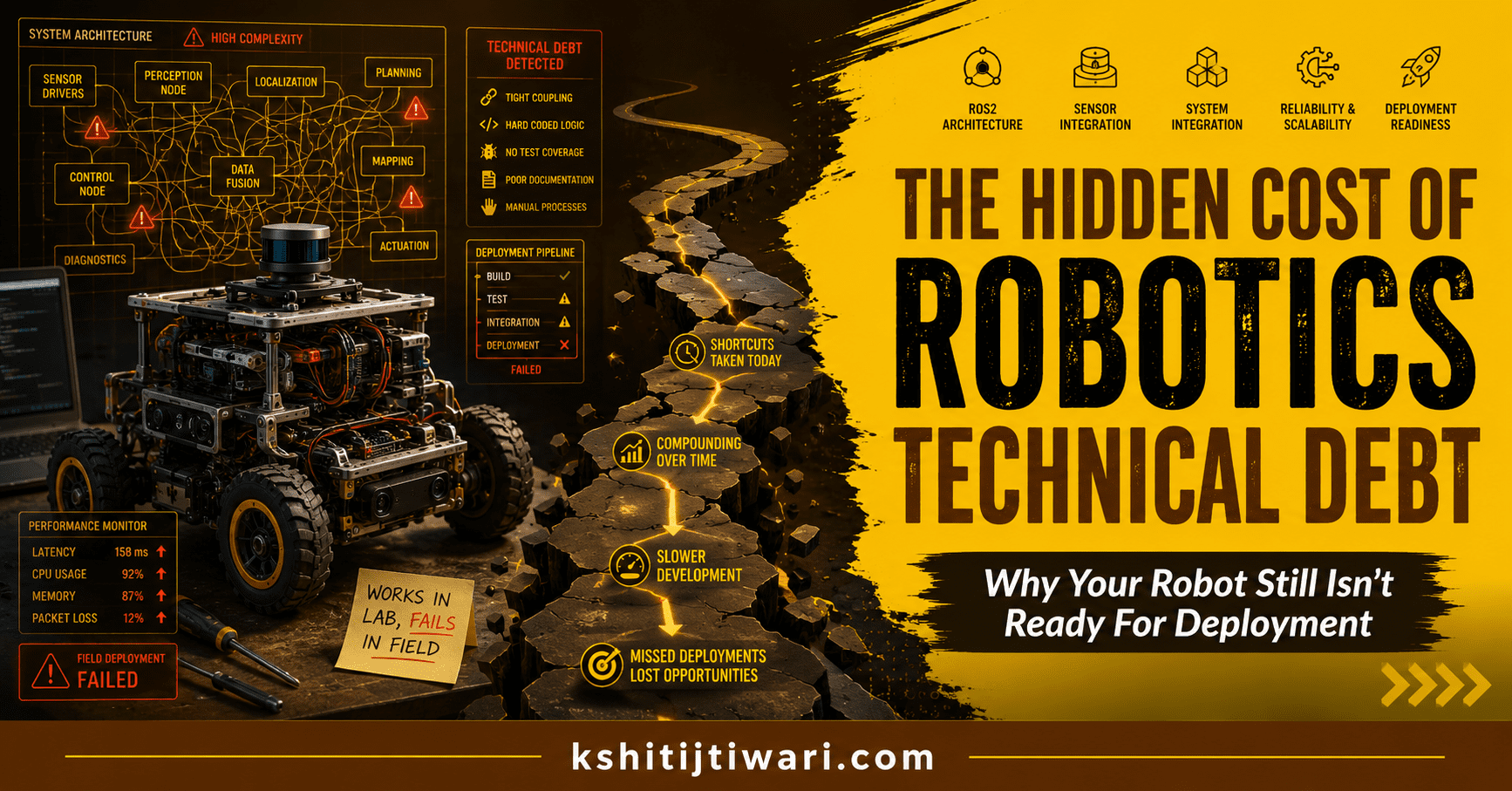
Robotics technical debt is one of the most overlooked reasons robotics projects stall, miss deadlines, burn investor capital, and ultimately fail to reach commercial deployment.
While software startups can often survive with imperfect architecture, robotics companies operate under a completely different set of constraints. A poorly designed software module does not simply slow down a website—it can lead to degraded autonomy, unreliable sensor fusion, communication bottlenecks, and field failures.
If your robot works perfectly in the lab but struggles in the field, technical debt may already be undermining your roadmap.
Table of Contents
ToggleWhat Is Robotics Technical Debt?
Technical debt refers to engineering decisions that prioritize short-term speed at the expense of long-term maintainability, reliability, and scalability.
Examples include:
- Hardcoded parameters
- Poor ROS 2 node architecture
- Missing documentation
- Unreliable middleware configuration
- Lack of simulation validation
- Inadequate testing pipelines
- Sensor integration shortcuts
Initially, these decisions seem harmless.
The prototype works.
The demo succeeds.
Investors are impressed.
Then reality arrives.
Every new feature takes longer to implement.
Bugs become harder to isolate.
Engineers spend more time debugging than innovating.
Eventually progress slows to a crawl.
Why Robotics Technical Debt Is More Dangerous Than Software Technical Debt
Robotics systems combine multiple engineering domains:
- Embedded systems
- Sensors
- Middleware
- Networking
- Controls
- Planning
- Perception
- Hardware integration
A single architectural mistake can cascade through the entire stack.
For example:
A poorly configured ROS 2 communication architecture may create latency spikes.
Those latency spikes affect localization.
Localization drift affects planning.
Planning errors affect navigation.
Navigation failures damage confidence during field testing.
One shortcut can eventually compromise an entire deployment.
This phenomenon is closely related to what I call the “Robotic Valley of Death” where promising prototypes fail to mature into production-ready systems.
Five Warning Signs Your Robotics Startup Has Technical Debt
1. Every New Feature Breaks Something Else
When engineers fear modifying existing code, architecture quality has already deteriorated.
Healthy systems support change.
Debt-ridden systems resist it.
2. Deployment Timelines Keep Slipping
Repeated delays often indicate hidden integration issues rather than poor planning.
Many founders mistakenly assume they need more developers.
Often they need better architecture.
3. Your Team Depends on One “Hero Engineer”
If only one engineer understands critical components of the system, the organization has accumulated dangerous knowledge debt.
This becomes a business risk.
4. Field Results Never Match Simulation
A widening gap between simulation performance and deployment performance usually signals deeper architectural issues.
This is particularly common in autonomy projects.
5. Hiring New Engineers Is Painful
When onboarding takes months instead of weeks, technical debt is silently taxing productivity.
New hires spend their first months deciphering undocumented systems rather than delivering value.
How Technical Debt Destroys Fundraising Efforts
Investors increasingly conduct technical due diligence.
They want answers to questions such as:
- Can this architecture scale?
- Is the autonomy stack maintainable?
- Can the team execute the roadmap?
- How much engineering risk remains?
Technical debt weakens every answer.
A robotics startup with impressive demos but poor architecture often struggles to convince investors that deployment is realistic.
This is one reason many founders seek Fractional CTO support before major funding rounds.
Common Sources of Robotics Technical Debt
Poor ROS 2 Architecture
Many teams build working ROS 2 systems without designing scalable communication patterns.
The result:
- Excessive latency
- Unnecessary bandwidth consumption
- Difficult debugging
For teams still establishing their ROS 2 foundation, this guide on setting up ROS 2 without dual boot may help.
Lack of Failure Mode Analysis
Robots operate in uncertain environments.
Ignoring failure scenarios creates hidden risk.
This is why deployment-ready systems require structured FMEA and reliability planning.
Rushed Sensor Integration
Quick integrations often work under controlled conditions.
Field environments expose synchronization issues, calibration errors, and timing problems.
No Long-Term Technical Leadership
Many startups postpone senior technical leadership until “later.”
Unfortunately, architecture decisions made today determine scalability tomorrow.
How To Reduce Robotics Technical Debt
Conduct an Architecture Audit
The first step is understanding where debt exists.
Review:
- Middleware architecture
- Data flow
- Sensor interfaces
- Failure recovery mechanisms
- Deployment pipelines
Prioritize Reliability Over Features
A reliable robot with fewer features often creates more customer value than an advanced robot that fails unpredictably.
Build Documentation Early
Documentation is not bureaucracy.
Documentation is scalability.
Future engineers should be able to understand critical systems without requiring tribal knowledge.
Invest in Strategic Technical Leadership
Technical debt rarely disappears on its own.
Someone must own architectural decisions.
Whether through an experienced CTO or a Fractional CTO model, leadership is essential for maintaining long-term engineering velocity.
If technical debt is beginning to affect your roadmap, deployment timeline or engineering capacity, the next step is to assess the wider system rather than fixing individual symptoms. See the Robotics Architecture Audit for a structured evaluation.
The Cost of Waiting
Technical debt compounds.
The longer it remains unaddressed:
- Development slows
- Hiring becomes harder
- Deployment risks increase
- Investor confidence decreases
Most founders notice technical debt only after it becomes expensive.
The highest-performing robotics companies address it before it becomes visible.
Key Takeaways
The goal of robotics engineering is not building impressive prototypes.
The goal is reliable deployment.
Every shortcut taken today becomes tomorrow’s obstacle.
Technical debt is not simply an engineering problem.
It is a business problem.
It affects funding, hiring, deployment, customer satisfaction, and long-term competitiveness.
Technical debt is therefore best treated as part of a broader robotics R&D strategy, rather than as an isolated software-maintenance issue. Architecture, hiring, deployment readiness, productization and technical leadership all influence how quickly that debt compounds.
If your team is struggling with integration challenges, architecture bottlenecks, or deployment delays, it may be time to evaluate the health of your robotics stack before the next milestone becomes another missed deadline.
Ready For An Independent Architecture Review?
Many robotics startups do not need more developers.
They need clarity.
A structured technical audit can identify architectural bottlenecks, hidden risks, and deployment blockers before they consume additional months of engineering effort.