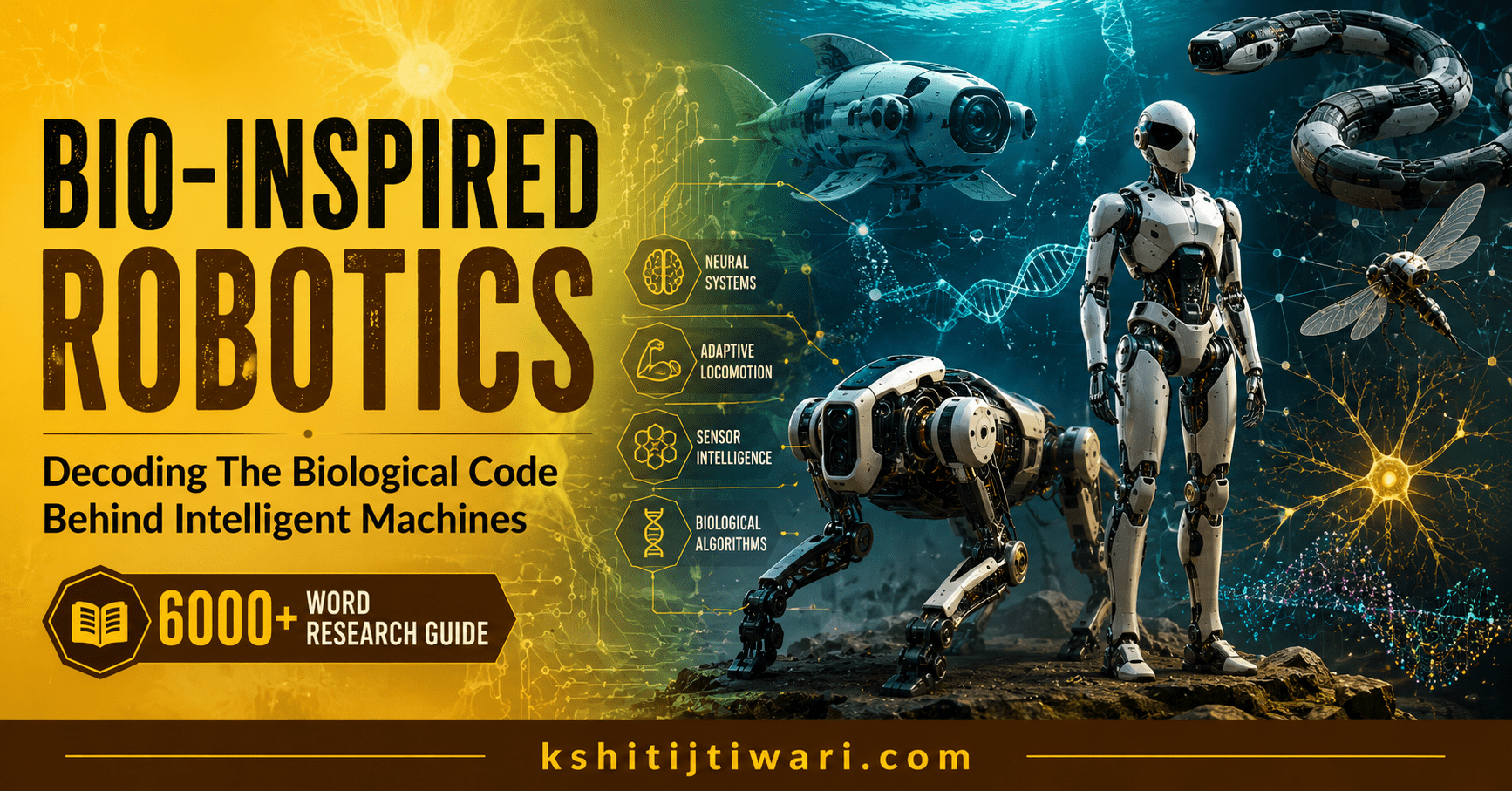
The most advanced research labs on Earth—from Boston Dynamics to MIT’s Legged Robotics Group—are engaged in a constant arms race. They are trying to beat the original, and still undefeated, R&D champion: Nature.
Why are the fastest, most agile robots in the world still outperformed by a cockroach, a housefly, or a gecko? Because nature has run a 3.8-billion-year R&D cycle, engineering solutions refined by relentless evolutionary pressure.
For engineers, scientists, and corporate R&D leaders, the pathway to next-generation autonomy is clear: we must stop designing robots from scratch and start decoding the efficiency principles of biology.
This field, known as Bio-Inspired Robotics (or Biorobotics), is more than just Biomimicry (the simple act of copying nature). It is a highly specialized engineering discipline focused on abstracting, simplifying, and enhancing the core mechanisms of life to create revolutionary autonomous systems.
This definitive guide will deconstruct the biological code powering the future of robotics across three critical pillars:
Locomotion: Mastering movement on, above, and under complex terrain.
Perception: Ultra-efficient, event-driven sensing that overcomes the limitations of cameras and LiDAR.
Computing: Brain-inspired hardware and algorithms that solve the energy crisis of Edge-AI.
This is not a theoretical exercise. This is the blueprint for solving the toughest R&D challenges of navigation, power consumption, and real-time computation—the foundational principles for truly autonomous systems.
Table of Contents
ToggleWhat Is Bio-Inspired Robotics?
Bio-inspired robotics is a field of robotics that develops machines by studying biological organisms such as insects, birds, fish, reptiles, mammals, and even neural systems. Rather than copying nature directly, engineers extract underlying principles of locomotion, sensing, adaptation, and energy efficiency to design more capable robotic systems.
Key Characteristics
- Nature-inspired design
- Adaptive movement
- Energy efficiency
- Distributed intelligence
- Robustness in complex environments
Bio-Inspired Locomotion & Mechanism Design
The challenge of locomotion is not just movement, but efficient interaction with an unstructured environment. Biorobotics achieves this through compliant materials and dynamic stability principles.
A. Terrestrial Agility: Dynamics, Gaits, and Compliance
The physics of dynamic movement are key to efficiency.
1. Bipedal Dynamics: The Mastery of Running
The transition from slow, statically stable humanoids to fast, dynamically stable runners like Cassie (Agility Robotics) is a triumph of bio-inspired physics.
The SLIP Model Explained: The Spring-Mass Model (SLIP – Spring Loaded Inverted Pendulum) is the central concept. It models the body mass as a point mass supported by a massless spring. In running, the leg acts as a spring, compressing and storing energy during ground contact, and then releasing it to propel the body forward.
R&D Implication: Modern bipedal robots prioritize passive compliance in their joints. By allowing the leg to act as a physical spring, the robot’s control system doesn’t have to perform complex, continuous calculations to stabilize every micro-perturbation. This vastly reduces computational load and energy consumption while enhancing robustness. The robot recovers passively rather than reacting actively.
Actuation Challenges: To replicate this, engineers use Series Elastic Actuators (SEAs) [Link to academic paper on SEA design]. The SEA contains a physical spring in series with the motor, which measures force and provides impact resistance, mimicking the tendons and muscles of a human leg.
2. Quadrupeds and Multi-Terrain Resilience
While bipedal motion is fast, four legs offer a superior blend of speed, stability, and payload capacity.
Gaits and Rhythms: Bio-inspired research has cataloged efficient gaits: the trot (diagonal pairs move together), the bound (forelegs together, hindlegs together), and the gallop (asynchronous bounding). These gaits are often controlled by Central Pattern Generators (CPGs)—simple rhythmic neural circuits found in the spinal cords of animals. Simulating CPGs on a robot vastly simplifies the control logic needed for complex walking and running patterns.
Case Study (Robo-Cheetahs): High-speed quadrupeds prioritize reducing ground contact time and maximizing the storage/release of kinetic energy, mirroring how a cheetah’s spine and limbs act like massive, energy-storing springs.
3. Limbless Locomotion: Redefining Mobility
In extreme environments (rubble, pipes, crevices), limbs are a liability.
Snake Robots: These robots employ multiple serpentine gaits (e.g., lateral undulation, sidewinding, rectilinear motion) that are chosen based on the ground texture and clearance. The key is to control the localized friction along the body segments—bio-inspired scaly skin can be actuated to change friction, propelling the robot forward only when the body segment is pushing against the ground.
Soft Robots (Peristaltic Motion): Utilizing fluid-driven silicone actuators, these robots move like inchworms or caterpillars. This peristaltic motion allows them to traverse highly confined, irregular, and sensitive spaces (e.g., medical robotics).
B. Aerial Mastery: Beyond the Propeller
At the scale of an insect (low Reynolds Number), air behaves more like honey than a gas. Propellers become highly inefficient.
Flapping Wing Micro Aerial Vehicles (FWMAV):
Inspiration: The tiny, fast-flapping wings of insects.
Mechanism (The LEV): The mechanism that enables this is the Leading Edge Vortex (LEV) [Link to Harvard’s RoboBee research]. As an insect wing flaps and rotates, a vortex of air spins off the front edge of the wing. This spinning vortex creates a large region of low pressure over the wing, generating lift far exceeding what traditional aerodynamic theory predicts. Robotics mimics this by precisely controlling the stroke plane and pitch of the flapping wing.
Passive Glide and Precision Descent: Bio-inspired single-wing and rotating designs (like the maple seed and samara) allow sensors to be released from high altitudes and achieve controlled, energy-free descent and payload delivery, a critical technology for low-cost atmospheric monitoring.
C. Marine Mastery: Submerged Efficiency and Maneuverability
Underwater robotics faces a unique set of challenges: high fluid density, crushing pressure, and acoustic stealth. Bio-inspired designs offer superior solutions compared to conventional propeller-driven vehicles.
1. Oscillating Propulsion (Fish-Inspired)
Traditional thrusters are noisy, consume significant power, and struggle with fine-grained maneuvering in tight spaces.
Inspiration: Fast, efficient pelagic fish like the Tuna (for speed) and the Cownose Ray (for maneuverability).
Mechanism:
Thunniform Swimming (Speed): High-speed Autonomous Underwater Vehicles (AUVs) mimic the powerful, stiff, lunate caudal fin (tail fin) of the tuna. The propulsion comes almost entirely from the tail fin, minimizing drag on the body. This oscillating propulsion is significantly more efficient than propellers, especially over long distances.
Undulatory/Finfold Swimming (Maneuverability): For tasks like inspection and surveillance, bio-inspired undulating fins (like those found on the Cownose Ray or cuttlefish) offer superior agility. These soft, compliant, and highly redundant systems allow for instantaneous, multi-directional movement without complex thruster arrays, enabling stealth and precision.
2. Bio-Inspired Buoyancy Control (The Siphon and Bladder)
Inspiration: The internal mechanisms used by many marine organisms to regulate depth without constant motor use.
Mechanism: Engineers mimic the swim bladder and siphon systems. For example, some robots use internal reservoirs and peristaltic pumps to ingest and expel small amounts of water to achieve fine-grained buoyancy control for long-duration deployments, avoiding the constant energy drain of vertical thrusters.
3. Amphibious and Multi-Modal Systems
The most demanding frontier is the land-sea interface.
Inspiration: The Salamander and the Mudskipper.
Mechanism: Creating multi-modal robots that can seamlessly transition between terrestrial gaits (walking/crawling) and aquatic propulsion (swimming) without sacrificing efficiency in either domain. This often requires highly customized, redundant actuators and control systems, crucial for reconnaissance in coastal areas or disaster response.
Bio-Inspired Perception and Sensing
The next major bottleneck in R&D is not generating data (LiDAR and cameras do that constantly), but generating meaningful, low-power data relevant to the task.
A. The ‘Last Inch’ Problem: Tactile and Haptic Sensing
LiDAR and vision are excellent for far-field mapping, but they are blind to the crucial “last inch” of interaction: what is the object made of? How soft is it? How much force should be applied?
The Limitations: In dark, dusty, or dense environments, camera and LiDAR data is noisy or non-existent, making close-quarters manipulation impossible.
Case Study: Whisker Sensors (Vibrissae) for Active Touch:
Inspiration: Rats, cats, and seals—mammals that use vibrissae (whiskers) for high-resolution spatial mapping and object identification in zero-light or opaque water.
Mechanism: Robotic whiskers are compliant rods with sensitive force/moment sensors at their base. When a whisker contacts an object, the sensor measures the vibration frequency and deflection angle. This allows a robot to determine the distance, shape, texture, and stiffness of an object with high accuracy, even when submerged or in darkness [Link to Sheffield/Bristol University Whisker research].
R&D Application: Essential for deep-sea AUV inspection, pipeline crawlers, and surgical robots that rely on haptic feedback over vision.
Gecko/Insect Adhesion (Climbing):
Inspiration: The gecko’s ability to walk on any surface.
Mechanism: The gecko’s feet contain millions of tiny hairs (setae) that generate Van der Waals forces [Link to Gecko robotics commercial application]. This principle has been engineered into robotic “climbing skins” that enable vertical ascent without traditional suction or sticky chemicals, providing low-power, reusable adhesion for inspection bots.
B. Event-Driven Vision and Hearing
The eye and ear don’t stream continuous data; they process events. This simple biological fact is revolutionizing machine perception.
The Silicon Retina (Event Cameras):
Inspiration: The biological eye’s retinal structure.
Mechanism: Unlike conventional cameras that send 30 full image frames per second (wasting energy on static pixels), Event Cameras (or Dynamic Vision Sensors – DVS) [Link to Prophesee/Inivation research] only output data when a pixel detects a change in light intensity. This is an event-driven process.
Impact: Drastically reduces data load by up to 99%, eliminates motion blur (critical for fast robots), and provides microsecond latency—a necessity for high-speed robotic control.
Directional Hearing (Moth/Owl):
Inspiration: The tiny, highly directional ears of certain insects and owls.
Mechanism: Engineering compact, two-microphone systems that use the body’s baffle effect to enhance sound localization and directionality, crucial for security, surveillance, and collaborative robotics.
C. Electronic Noses (E-Noses) and Olfactory Sensing
This addresses the chemical dimension of perception—crucial for security, environmental monitoring, and medical diagnosis.
Inspiration: The canine or insect olfactory system (noses and antennae). These systems do not rely on a single sensor but on a massive array of slightly varying sensors to detect complex chemical signatures (Volatile Organic Compounds or VOCs).
Mechanism: An Electronic Nose (E-Nose) uses an array of chemical sensors (e.g., polymer films, metal oxides) that change electrical resistance or frequency upon contact with specific molecules. The key innovation is the pattern recognition algorithm (often utilizing neural networks) that processes the combined signature from the entire array, much like the brain processes the signals from thousands of olfactory receptor neurons.
R&D Application:
Security & Safety: Detecting explosives, narcotics, or chemical leaks.
Medical: “Sniffing” out early signs of disease (e.g., breath analysis for diabetes or cancer).
Agriculture: Monitoring food quality or detecting plant diseases before visual symptoms appear.
D. Electroreception and Magnetoreception (GPS-Denied Navigation)
These address the “sixth senses” that provide navigation and hidden-object detection, particularly useful when GPS or visual data is unavailable.
Inspiration:
Electroreception: Sharks and Electric Eels use specialized organs (Ampullae of Lorenzini) to sense incredibly weak electrical fields generated by muscle contractions in living prey.
Magnetoreception: Birds, sea turtles, and certain bacteria use magnetic crystals to sense the Earth’s magnetic field for global navigation and orientation.
Mechanism:
Electroreception: Robotics mimics this using highly sensitive electric field sensors that measure conductivity gradients in water or soil. This allows robots to detect objects (like buried cables, mines, or structural anomalies) that alter the ambient electric field.
Magnetoreception: Using miniature, highly accurate magnetometers, robots can develop an absolute orientation reference that is impervious to visual occlusion or radio-frequency jamming, critical for navigation in subterranean or deep-sea environments.
R&D Application: Mine detection, subsea pipeline inspection, or autonomous navigation in caves or under dense tree canopies where traditional visual/GPS methods fail.
E. Polarization Vision (The Anti-Glare Sensor)
This addresses the challenge of visual perception in reflective or turbid environments.
Inspiration: Insects (like ants and bees) and certain marine animals (like cuttlefish and mantis shrimp) can detect the polarization of light (the orientation of light waves).
Mechanism: A polarization sensor uses specialized filters placed over a pixel array. By analyzing the plane of polarization, a robot can distinguish between reflected light (glare) and direct light, giving it a powerful advantage.
R&D Application:
Underwater: Polarization vision cuts through water surface reflections and haze, offering superior contrast and object detection.
Navigation: Insects use the pattern of polarized light in the sky to navigate precisely, even when the sun is obscured. This is being replicated in aerial vehicles for robust navigation.
Camouflage Detection: Animals that can see polarization can easily spot objects camouflaged to the human eye, a capability being integrated into inspection robots.
F. Proprioception and Haptic Skin
This expands the concept of touch beyond the focused point of a whisker to the entire surface of the robot.
Inspiration: Human skin and the body’s internal sense of proprioception (awareness of body position and movement).
Mechanism: Robotic Haptic Skin uses flexible, conformable sensor arrays (often based on micro-cracks, quantum tunneling composites, or capacitive materials) to measure localized pressure, temperature, and stretch. These can cover manipulator arms or robot bodies.
R&D Application:
Human-Robot Interaction (HRI): Safety-critical applications where a robot must sense accidental human contact instantly.
Manipulation: Enabling a robotic hand to “feel” the stiffness and slipperiness of an object to adjust its grip force precisely (e.g., picking up a soft piece of fruit without crushing it).
Diagnostics: Sensing self-damage (where a robot can feel a fault in its own structure)
Bio-Inspired Computing (Neuromorphic Engineering)
The ultimate limit to mobile autonomy is power. A GPU can perform billions of operations per second, but its energy demands are impossible for a small drone or multi-day UGV mission. The solution is to build a brain, not a supercomputer.
A. The Efficiency Crisis in AI
The Problem: Traditional AI relies on the Von Neumann architecture, where the processor and memory are separate. Every operation requires constant, high-energy data movement—the infamous Von Neumann Bottleneck. This is why training large language models is power-intensive, and why Edge-AI struggles on battery-limited devices.
The Brain’s Solution: The human brain is a massively parallel system where processing and memory are fundamentally integrated (synapses). Information is processed asynchronously and on-demand using a fraction of the power—a perfect model for low-latency, energy-constrained robotics.
B. Spiking Neural Networks (SNNs) and The Architecture
The goal of neuromorphic engineering is to replicate the structure and function of the brain directly on a chip.
1. Spiking Neural Networks (SNNs) Explained
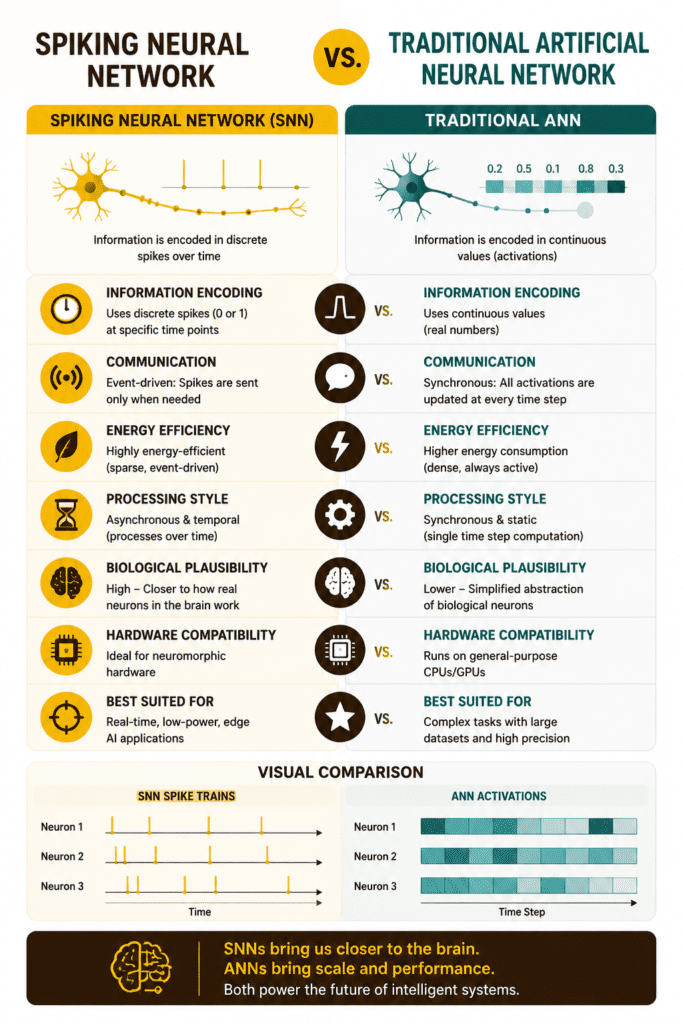
SNNs are the third generation of neural networks, moving beyond the static values of Deep Learning to model the temporal, event-driven communication of biological neurons. They communicate via discrete, timed electrical pulses (spikes) [Link to SNN theory]. This approach processes information sparsely and asynchronously.
2. SNNs vs. Traditional Deep Learning (ANNs)
The transition from a standard Artificial Neural Network (ANN) to an SNN is a fundamental shift in how information is processed, offering three strategic advantages crucial for mobile autonomy:
3. Real-Time Adaptive Learning: STDP
SNNs utilize Spike-Timing Dependent Plasticity (STDP), the core bio-inspired learning rule. STDP dictates that the connection (synapse) between two neurons is strengthened or weakened based on the precise timing of their spikes. If the pre-synaptic neuron consistently fires just before the post-synaptic neuron, the connection is reinforced. This makes SNNs inherently suited for learning from the timing of real-world events, such as those generated by a dynamic vision sensor.
4. Applications at the Edge
Low-Latency Perception: By pairing Event Cameras (Pillar 2) with Neuromorphic chips, the robot only processes data when an event occurs, resulting in milliseconds of latency and nanowatts of power consumption. This is a game-changer for high-speed tasks like autonomous driving and drone collision avoidance.
Robot Control (CPGs): Complex rhythmic motions—like the trot gait of a quadruped—can be controlled by simple, cyclical neural circuits known as Central Pattern Generators (CPGs). Neuromorphic chips are ideally suited to implement these small, rhythmic, and self-stabilizing circuits, drastically simplifying the control stack for legged robots.
Morphological Computing & The Materials Revolution
The most profound realization in Biorobotics is that intelligence does not reside solely in the brain; it is distributed throughout the body. The octopus tentacle, the gecko foot, or the compliant leg of a runner performs complex calculations simply through its physical structure. This is the field of Morphological Computing, which fundamentally reduces the computational burden on the robot’s electronic brain.
A. Compliant Mechanisms: Outsourcing Computation to the Body
Biological systems are fundamentally compliant (flexible and forgiving), allowing them to passively manage environmental interaction without high-speed computation.
1. The Principle of Passive Stability
Definition: Compliant mechanisms are monolithic structures (often 3D-printed or molded) that gain motion from the elastic deformation of their flexible segments, rather than from traditional pinned joints and linkages.
Advantages over Rigid Bodies:
Friction Elimination: No sliding joints means no friction, no wear, and no need for lubrication, leading to higher precision.
Impact Resistance: Compliance allows the structure to passively store and release energy, making the robot inherently robust and able to absorb major impacts (e.g., a legged robot stumbling).
Part Reduction: A single compliant structure can replace dozens of rigid links, springs, and pins, simplifying assembly and lowering manufacturing costs (crucial for commercial scaling).
R&D Challenge (The Design Headache): While compliant mechanisms are robust, they are non-linear. Analyzing and designing systems where movement depends on material deflection (which changes the geometry under load) is mathematically complex. Engineers often rely on advanced Finite Element Analysis (FEA) and optimization techniques (like topology optimization) to design these monolithic structures. [Link to academic paper on compliant mechanism FEA]
2. Variable Stiffness and Tendon-Driven Compliance
Inspiration: The musculoskeletal system, where tendons and muscles can instantly change stiffness. The leg is floppy when swinging but rigid when contacting the ground.
Mechanism (Variable Stiffness Actuators – VSAs): Robotic actuators are designed to actively change their compliance. VSAs often use opposing springs or clutches to modulate the effective stiffness of a joint in real-time. This provides the robot with the ability to:
Safely Interact: Become instantly soft during accidental human contact.
Optimize Task: Be rigid for high-precision manipulation and soft for running/impact absorption.
B. Advanced Fabrication and Soft Actuators
To build compliant and bio-inspired robots, traditional metallic components must be replaced with advanced, highly responsive materials.
1. Soft Robotics Materials (Elastomers and Polymers)
The core technology of Soft Robotics is the use of elastomers (like silicone rubber) and smart polymers. This shifts the focus of actuation from motors to material deformation.
Pneumatic/Hydraulic Actuators: Most soft robots use Pneumatic Networks (PneuNets)—internal channels pressurized with air or fluid. The specific geometry of these channels dictates how the robot curls, bends, or elongates, achieving complex movements with minimal electronic control.
Hydrogels and Ionic Polymer-Metal Composites (IPMCs): These “smart” materials can respond to external stimuli like electricity (IPMCs), temperature, or pH by swelling or bending. They are being explored for extremely tiny, low-power actuators for micro-robotics or artificial muscle fibers.
2. Bio-Inspired Manufacturing (4D Printing and Self-Assembly)
The fastest way to achieve the complexity of biology is through advanced, integrated manufacturing.
4D Printing: This is the process of 3D-printing a structure that changes its shape (the 4th dimension being time) upon exposure to an external stimulus (heat, light, water). This allows engineers to program complex morphological changes directly into the material structure, enabling things like:
Self-Folding Drones: A flat structure folds itself into a functional drone upon exposure to heat.
Adaptive Skins: A robot’s skin autonomously changes texture or compliance in response to temperature changes.
Self-Healing Materials: Inspired by biological healing, researchers are creating polymer composites that can automatically fill and repair internal cracks and damage. This is essential for long-duration space missions or deep-sea robotics where manual repair is impossible.
The Unifying Principle: The Role of Embodiment in Biorobotics
The discussion of compliant mechanisms and morphological computing leads directly to the core tenet of advanced bio-inspired design: embodiment. This is the single most important conceptual distinction between traditional industrial robotics and the next generation of autonomous systems.
Embodiment: The Body as Part of the Brain
Embodiment asserts that a robot’s intelligence, control, and functional capabilities are not contained solely within its computational hardware (the CPU or SNN), but are distributed across its physical body, materials, and interaction with the environment.
In a conventionally engineered rigid robot, the sensors must constantly feed data to the central processor, which calculates the next move, and sends control signals to the actuators. The body is merely a mechanical vessel. This leads to the CPU Bottleneck and high latency.
In a bio-inspired, embodied robot, the body solves problems autonomously:
Locomotion & Passive Stability: A compliant leg (Pillar 1/4) automatically recovers from a slip using stored spring energy and material properties, rather than requiring the CPU to calculate the reaction. The body performs the stability calculation passively.
Sensing & Filtering: Event Cameras (Pillar 2) and SNNs (Pillar 3) are powerful because they embrace embodiment. They ignore 99% of the static data, allowing the sensor’s own architecture to act as a low-pass filter, reducing the cognitive load on the system.
Manipulation & Dexterity: A soft gripper (Pillar 4) can conform to the shape of an object and grasp it securely simply by applying pneumatic pressure, regardless of the object’s geometry. The complexity is absorbed by the material, not the algorithm.
R&D Implications: Simplifying the Control Stack
The strategic goal of engineering embodiment is control simplification. By designing the body (the morphology) to manage physics challenges automatically, engineers can use simpler, lower-power computational controllers.
This shift moves the R&D focus from infinitely complex software algorithms and high-power central processing to elegant hardware and materials solutions.
The embodiment approach is the ultimate energy optimization strategy, making long-duration, battery-powered autonomy viable across all terrestrial, aerial, and marine environments.
Embodiment is the convergence point where all the advanced mechanisms—from the dynamics of a running gait to the sparse data of a neuromorphic chip—come together to create systems that are robust, efficient, and truly autonomous.
Key Takeaways
The era of designing brute-force, power-hungry robots is over. Bio-Inspired Robotics is not a niche subfield; it is the ultimate optimization strategy, tackling the fundamental constraints of power, perception, and dynamic performance simultaneously.
Every technology discussed here—from compliant legs and whisker sensors to event-driven processors—is rooted in the same realization: evolution has already solved our toughest engineering problems. The commercial and academic leaders of the next decade will be those who can strategically decode this biological blueprint.
Excitement over the technology is only the first step. The critical transition is moving from academic inspiration to a stable, deployable, and profitable R&D product. This process requires discipline, strategic planning, and specialized expertise.
Translating biological principles into useful robotic capabilities ultimately requires more than an interesting research concept; it requires a disciplined robotics R&D strategy connecting research novelty to engineering feasibility and deployment.
Ready to translate the massive potential of Biorobotics into a successful commercial or research project? The next step is translating the concept into a rigorous, de-risked R&D roadmap.
Learn how to master the R&D process from concept to commercial deployment, securing your competitive advantage.
Ready for a Strategic Discussion?
Your robotics project or academic career deserves a strategic roadmap built on international, Ph.D.-level expertise. Let’s map out your path to accelerated results.