You have a groundbreaking mobile autonomy concept, a highly talented engineering team, and a roadmap that promises massive commercial returns. But when you face the board, potential investors, or critical internal stakeholders, the biggest threat isn’t market competition—it’s the technical unknown.
Technical unknowns kill funding rounds, stall commercialization timelines, and expose companies to catastrophic failure points down the line.
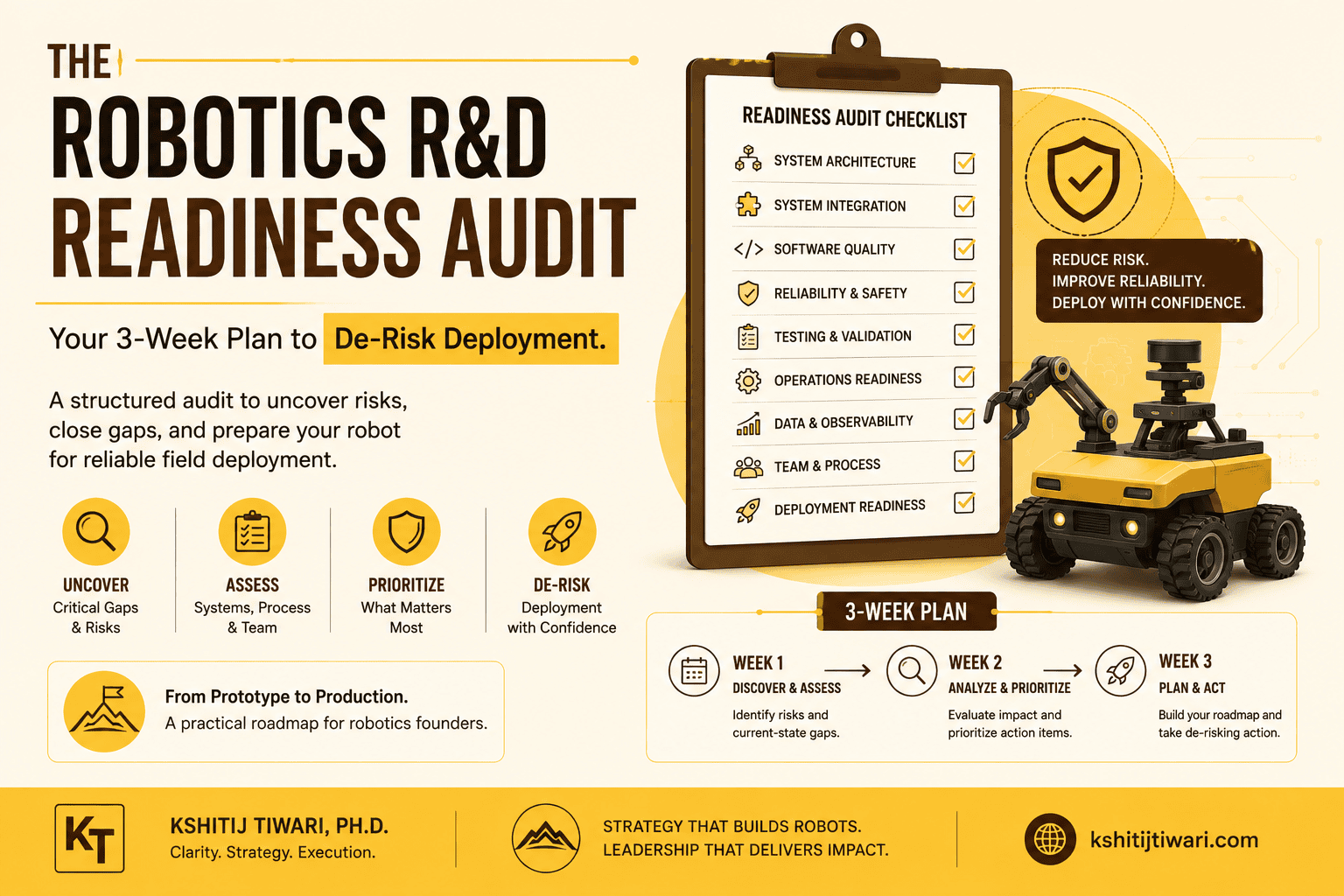
Our Robotics R&D Readiness Audit is a strategic, 3-week engagement designed to eliminate those unknowns. It produces an objective, third-party assessment—the Technical Readiness Report—that provides the necessary proof to secure financing, align your engineering strategy, and proceed to deployment with confidence.
This isn’t just a technical review; it’s a strategic de-risking maneuver. Before conducting a readiness assessment, it helps to understand how architecture, technical debt, system integration, hiring and deployment fit together within a broader robotics R&D strategy.
Table of Contents
ToggleWhy You Need a Ph.D.-Led Technical Readiness Audit
Your engineering team is focused on execution. That focus is essential, but it often means critical long-term risks are overlooked. An external, Ph.D.-led audit provides an adversarial perspective, meticulously scrutinizing the hidden liabilities that threaten the success of your entire program.
We uncover three unique, high-cost risks that often escape internal review:
1. Technical Debt for Scalability
Your prototype works brilliantly in the lab. But will your architecture handle a 100-unit fleet operating globally? We dive deep into the core software and hardware choices—ROS architecture, sensor fusion pipelines, state estimation methods—to identify foundational debt. A simple choice made today about message passing protocols or dependency management can lead to astronomical technical debt when scaling, which we flag early.
2. IP Defensibility and Freedom-to-Operate (FTO)
In mobile autonomy, your competitive edge is your intellectual property. Our audit assesses the defensibility of your unique algorithms and implementations. Furthermore, we examine the Freedom-to-Operate (FTO) risks by looking at common industry standards and patent landscapes, ensuring your core systems are protected and won’t invite future litigation.
3. Operational Failure Points (The Edge Cases)
Every autonomous system has critical points of failure at the operational edge. For instance, Operational Range Estimation, a topic requiring deep technical specialization, is often handled by a simple battery percentage—a major strategic flaw. We identify these vulnerabilities (like poor sensor calibration routines, edge case handling in degraded environments, or inadequate cybersecurity protocols) that lead directly to costly operational downtime and reputational damage.
The audit provides objective documentation of these risks, giving you the power to address them proactively rather than reactively.
A readiness audit identifies whether your robotics project is prepared for deployment, but it doesn’t always explain why hidden engineering bottlenecks exist. In many cases, the underlying issue is a fragile software or systems foundation. Our in-depth Robotics Architecture Audit explores the 15 warning signs that indicate your robotics architecture may not scale as your product, engineering team, or customer base grows.
What the 3-Week Readiness Audit Process Looks Like
We designed this process to be fast, non-disruptive, and highly targeted. We respect your team’s time and provide clear boundaries for engagement.
Phase 1: Diagnostic Interviews & Data Intake (Week 1)
The process begins with virtual, structured interviews with your key R&D stakeholders, Engineering Leads, and Product Managers. We concurrently request access to high-level documents:
Current R&D Roadmap and Budget Allocation
System Architecture Diagrams (High-Level)
Top 3 Technical Challenges Identified by the Team
Phase 2: Technical Deep Dive & Analysis (Weeks 2-3)
This is the intensive technical review period. We analyze your code repositories (focusing on core autonomy algorithms), sensor data logs, and deployment methodologies. We specifically model the impact of scaling and edge cases on your current system. This phase culminates in the construction of the final report’s data-driven conclusions.
Phase 3: Technical Readiness Report Delivery & Debrief (End of Week 3)
We deliver the Technical Readiness Audit Report: a concise, highly strategic document detailing findings, quantifying risks, and providing actionable recommendations. We then schedule a final debriefing session with your leadership team to walk through the conclusions, answer questions, and finalize the roadmap.
The Report is Not the End (The Conversion Bridge)
The Technical Readiness Report is your definitive gap analysis. It is a diagnosis that provides the objective proof needed to execute a successful R&D strategy.
The report identifies the precise roadmap to success—whether that involves a talent realignment, a fundamental architecture shift, or prioritizing a specific autonomy feature. Your next strategic step is implementing the report’s findings and providing the consistent, expert technical leadership necessary to close those identified gaps.
This is precisely where the Fractional CTO-as-a-Service model becomes the most powerful and cost-effective solution for implementation and oversight.
Passing a readiness audit doesn’t automatically mean your robotics platform is built to scale. Many startups discover that deployment challenges are symptoms of deeper architectural issues such as tightly coupled software, growing technical debt, fragile sensor integrations, or undocumented engineering workflows. If you’re planning to expand your robot fleet, onboard additional developers, or prepare for commercialization, our Robotics Architecture Audit: 15 Warning Signs Your System Won’t Scale will help you identify these hidden risks before they become expensive engineering problems.
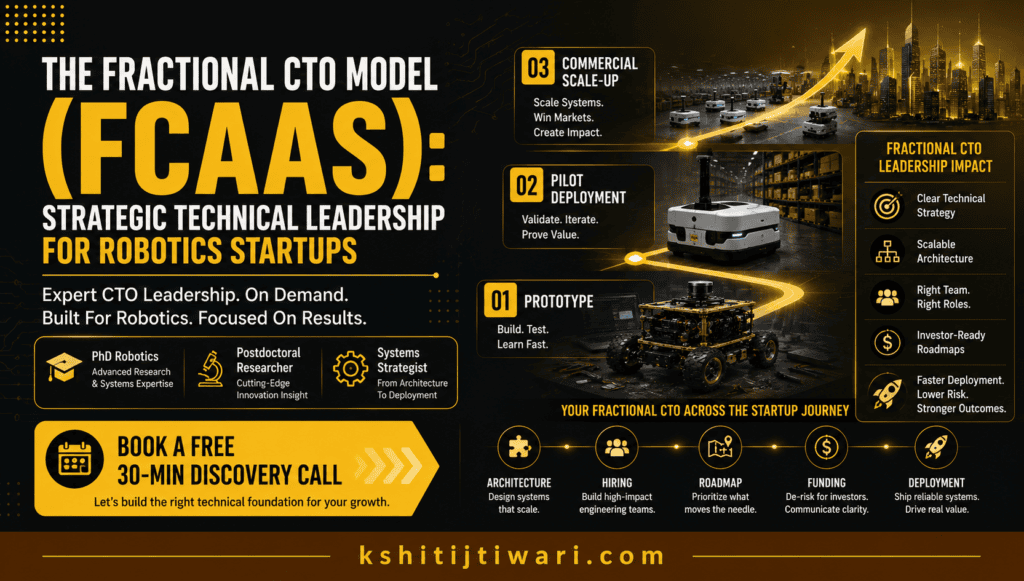
If this assessment reveals multiple interconnected risks rather than a single engineering bottleneck, the next step may be strategic technical leadership. Learn how a Fractional CTO can help robotics startups move from technical uncertainty to a structured R&D roadmap.
Ready for a Strategic Discussion?
Your robotics project or academic career deserves a strategic roadmap built on international, Ph.D.-level expertise. Let’s map out your path to accelerated results.