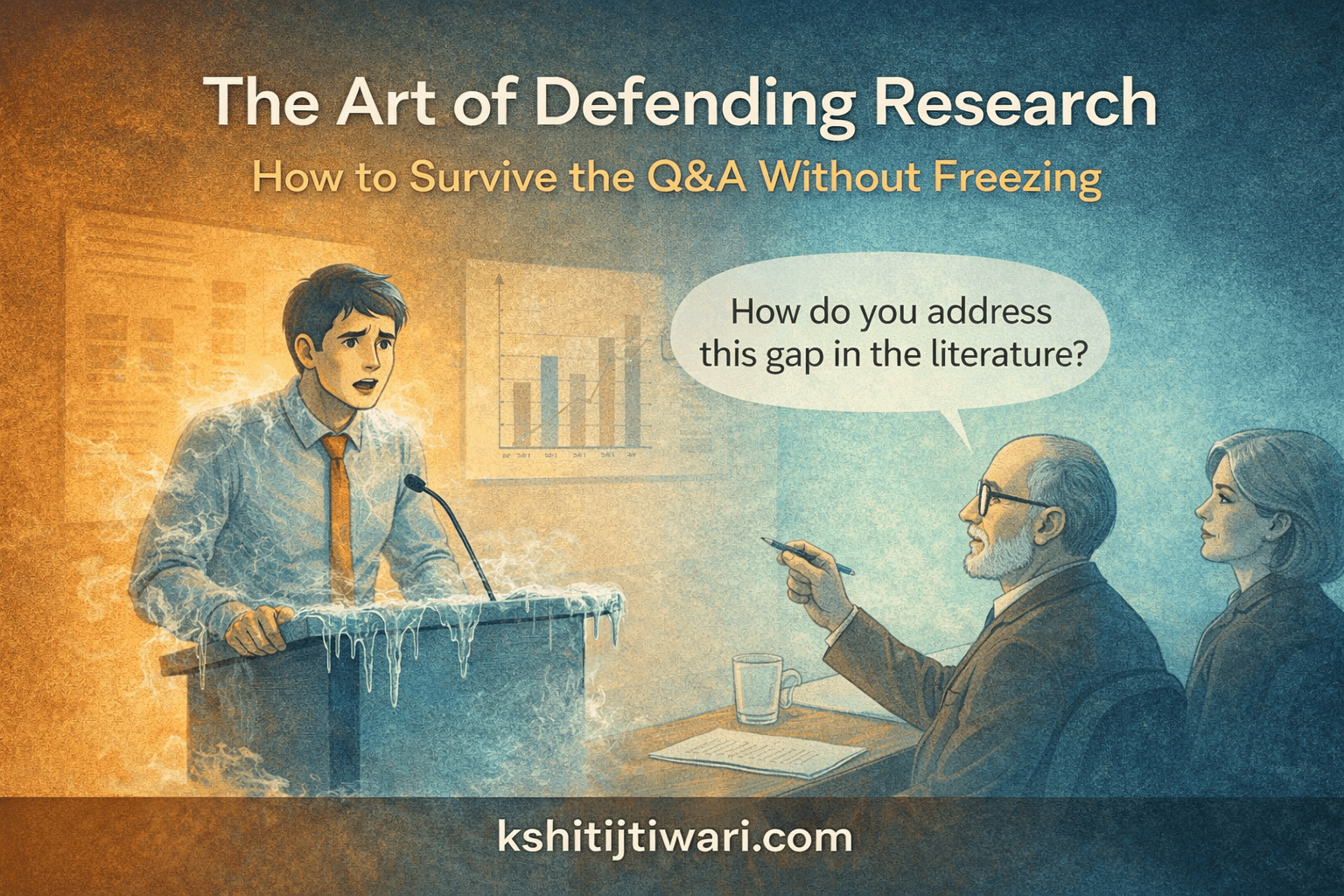
You’ve just finished the last slide of your presentation. You’ve successfully navigated the technical details, the animations worked, and you’re finally starting to breathe again. Then, the session chair says those four terrifying words:
“Any questions from the audience?”
Suddenly, the room feels smaller. You see a hand go up in the back. You worry: “What if they find a hole in my logic? What if they realize I’m just an early-stage student? What if I can’t justify my results?”
For many early-stage scholars, defending research contributions feels less like a conversation and more like an interrogation. But here is the truth: your success as a researcher isn’t just about the work you do in the lab—it’s about how you defend that work under pressure.
 Related Resource: This article is part of the Unwritten PhD Resource Library—a comprehensive collection of guides, decision frameworks, and practical resources covering every stage of the PhD journey, from choosing a research topic and applying for a PhD to publishing papers, managing burnout, and planning your career after graduation.
Table of Contents
ToggleWhy Early-Stage Scholars Struggle with Q&A
In our guide to The PhD Competence Accelerator, we discuss how PhD competence is built through “process mastery.” The Q&A is simply a process. Most students struggle because they view questions as “attacks” rather than “validations.”
1. The Imposter Syndrome Trap
Early-stage students often feel they haven’t “earned” the right to be on stage yet. When a professor asks a difficult question, the student hears: “You don’t belong here.” Mastery of academic presentation confidence starts with realizing that the question is about the data, not your identity.
2. The “Knowledge Gap” Anxiety
There is a massive fear that someone will ask about a paper you haven’t read or a method you didn’t use. As we discuss in The PhD Scholar’s Compass, mastering the ambiguity of research means accepting that you cannot know everything—but you can have a system for handling what you don’t know.
The 10 Dimensions of Research Inquiry: Why Patterns Beat Memorization
To build academic presentation confidence, you must stop trying to memorize every possible answer. There is an easier way. Through 20+ years of R&D experience, I have mapped every potential “attack” or query into a Taxonomy of 10 Question Categories.
Once you recognize the intent of the questioner, you no longer have to think; you just activate the corresponding script. Here is the framework of patterns we cover in the full toolkit:
1. The Methodology Defense (Justifying Your Choices)
The Strategic Goal: Explaining why you chose specific parameters or algorithms without sounding like you are making excuses. You move from “defensiveness” to “justification.”
2. The Novelty Police (Defending Uniqueness)
The Strategic Goal: Someone claims your work isn’t “new.” You must pivot from the similarities they see to the unique delta of your specific Minimal Publishable Unit (MPU).
3. The Data Doubters (Validating Rigor)
The Strategic Goal: Handling skepticism about your results or sample size by reinforcing the integrity of your process.
4. Scope & Limitations (Defining Boundaries)
The Strategic Goal: Gracefully declining a question that falls outside your study without sounding like you’ve missed something important.
5. The “I Don’t Know” (Handling the Unknown Confidently)
The Strategic Goal: Using a “Professional Pivot” to maintain your authority while admitting a knowledge gap—the exact sentence to use so you don’t lose credibility.
6. The Hostile Reviewer (Managing Aggressive Questions)
The Strategic Goal: De-escalating tension when a questioner is rude or simply trying to “lecture” you from the floor.
The Full Spectrum of Mastery
In the complete Q&A Survival Kit, we go even deeper, providing scripts for:
The Clarification: Simplifying complex concepts for a non-expert audience.
Future & Impact: Answering the dreaded “So What?” about your long-term vision.
Hypotheticals: Handling “What if?” scenarios that try to pull you into speculation.
The Soft Skills: Answering reflective questions about your personal lessons learned during the research.
By learning to recognize the pattern instead of memorizing a script, you remove the uncertainty that causes presentation anxiety. You aren’t just giving a talk; you are leading a high-level technical discussion.
Mastering Your PhD Communication Skills Under Fire
Every Q&A is an opportunity to practice your PhD communication skills. If you can navigate a hostile or confusing question with grace, you build more authority than if you had simply given a perfect presentation.
This is why defending research contributions is a core skill we emphasize in our [PhD Mentorship Framework]. It teaches you to:
Listen for the “intent” behind the question.
Pause before answering (the “2-second rule”).
Answer with an Editorial Mindset—focused on the contribution, not the ego.
Introducing: The Q&A Survival Kit
If you are an early-stage scholar who is tired of losing sleep before every lab meeting or conference, I have designed a “Training Simulator” for you.
The Q&A Survival Kit is a collection of 50+ Scripts to defend your research without freezing.
This toolkit removes the uncertainty. I have categorized the 58 most common, difficult, and aggressive questions you will face at this stage—from the “Novelty Police” to the “Blackout” moments where you simply don’t know the answer.
It provides “Fill-in-the-Blank” formulas so you can:
Handle Hostile Comments with professional grace.
Justify Methodology Choices without sounding defensive.
Bridge to What You Know when you’re hit with a curveball.
Key Takeaways
Don’t wait until your final thesis defense to learn how to handle questions. The scholars who succeed are those who build academic presentation confidence in their first year.
For less than the price of a coffee (₹199), you can walk into your next presentation knowing that no matter what they ask, you have the script ready.
Ready for your copy?
Download the Q&A Survival Kit and never freeze on stage again be it to defend your findings at a Conference or defend your thesis at your Defence.