The Robot Operating System (ROS) is, without a doubt, a titan in the world of robotics. For over a decade, it has served as the de facto standard for academic research, rapid prototyping, and countless open-source robotics projects. Its vast libraries, extensive tooling, and vibrant community have democratized robotics development, allowing students and researchers to build complex systems without reinventing every wheel.
Yet, despite its widespread adoption and undeniable influence, a significant rift has emerged. Walk into a university lab, and ROS is almost ubiquitous. Step into many commercial robotics companies, however, and you’ll find a more nuanced, sometimes skeptical, perspective. Some companies embrace it wholeheartedly, others use it for specific tasks, and a growing number choose to build entirely custom solutions or leverage lightweight alternatives.
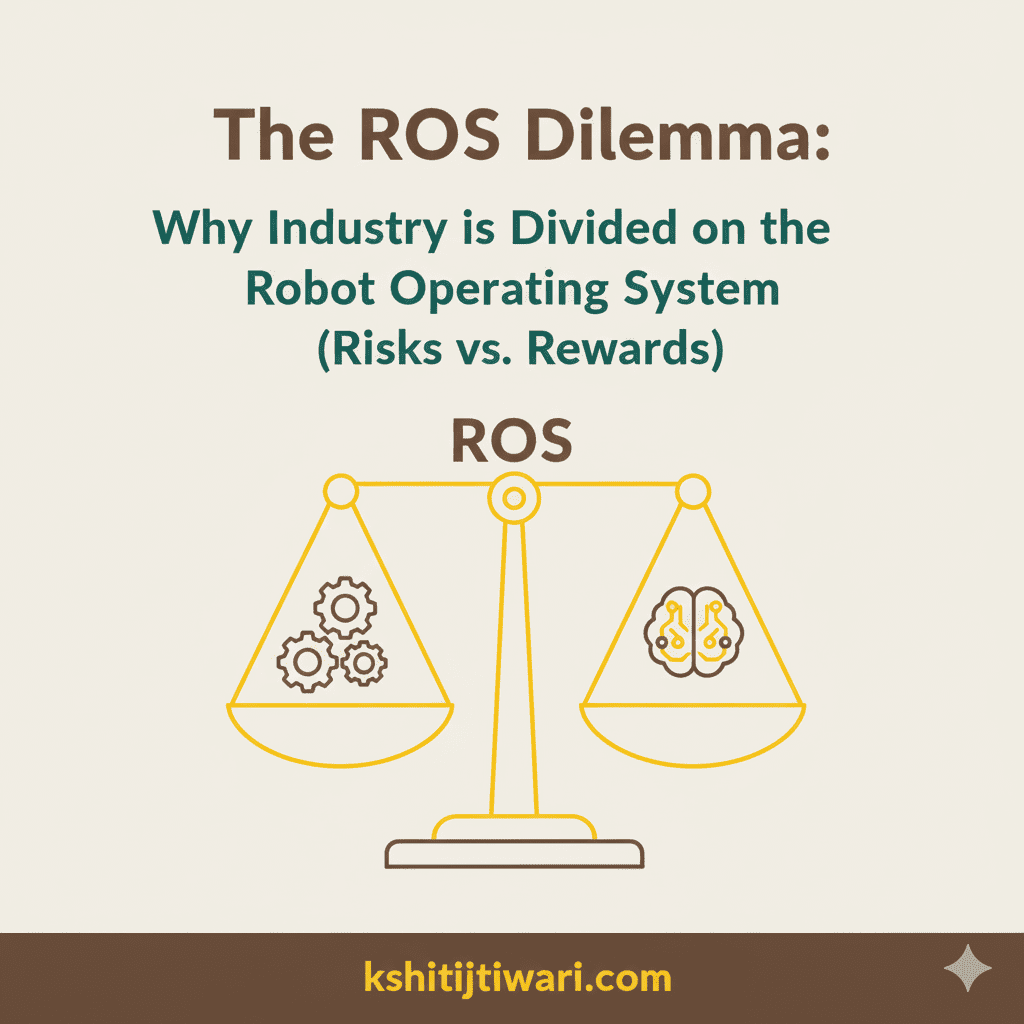
Why this division? Why isn’t an “operating system” designed to accelerate robotics universally adopted by an industry clamoring for speed and innovation? This isn’t an anti-ROS polemic, nor is it blind praise. This is a deep dive into The ROS Dilemma: exploring the real risks, the undeniable rewards, and the strategic considerations that dictate where and when ROS truly belongs in the high-stakes world of commercial mobile autonomy.
Table of Contents
ToggleROS: The Academic Imperative and Its Core Strengths
To understand the industry’s hesitations, we must first appreciate where ROS truly shines. Its origins are deeply rooted in academia, fostered by institutions like Stanford and Willow Garage. This foundation shaped its strengths, making it an indispensable tool for research and rapid development.
Rapid Prototyping & Development
Imagine trying to build a mobile robot from scratch: you’d need drivers for sensors (cameras, LiDAR, IMUs), algorithms for navigation (mapping, path planning, localization), tools for visualization, and a robust communication layer. ROS provides all of this off-the-shelf. Its modular architecture allows developers to quickly integrate components, test ideas, and iterate without spending months on foundational infrastructure. This speed is invaluable in a research setting where novel ideas are paramount.
Vast Ecosystem & Community Support
One of ROS’s greatest assets is its sprawling ecosystem. The ROS Wiki serves as a comprehensive knowledge base, while platforms like ROS Discourse foster a global community of developers. This means that for almost any common robotics task—from SLAM (Simultaneous Localization and Mapping) to manipulator control (MoveIt!)—there’s likely an existing ROS package, reducing development time and effort. This collaborative, open-source spirit accelerates innovation significantly.
Standardization & Interoperability
ROS provides a standardized way for different components of a robotic system (nodes) to communicate using messages and services. This uniform interface simplifies the integration of hardware and software from various vendors. A sensor driver written for ROS can be easily swapped out, and algorithms developed by one team can be integrated by another, fostering a degree of interoperability that is rare in complex systems development. This is particularly beneficial in multi-robot research environments or when building upon existing open-source projects.
Rich Tooling for Visualization and Debugging
Tools like RViz (for 3D visualization of sensor data and robot state) and rosbag (for recording and replaying sensor data) are incredibly powerful for debugging and analysis. They allow developers to “see” what their robot is perceiving and planning, significantly speeding up the development cycle. These tools, often taken for granted by experienced ROS users, are a major draw for newcomers.
In essence, ROS provides a fantastic platform for experimentation, learning, and academic collaboration. It’s a sandbox where you can build almost anything without having to mine for the sand, refine the cement, or cut the lumber yourself. But what happens when you need to build a skyscraper, not just a sandbox castle?
The Industry's Red Flags: Why Companies Walk Away
While ROS excels in academic and prototyping environments, the leap to commercial deployment introduces a new set of challenges that often expose its limitations. Companies evaluating ROS for production often encounter what I call the “Hidden Costs of Convenience.”
Performance & Real-Time Constraints
Many commercial mobile robots, especially those operating in safety-critical or high-throughput environments (e.g., autonomous vehicles, factory AGVs), require deterministic, real-time performance. ROS, particularly earlier versions (ROS 1), was not designed with hard real-time guarantees. Its communication layer (publish/subscribe model) can introduce unpredictable latency and jitter, making it unsuitable for applications where precise timing is paramount. ROS 2, with its use of DDS (Data Distribution Service), aims to address some of these issues, but it still often requires careful tuning and potentially custom real-time operating systems (RTOS) to achieve true deterministic behavior.
Resource Footprint & Efficiency
ROS can be resource-intensive. Running a full ROS stack on embedded systems with limited compute power and memory can be challenging. Its message passing, serialization, and deserialization overhead can consume significant CPU cycles and memory, which are critical constraints for power-efficient mobile robots that rely on onboard processing and long battery life. Companies often find themselves needing to strip down ROS components or offload processing to more powerful (and power-hungry) hardware, which can be counterproductive to the mobile autonomy goal.
Complexity & Steep Learning Curve for Production
While ROS lowers the barrier to entry for beginners, mastering it for production-grade deployments is a different beast and is a critical factor worth considering when evaluating the technical R&D readiness. Debugging complex, distributed ROS systems, managing dependencies across numerous packages, and ensuring robust error handling can become a significant challenge. Maintaining a large ROS-based codebase, especially with frequent updates to upstream packages, can lead to substantial engineering overhead and potential instability. This is where a Fractional CTO Model can be invaluable, providing expert guidance without the full-time commitment.
Lack of Commercial Support & Licensing Ambiguity
ROS is open-source, which is a double-edged sword. While it fosters innovation, it means there’s no single vendor offering commercial support, warranties, or liability. For companies building products, this can be a major hurdle for compliance, risk management, and investor confidence. Furthermore, the licensing of individual ROS packages (often a mix of Apache 2.0, BSD, MIT, etc.) can be complex to navigate, especially for products with proprietary elements. The legal overhead can be non-trivial.
Security Concerns
Security was not a primary design consideration for ROS 1. While ROS 2 has introduced security features like authentication, encryption, and access control based on DDS-Security, implementing and managing these can add complexity. For robots operating in sensitive environments or handling critical data, ensuring the entire ROS stack is secure can be a major challenge, often requiring extensive custom hardening.
Vendor Lock-in (Paradoxically)
While ROS is open-source, becoming deeply embedded in a particular ROS-centric ecosystem (e.g., relying heavily on specific packages that might not be actively maintained or well-documented) can paradoxically create a form of vendor lock-in. Migrating away from a complex ROS 1 system, for instance, has proven to be a monumental task for many companies, often necessitating a complete re-architecture. The lack of standardized APIs beyond the ROS framework itself can make it difficult to swap out core components without significant refactoring.
ROS in Commercial Deployment: Is It an Absolute Must?
So, given these trade-offs, is ROS an absolute prerequisite for commercial mobile autonomy? No, it is an optional tool, not a required operating system.
The industry’s landscape is far more diverse than often portrayed in academic circles. Here’s a more accurate picture:
Prototyping & Early-Stage R&D (Yes, Often)
For initial concept validation, rapid experimentation, and building proofs-of-concept, ROS remains an excellent choice. Its speed and vast library make it ideal for getting ideas off the ground quickly. Many startups begin with ROS during their initial R&D phases to accelerate progress.
Mid-Stage Product Development (Sometimes, with Caveats)
As a product matures, companies often adopt a hybrid approach. They might keep some ROS components for less critical functions (e.g., logging, low-level sensor drivers) but replace core, performance-critical modules with custom-optimized code. They might also leverage Micro-ROS or ROS 2 specifically for its improved real-time capabilities on embedded hardware. The strategic decision of when to build vs. buy (or adapt) becomes paramount here.
Full-Scale Commercial Deployment (Rarely, Purely)
For high-volume, safety-critical, or cost-sensitive products, purely relying on an unmodified, full ROS stack is rare. Companies often migrate to:
Custom-built frameworks: Tailored for specific hardware, performance needs, and real-time guarantees.
Commercial RTOS platforms: Operating systems like QNX, VxWorks, or embedded Linux distributions with real-time patches.
Lightweight communication middleware: Using optimized DDS implementations or custom RPCs.
A key point to understand is that the underlying concepts and algorithms (SLAM, path planning, control theory, sensor fusion) are universal. ROS is merely one framework for implementing them. You can (and often must) implement these concepts using other, more optimized tools for production.
The Strategic Evaluation: When to Build vs. Buy
The decision to use or forgo ROS is not a technical one; it’s a strategic R&D decision that directly impacts budget, timeline, talent acquisition, and long-term product viability. This is precisely where expert Robotics Consulting becomes invaluable.
Assessing Your Project’s Needs
Before committing to any architecture, ask critical questions:
Real-time requirements: Does your robot need guaranteed response times (e.g., collision avoidance)?
Hardware constraints: Are you deploying on low-power embedded systems?
Team expertise: Does your team have the skills to maintain a complex ROS system, or to build a custom solution?
Scalability: How many robots will you deploy? How will you manage updates and maintenance?
Safety & Certification: Does your application require functional safety certification (e.g., ISO 26262 for automotive)?
In essence, this is a thorough Technical R&D Readiness Audit, which will reveal actionable business insights and uncover the needs vs wants of your project.
Understanding the Ecosystem & Talent Landscape
While many engineers are familiar with ROS, finding those who can build production-grade, hardened systems on ROS (or completely custom systems) is a different challenge. Your hiring strategy must align with your architectural choice.
The Cost of Inaction or Misguided Decisions
Choosing the wrong architecture early in the R&D process can lead to:
Massive Technical Debt: Requiring costly re-architecture efforts later on.
Delayed Time-to-Market: Extending development cycles due to unforeseen integration or performance issues.
Increased Hardware Costs: Needing more powerful computing to compensate for inefficient software.
Safety Incidents: In real-world deployments, unpredictable latency can have catastrophic consequences.
Consider reading research on “Formal Methods in Robotics” to understand the depth of verification needed
This decision isn’t about avoiding ROS; it’s about making an informed, strategic choice that aligns with your specific product goals and business objectives.
Key Takeaways
The Robot Operating System is a powerful tool, but like any tool, it has its optimal use cases and its limitations. For academia and rapid prototyping, its rewards far outweigh the risks. For commercial deployment, especially in safety-critical or performance-intensive applications, the risks—performance, efficiency, complexity, and support—demand a much more careful and strategic evaluation.
The “ROS dilemma” is not about whether ROS is good or bad. It’s about recognizing that the decision to use it, adapt it, or build beyond it is a crucial strategic R&D choice. It’s a decision that can save or cost your company millions, dictate your time-to-market, and define the robustness of your product.
Don’t let architectural choices be dictated by habit or hype. Get a strategic, unbiased R&D consultation before writing the first line of production code. If you do end up utilizing ROS for your R&D project, you should consider opting for our specialized ROS 2 Training Accelerator that caters to Corporations/Startups and academic faculty looking to upskil.
Ready for a Strategic Discussion?
Your robotics project or academic career deserves a strategic roadmap built on international, Ph.D.-level expertise. Let’s map out your path to accelerated results.