You’ve spent weeks perfecting your methodology. You’ve run the simulations, cleaned the data, and finally have a result worth sharing. Then comes the hardest part of the day: Emailing your supervisor.
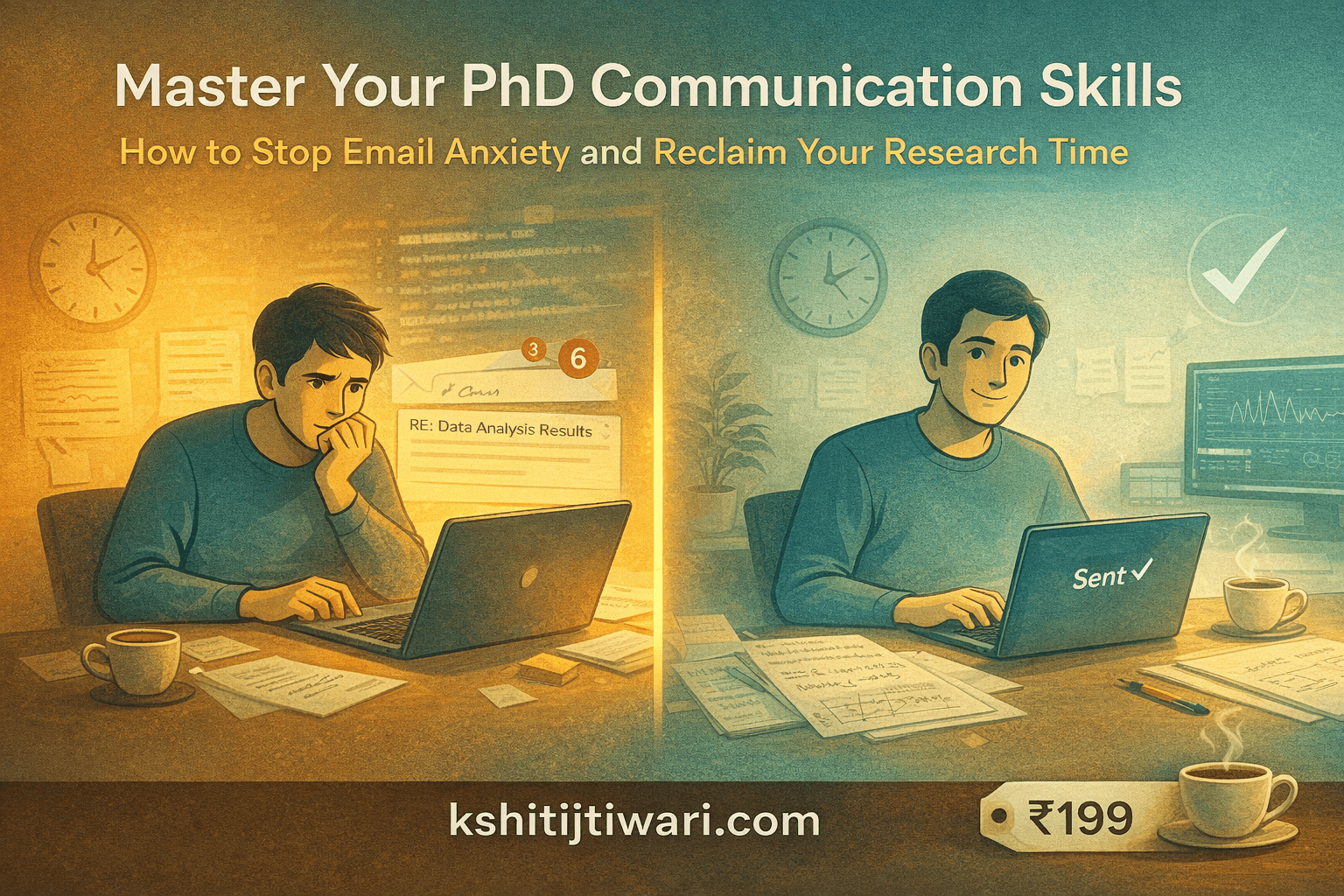
You stare at the blinking cursor. You type a sentence, delete it, and re-type it. You wonder: “Is this too aggressive? Do I sound like I’m making excuses? Will they think I’m incompetent if I ask for this extension?”
Suddenly, a 5-minute update has eaten 45 minutes of your morning. This isn’t just “procrastination”—this is a lack of structured PhD communication skills, and for most researchers, it is a massive, invisible drain on R&D productivity. In our guide to [The PhD Competence Accelerator], we discuss how PhD competence isn’t just about technical prowess; it’s about your ability to navigate the academic system with surgical precision.
Table of Contents
ToggleThe Psychology of Power: Why You Need Strategic PhD Communication Skills
Why is academic email etiquette so paralyzing? Unlike a corporate environment where “deliverables” are clearly defined, the PhD is a high-stakes, hierarchical relationship where your mentor is simultaneously your boss, your judge, and your gatekeeper to a future career.
1. The Competence Paradox
Many students feel that asking for help or an extension is an admission of failure. They over-explain, use passive language, and inadvertently signal a lack of confidence. Mastering PhD communication skills means learning to communicate as a junior colleague, not a student asking for permission.
2. The Time-Poverty of Supervisors
Your supervisor likely receives 100+ emails a day. If your email is a “wall of text” without a clear “Ask,” it gets pushed to the bottom of the pile. When you refine your communication for scanability, you aren’t just being polite—you are de-risking your project by ensuring your mentor can make decisions quickly.
3 Pillars of Effective PhD Communication Skills
To bridge the gap, you must move beyond “trial and error.” High-impact academic interaction rests on three strategic pillars:
Pillar 1: The “Lead with the Ask” Framework
In a high-stakes email (like responding to Reviewer #2), never bury your point. State the purpose in the first two sentences. Whether it’s an update or a request for a [prospective PhD supervisor] to collaborate, the recipient should know exactly what is required of them within 10 seconds.
Pillar 2: Neutralizing Tone via “Professional Detachment”
Emotional labor kills productivity. When responding to a rejection or a lab conflict, the goal is to remove “I feel” and replace it with “The data suggests” or “The current timeline dictates.” This is the core of the [Editorial Mindset].
Pillar 3: Managing Expectations Upward
Don’t wait for your supervisor to ask for an update. Proactive, structured updates (even if they contain bad news) build trust. It shows you are mastering the PhD Scholar’s Compass by managing the ambiguity of research rather than letting it manage you.
Scenarios Where PhD Communication Skills Save Your Research Momentum
Without a toolkit of proven scripts, these four scenarios often lead to “Email Paralysis”:
The Follow-up Gauntlet: You sent an email 4 days ago. No reply. A strategic “Nudge” script ensures you stay on their radar without sounding desperate.
The “No” to Extra Work: Being a “lab citizen” is great until it eats your thesis time. Saying “No” to your supervisor’s side project requires a delicate balance of boundary-setting and alignment with your core R&D goals.
The Reviewer #2 Rebuttal: Peer review is the ultimate test of PhD communication skills. If you take it personally, you lose. If you respond with a structured, respectful, yet firm rebuttal, you get published.
Industry Outreach: If you are weighing the [Real Cost vs. Value] of staying in academia, you need to talk to industry mentors. Cold-emailing a Senior Scientist requires a completely different “language” than academic prose.
Introducing: The PhD Communication Vault
As a roboticist and mentor with over 20 years in the academic trenches, I’ve realized that 90% of the “sticky situations” in a PhD follow the same patterns.
You shouldn’t have to reinvent the wheel. Consider this a gift as we prepare for a fresh start in 2026: [The PhD Communication Vault].
This is not a textbook; it’s a high-speed toolkit. It contains 20+ Battle-Tested, “Copy-Paste” Scripts that act as a shortcut for your PhD communication skills:
The “Boss” Scripts: Agendas that get meetings back on track.
The “Growth” Scripts: Templates for [Contacting Professors for PhD Positions] and industry partners.
The “High Stakes” Scripts: Navigating Rejections and Reviewers with poise.
The “Boundaries” Scripts: Handling lab politics and saying “No” while keeping the peace.
Key Takeaways
Your research requires your full cognitive load. Every minute spent “worrying” about the tone of an email is a minute stolen from your simulations, your writing, and your [PhD scholar’s burnout prevention].
Communication isn’t a “soft skill”—it is the engine of your R&D career. For less than the price of a coffee (₹199), you can own the communication systems that took me two decades to refine.
Ready to grab your copy?
Download The PhD Communication Vault and stop staring at the blinking cursor