In the fast-paced, highly specialized world of robotics, innovation is currency. Startups in this sector operate at the bleeding edge of technology, often with lean teams and intense pressure to develop groundbreaking solutions. While visionary founders and brilliant engineers drive the core product, a critical piece of the puzzle often goes missing or is delayed: strategic technical leadership. This is where the Fractional CTO model, often called “CTO as a Service” (FCAAS), emerges as a game-changer for robotics startups.
Imagine gaining access to world-class technical executive experience without the hefty salary, giving up equity and long-term commitment of a full-time hire. That’s the promise of a Fractional CTO – a seasoned technology leader who dedicates a portion of their time to guide your startup’s technical vision, strategy, and execution. For robotics- be it logistics, civil or defense, where technical decisions carry immense weight and complexity, this model is not just a luxury but a strategic imperative.
Table of Contents
ToggleWhy Robotics Startups Face Unique Technical Leadership Challenges
Robotics development is inherently complex, requiring deep expertise across multiple domains: hardware engineering, software development, AI/ML, sensor integration, system architecture, and often, specialized industry knowledge (e.g., medical, logistics, industrial automation). This complexity creates several hurdles for startups:
High Cost of Full-Time CTO: A truly experienced CTO in robotics commands a substantial salary, benefits package, and often equity. For an early-stage startup, this can be an astronomical expense, potentially exhausting vital funding.
Scarcity of Specialized Talent: Finding a CTO with a proven track record specifically in robotics, who also possesses strong leadership, strategic thinking, and business acumen, is incredibly difficult. The talent pool is shallow.
Founders Wearing Too Many Hats: Technical founders, while brilliant, may find themselves overwhelmed by the operational demands of scaling a company, diverting their focus from strategic technical planning.
Rapid Technological Shifts: The robotics landscape evolves constantly. Staying ahead requires continuous research, strategic pivots, and a leader who can discern fleeting trends from foundational advancements.
Scaling Technical Teams: Growing an engineering team effectively requires experienced leadership to define architecture, set best practices, and mentor junior engineers – tasks that founders often lack the time or specific expertise for.
Navigating IP and Compliance: Robotics involve complex intellectual property considerations and often stringent regulatory compliance (e.g., safety standards, data privacy), requiring expert oversight.
These challenges highlight a critical need for strategic technical guidance that a full-time hire might not be feasible for, and where a Fractional CTO can bridge the gap.
What is a Fractional CTO (FCAAS)?
A Fractional CTO is an experienced technology executive who works with multiple companies on a part-time, contract basis. Instead of being an exclusive, full-time employee, they provide their expertise for a set number of hours per week or month, focusing on high-impact strategic initiatives such as strategic Technology Readiness Audit.
The “CTO as a Service” (FCAAS) moniker emphasizes this external, on-demand, and flexible delivery model. It’s not just consulting; it’s embedding a senior technical leader into your team, even if only for a fraction of their time.
Key Responsibilities and Impact of a Fractional CTO for Robotics Startups
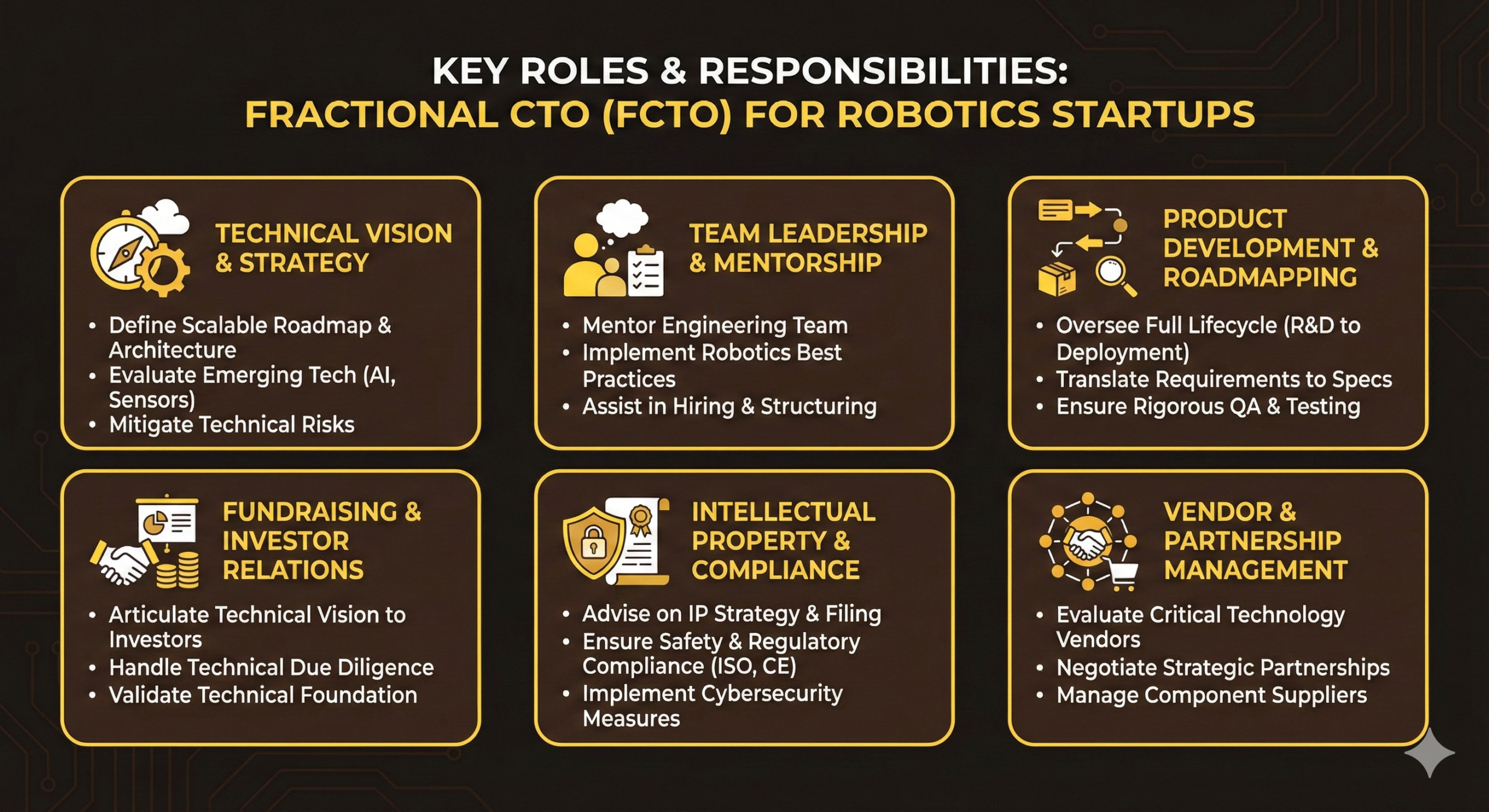
A Fractional CTO (FCAAS) brings a wealth of experience and a strategic perspective that can profoundly impact a robotics startup’s trajectory:
Technical Vision & Strategy:
Defining the overarching technical roadmap that aligns with business goals.
Evaluating emerging technologies (e.g., new sensor tech, advanced AI algorithms for perception, novel actuation methods) and advising on their applicability.
Ensuring the architecture of the robotics system (hardware, software, cloud integration) is scalable, robust, and future-proof. A core part of this is overseeing complex robotics system integration to prevent the common ‘prototype-to-product’ failures that stall most startups.
Identifying potential technical risks and developing mitigation strategies.
Team Leadership & Mentorship:
Providing leadership and mentorship to the engineering team, fostering a culture of technical excellence.
Implementing best practices for software development, hardware design, testing, and deployment specific to robotics.
Assisting in hiring key technical talent, structuring engineering teams, and conducting technical interviews.
Mediating technical disagreements and fostering collaboration.
Product Development & Roadmapping:
Translating product requirements into clear technical specifications.
Guiding the selection of development methodologies (Agile, Waterfall, etc.) tailored for robotics projects.
Overseeing the full product lifecycle, from R&D and prototyping to manufacturing and deployment.
Ensuring quality assurance and rigorous testing protocols for both hardware and software.
Fundraising & Investor Relations:
Articulating the technical vision and capabilities to potential investors.
Participating in investor pitches, demonstrating technical feasibility, and addressing technical due diligence questions.
Validating the technical foundation of the startup, instilling confidence in stakeholders.
Intellectual Property & Compliance:
Advising on intellectual property (IP) strategy, including patent filing and trade secret protection relevant to robotics.
Ensuring compliance with industry standards, safety regulations (e.g., ISO, CE marking), and data privacy laws.
Implementing robust cybersecurity measures for connected robotic systems.
Vendor & Partnership Management:
Evaluating and selecting critical technology vendors (e.g., component suppliers, cloud providers, specialized software).
Negotiating technical partnerships that enhance the startup’s capabilities.
Benefits of the Fractional CTO (FCAAS) Model for Robotics Startups
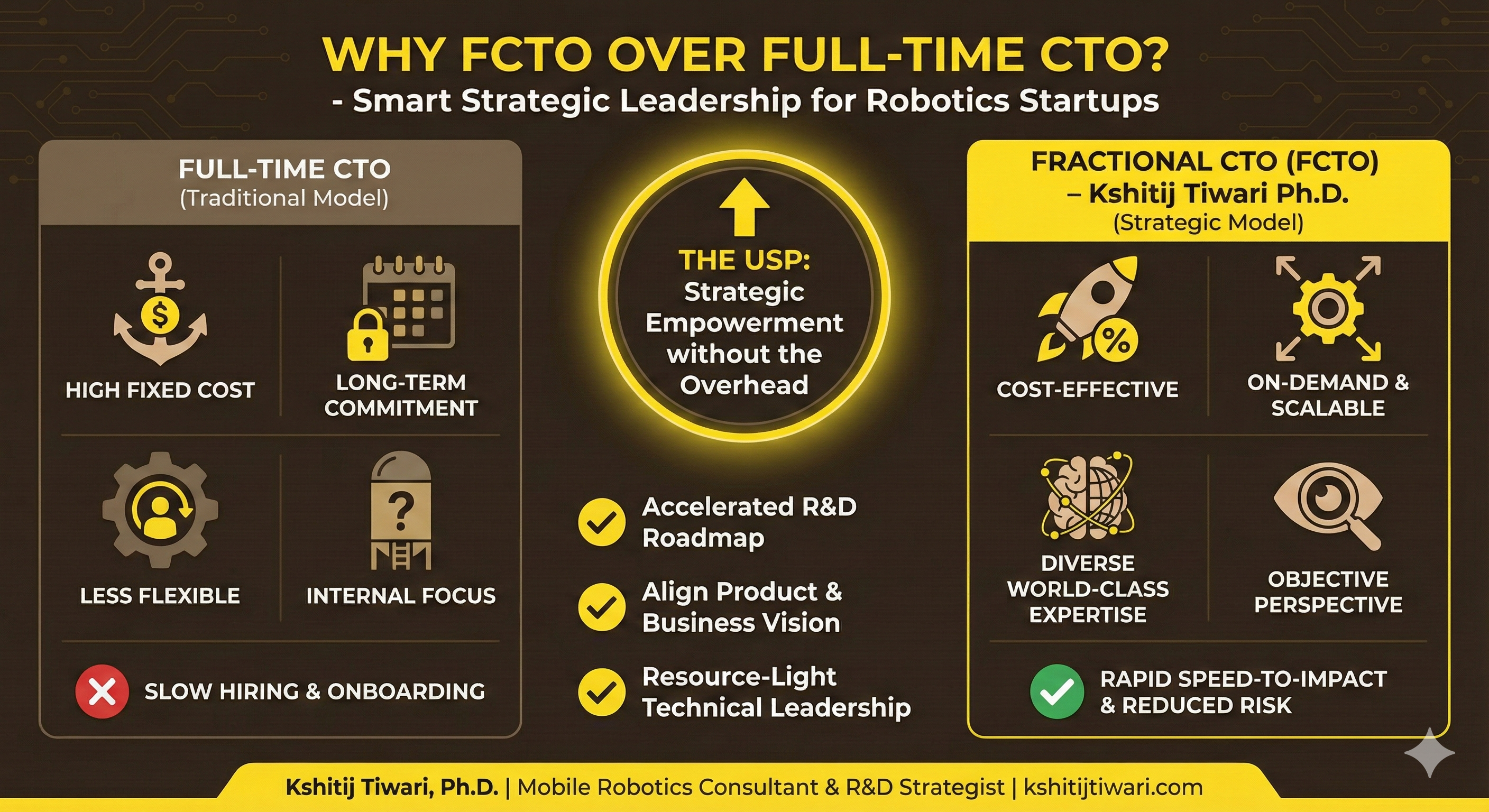
The advantages of adopting a Fractional CTO model are compelling, especially for companies operating in a capital-intensive and technically demanding field like robotics:
Cost-Effectiveness: Access high-level expertise at a fraction of the cost of a full-time CTO. This preserves precious capital for R&D and operational growth.
Flexibility & Scalability: Easily scale the level of engagement up or down based on your startup’s current needs and funding cycles. A Fractional CTO can be involved intensively during critical development phases and less so during maintenance periods.
Access to Diverse Experience: Benefit from a CTO who has likely navigated similar technical challenges across multiple organizations, bringing a broader perspective and proven solutions.
Reduced Hiring Risk: Avoid the lengthy and expensive process of recruiting a full-time CTO. If the fit isn’t right, adjusting the engagement is far simpler than an employee termination.
Objective Perspective: An external CTO can provide unbiased insights, challenge assumptions, and offer a fresh viewpoint on technical dilemmas, free from internal politics.
Accelerated Time-to-Market: With clear technical leadership, roadblocks are identified and resolved faster, streamlining development cycles and accelerating product launch.
Enhanced Credibility: Having an experienced Fractional CTO on your team can significantly boost investor confidence, demonstrating a mature approach to technical strategy.
How does a Fractional CTO (FCAAS) get paid?
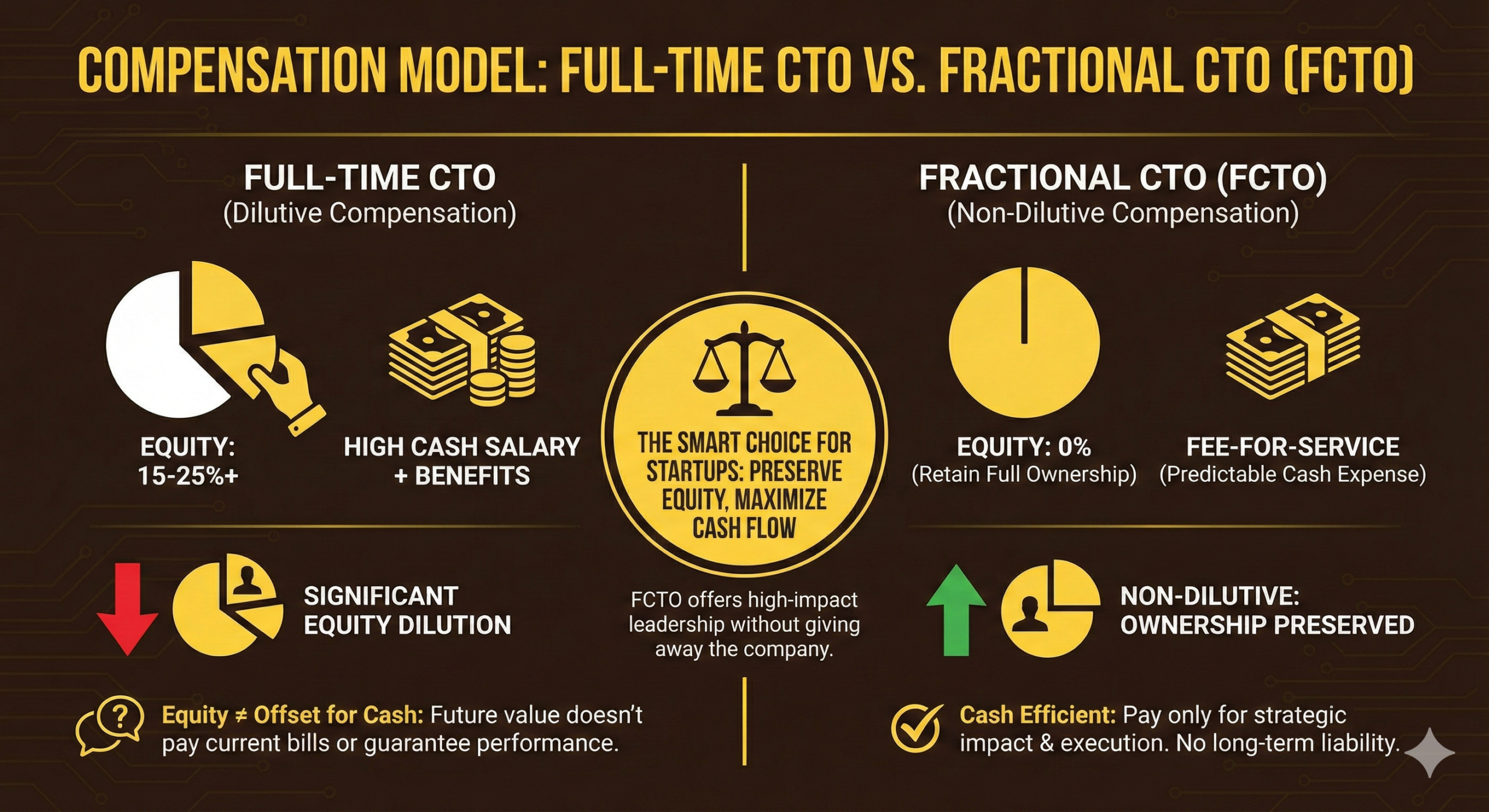
Perhaps the most critical advantage for founders wishing to maintain control is the compensation structure.
A high-caliber full-time CTO often requires 15-25%+ equity, leading to significant dilution of founder ownership before the company has even scaled. Furthermore, attempting to offset a lower cash salary with higher equity is a risky strategy that doesn’t pay current bills or guarantee future performance.
An FCTO operates on a fee-for-service basis. This is non-dilutive compensation. You pay a predictable cash expense only for the strategic impact and execution you need, retaining full ownership of your company while maximizing cash flow for operational growth.
Is a Fractional CTO (FCAAS) Right for Your Robotics Startup?
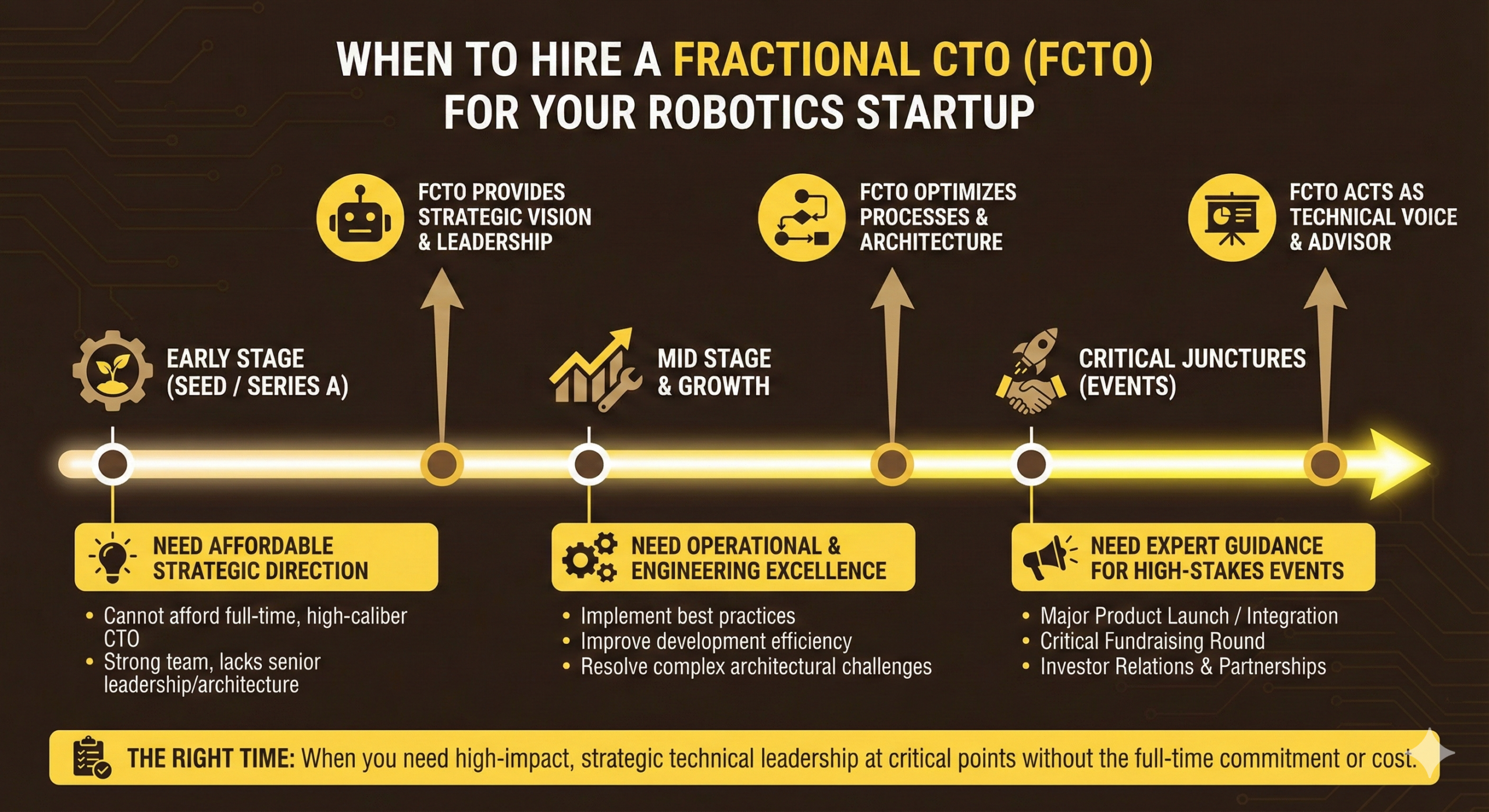
While the benefits are clear, the Fractional CTO model isn’t a one-size-fits-all solution. Consider if it’s the right fit if your robotics startup:
Is in its early stages (seed, Series A) and cannot yet afford a full-time, high-caliber CTO.
Has a strong technical team but lacks senior leadership to set strategic direction or resolve complex architectural challenges.
Needs expert guidance on specific, critical technical initiatives (e.g., preparing for a major product launch, a complex integration, or a critical fundraising round).
Seeks to implement best practices in engineering or improve development efficiency.
Requires a technical voice for investor relations or high-level partnerships.
Getting Ready for a Fractional CTO: What to Look For
If you decide to explore the FCAAS model, look for a Fractional CTO with:
Deep Robotics Experience: Beyond general software or hardware, they should have specific, demonstrable experience in robotics sub-domains relevant to your product (e.g., autonomous navigation, mechatronics, embedded systems, computer vision for robotics).
Strategic Acumen: The ability to translate business goals into technical strategies and articulate a clear technical vision.
Leadership & Communication Skills: They must be able to inspire, mentor, and communicate complex technical concepts to both engineers and non-technical stakeholders.
Proven Track Record: Evidence of successful product launches, team building, and navigating technical challenges in previous roles.
Cultural Fit: While part-time, they should integrate well with your existing team and company culture.
Key Takeaways
The robotics industry is poised for unprecedented growth, and startups are at its forefront. To navigate this complex and competitive landscape, strategic technical leadership is paramount. The Fractional CTO (FCAAS) model offers an agile, cost-effective, and powerful solution, providing the expert guidance needed to build robust, scalable, and innovative robotic solutions.
By leveraging the seasoned experience of a CTO as a Service, robotics startups can accelerate their development, mitigate technical risks, impress investors, and ultimately, bring their revolutionary ideas to life faster and more effectively. This isn’t just about outsourcing; it’s about smart, strategic empowerment for the next generation of robotics pioneers.
Frequently Asked Questions (FAQs)
A Technical Advisor typically provides high-level guidance, occasional networking, and "sanity checks" during monthly or quarterly meetings. In contrast, a Fractional CTO (FCTO) is an active, part-time member of your leadership team. They take ownership of the technical roadmap, manage the engineering culture, and architect systems integrity—providing hands-on leadership without the overhead of a full-time C-suite executive.
The FCAAS model is designed for startups that have outgrown their initial "hacker" phase but aren't yet ready for the expense of a permanent CTO. It allows founders to access veteran leadership to solve complex Robotics System Integration issues, de-risk R&D, and prepare for high-stakes investor due diligence at a fraction of the cost of a full-time hire.
The ideal time is typically between Seed and Series A funding. This is often the stage where the "prototype-to-product" transition begins. If your engineering team is struggling with technical debt, facing integration bottlenecks, or failing to meet commercial deadlines due to architectural complexity, an FCTO can provide the strategic pivot needed to scale.
Yes. One of the core responsibilities of an FCTO is to mentor the existing engineering team and establish a rigorous PhD Mentorship Framework within the company. They help identify the right technical talent, set up standard operating procedures (SOPs) for R&D, and ensure the team is moving from "feature-building" to "product-building" with a focus on system robustness.
Ready for a Strategic Discussion?
Your robotics project or academic career deserves a strategic roadmap built on international, Ph.D.-level expertise. Let’s map out your path to accelerated results.