So, you’ve weaved through the dilemma of whether or not you should install ROS, have settled on utilizing ROS 2 and have installed ROS 2 also. But then, what next? Just by installing ROS 2 environment on your PC and that of your R&D team, you can’t really do much. Maybe you were able to test out some hello world type examples: You’ve run the turtlesim demo, seen the nodes communicate via publisher/subscriber. Where do you go from there? You have a blinking cursor on your terminal—and an expensive problem at hand.
The real challenge of mobile robotics R&D isn’t getting the software to run; it’s building a reliable, high-performance, and defensible system.
The gap between a “Hello World” example and a production-ready autonomous stack is a massive skills canyon measured in time, technical debt, and millions in wasted R&D capital. A generic pub/sub tutorial does not prepare you for debugging asynchronous sensor fusion in a noisy environment, nor does it teach you how to structure a research project for Tier-1 publication.
This skills canyon spans two critical domains:
- Corporations and Startups: Teams (often Mech or ECE engineers) are mandated to adopt ROS 2 for next-generation products but lack the deep software architecture and strategic integration expertise required for high-reliability systems. They cannot afford the 18-month self-learning curve that leads to brittle code and product delays.
- Universities and Faculty: Core engineering faculty (ECE, Mechanical, CS) must modernize their curriculum and supervise cutting-edge PhD/Master’s projects. They need comprehensive Faculty Development Programs (FDPs) to pivot from legacy methods (like MATLAB/Simulink) to modern, deployment-ready ROS 2 frameworks that secure competitive research grants.
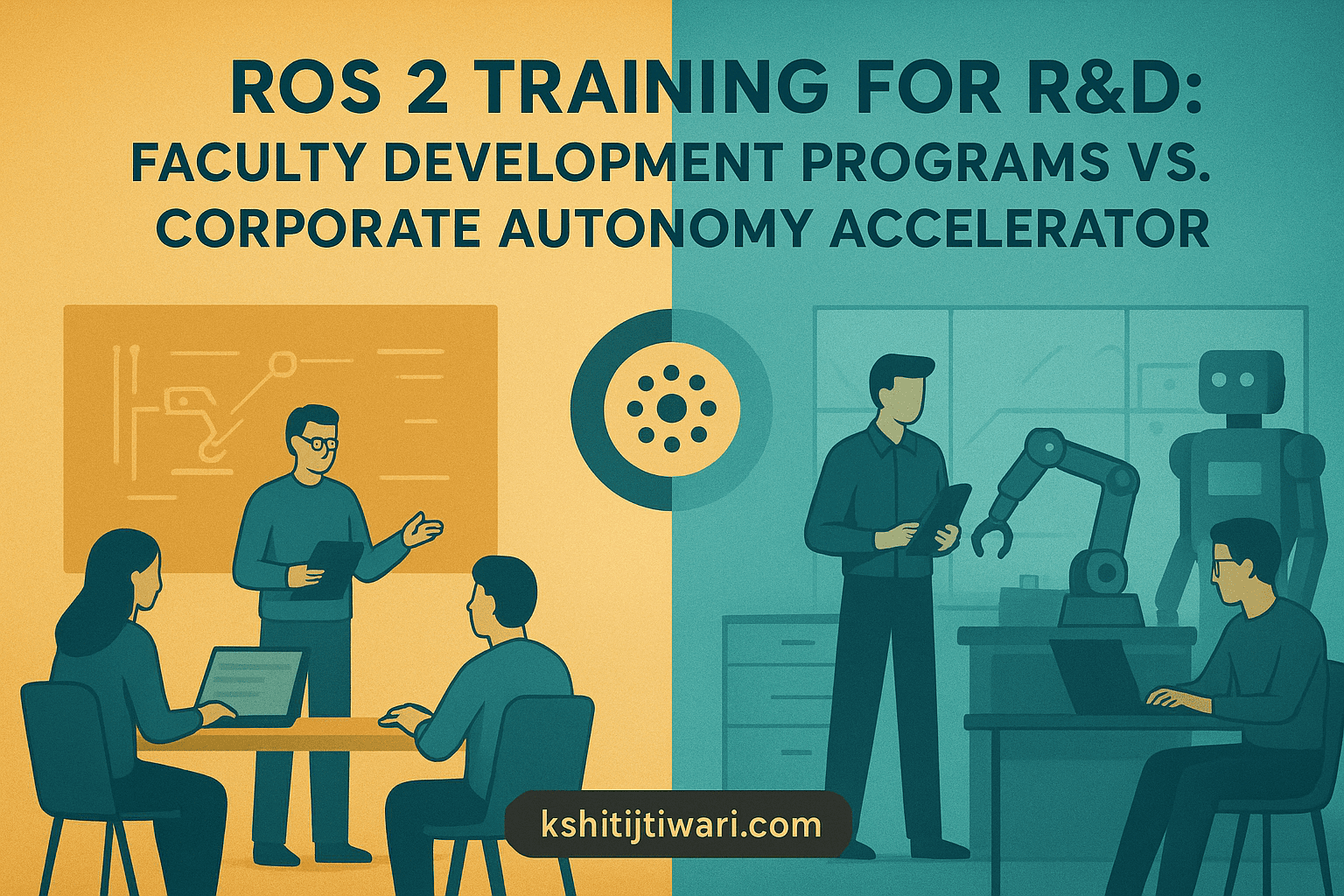
This is why specialized ROS 2 Training for R&D is a critical, high-ticket investment. We offer two distinct, results-driven accelerators, each precisely engineered to meet the unique ROI requirements of its audience. This definitive guide will dissect the scope, outcomes, and investment rationale for both the Corporate Autonomy Accelerator and the Faculty Development Program (FDP). Your decision is not about choosing a tool; it’s about choosing the correct strategic partner to accelerate your R&D future and eliminate costly failure.
Table of Contents
ToggleThe Corporate Autonomy Accelerator (B2B/Startups)
This program is designed for companies that need to minimize time-to-market, reduce technical debt, and quickly upskill existing engineering teams (Software, Embedded, Mechanical) into cohesive, production-ready Mobile Autonomy specialists.
Target Audience and Core Anxiety
The typical participant is a team of 4-10 engineers from a mid-sized startup or a large corporate R&D division (Automotive, Logistics, Agriculture, Defense, Surveillance or similar domains).
Core Anxiety: Time-to-Market and Technical Debt.
The fear of spending 1-2 years integrating ROS 2 incorrectly, leading to brittle, non-scalable, and unreliable production code. The high cost justifies mitigating this risk.
Program Scope and Deliverables: ROS 2 Training for R&D Proficiency
The Accelerator is structured as an intensive, 6-week (sometimes longer), project-based boot camp delivered online or on-site hybrid mode, culminating in a hardware-integrated Proof-of-Concept (PoC).
Here is what is typically covered in this Corporate ROS 2 Autonomy Accelerator cohort:
Foundational ROS 2 Architecture for Reliability
Focus: Moving beyond basic
publisher/subscriberinto building reliable, enterprise-grade systems.Modules:
ROS 2 Architectures (DDS/RCL): Deep dive into the Data Distribution Service (DDS), quality of service (QoS) settings, and managing data latency for real-time performance.
Nodes & Components: Implementing lifecycle nodes and managed components for robust error handling and system restarts—critical for commercial deployment.
Cross-Language Integration: Advanced use of Python and C++ interfaces within the same project, leveraging the best tool for each task.
Mobile Autonomy and Navigation Stack Implementation
Focus: Practical mastery of the industry-standard navigation pipeline.
Modules:
SLAM (Simultaneous Localization and Mapping) Deep Dive: Hands-on training with contemporary LiDAR and visual-based SLAM algorithms (Cartographer, RTAB-Map) for environment modeling.
Sensor Fusion for Degraded Environments: Implementing Extended Kalman Filters (EKF) and Particle Filters (PF) to fuse data from LiDAR, IMU, and Wheel Encoders for reliable state estimation, even with sensor noise or failure.
Nav2 Stack Mastery: Configuration, tuning, and strategic customization of the Nav2 stack for complex path planning and dynamic obstacle avoidance.
Enterprise-Grade Project Management and Tools
Focus: Ensuring the trained team can manage, debug, and deploy the system effectively.
Modules:
Continuous Integration/Continuous Deployment (CI/CD) for ROS: Setting up automated testing and deployment pipelines using tools like GitHub Actions or GitLab CI to streamline integration.
Debugging and Logging: Advanced use of
ros2 bagand custom logging tools for post-mortem analysis of failures—a non-negotiable skill for production systems.
Unique Selling Points (USPs) and ROI Justification
De-Risked Implementation (The Core ROI): We eliminate the two-year learning curve. The team receives production-ready code templates and best practices, saving millions in development time and preventing high-cost field failures.
Hardware-Agnostic, Industry-Specific PoC: The final project is executed on hardware specified by the client (or a high-fidelity reference platform), ensuring immediate relevance. The PoC directly addresses a business need (e.g., “Implement autonomous dock-to-dock navigation in our facility”).
Fractional CTO On-Ramp: This training often serves as the prerequisite to a Strategic Technical Scoping engagement, where we help define the 12-month R&D roadmap by getting involved as a Fractional CTO in tandem with the core team.
If you are still unsure whether this is the right time for you to opt for this service, fell free to opt for our Robotics R&D Readiness Audit wherein we will evaluate your technical readiness and identify optimal approach for implementing ROS 2 training for your R&D team.
Faculty Development Program (FDP) (B2A/Academia)
The Faculty Development Program (FDP) is tailored for academics who need to pivot their research and teaching focus to secure grants, supervise modern theses, and raise their department’s R&D profile.
Target Audience and Core Anxiety
The typical participant is a faculty member (Assistant/Associate Professor) from core engineering disciplines like ECE, Mechanical, or Computer Science departments.
Core Anxiety: Curriculum Obsolescence and Grant Ineligibility.
The fear of falling behind the technical curve, failing to attract top PhD/Master’s students, and being excluded from major government or industry R&D grants that mandate modern tools like ROS 2.
Program Scope and Deliverables: ROS 2 Training for R&D Curriculum Modernization
This program is structured as a 8-12 week, theory-to-application deep-dive, heavily focused on educational and research deliverables. Here are the typical aspects covered during the FDP tenure:
Theory Translation and Modern Methods
Focus: Bridging the gap between classical control theory and its modern, distributed implementation in ROS 2.
Modules:
Classical Control vs. Distributed Systems: Mapping traditional PID control, state-space modeling, and optimization techniques onto the distributed graph architecture of ROS 2.
Advanced Perception for Research: Moving beyond basic vision into specialized research topics like 3D point cloud registration, deep learning-based object detection (YOLO/R-CNN) for robotics, and sensor calibration techniques required for publishable results.
Curriculum Integration and Lab Standardization
Focus: Providing faculty with tangible assets to immediately update their coursework.
Modules:
Standardized Lab Environment Kit: Providing a pre-configured Docker/VM environment containing all necessary ROS 2 distributions, packages, and simulation assets (Gazebo/Unity).
Ready-to-Use Lab Manuals: A complete set of modular, tested lab exercises focused on core robotics concepts (e.g., “Implement a custom path follower using ROS 2 Actions,” “Integrate a virtual LiDAR model”).
Grant Acquisition and Research Strategy
Focus: The business of research—securing funding and publishing high-impact papers.
Modules:
Writing Fundable ROS 2 Proposals: Coaching on how to structure a grant proposal (e.g., NSF, DST, EU) that is technically sound, addresses a current R&D gap, and specifies a modern, de-risked ROS 2 implementation plan.
Tier-1 Publication Vetting: Guidance on selecting the appropriate journals (e.g., IEEE T-RO, Robotics and Automation Letters) for research utilizing ROS 2, and structuring the paper to highlight novelty in the system’s architecture.
Unique Selling Points (USPs) and ROI Justification
Immediate Curriculum Modernization: Faculty leave with a complete Curriculum Kit (labs, slides, projects), enabling them to immediately launch a competitive, modern course the next semester, attracting superior students.
Grant Acquisition Catalyst: The training directly enhances the faculty member’s technical competence in high-demand areas, making their research proposals significantly more competitive for funding.
Mentorship Pipeline: Faculty learn the Red Flags of poor project scope, ensuring they guide their own students toward viable, publishable thesis topics.
Strategic Comparison: Choosing Your Accelerator
While both programs offer intensive ROS 2 Training for R&D, their underlying philosophies and strategic outcomes are vastly different to suit the audience being catered to. Choosing the right one is essential to maximizing your investment.
The Critical Difference: Commercial Viability vs. Academic Novelty
The difference between the two programs hinges on the definition of success:
Corporations need training focused on commercial viability—can the robot reliably perform its task 24/7 in an unstructured environment without crashing?
Academics need training focused on scientific novelty—does the algorithm present a demonstrable improvement over the state-of-the-art that is publishable in a Tier-1 journal?
Our specialized ROS 2 Training for R&D ensures that every hour of instruction is aligned with your specific definition of success. This training is designed to help engineers bridge the gap in robotics system integration, moving beyond simple simulation to field-ready hardware orchestration.
Key Takeaways
The investment in specialized ROS 2 Training for R&D is not a cost; it is the highest-leverage strategic investment you can make in your professional or academic R&D capital. Training can improve the team’s ability to execute, but it should sit within a larger robotics R&D strategy covering architecture, deployment, technical debt, testing and commercialization.
For Corporations and Startups, this training is insurance against expensive technical debt and a direct accelerator for your product roadmap. For Universities and Faculty, it is the necessary modernization required to remain competitive in the global research landscape and attract millions in future funding.
Do not allow your R&D future to be built on outdated knowledge or generic training. Whether you need the production-readiness of the Corporate Autonomy Accelerator or the research competitiveness of the Faculty Development Program, your strategic partner must bring deep, specialized, and commercial-grade expertise.
The robotics revolution is here. The only question is, is your team ready to lead it with a strategically sound, ROS 2-powered foundation?
Ready for a Strategic Discussion?
Your robotics project or academic career deserves a strategic roadmap built on international, Ph.D.-level expertise. Let’s map out your path to accelerated results.