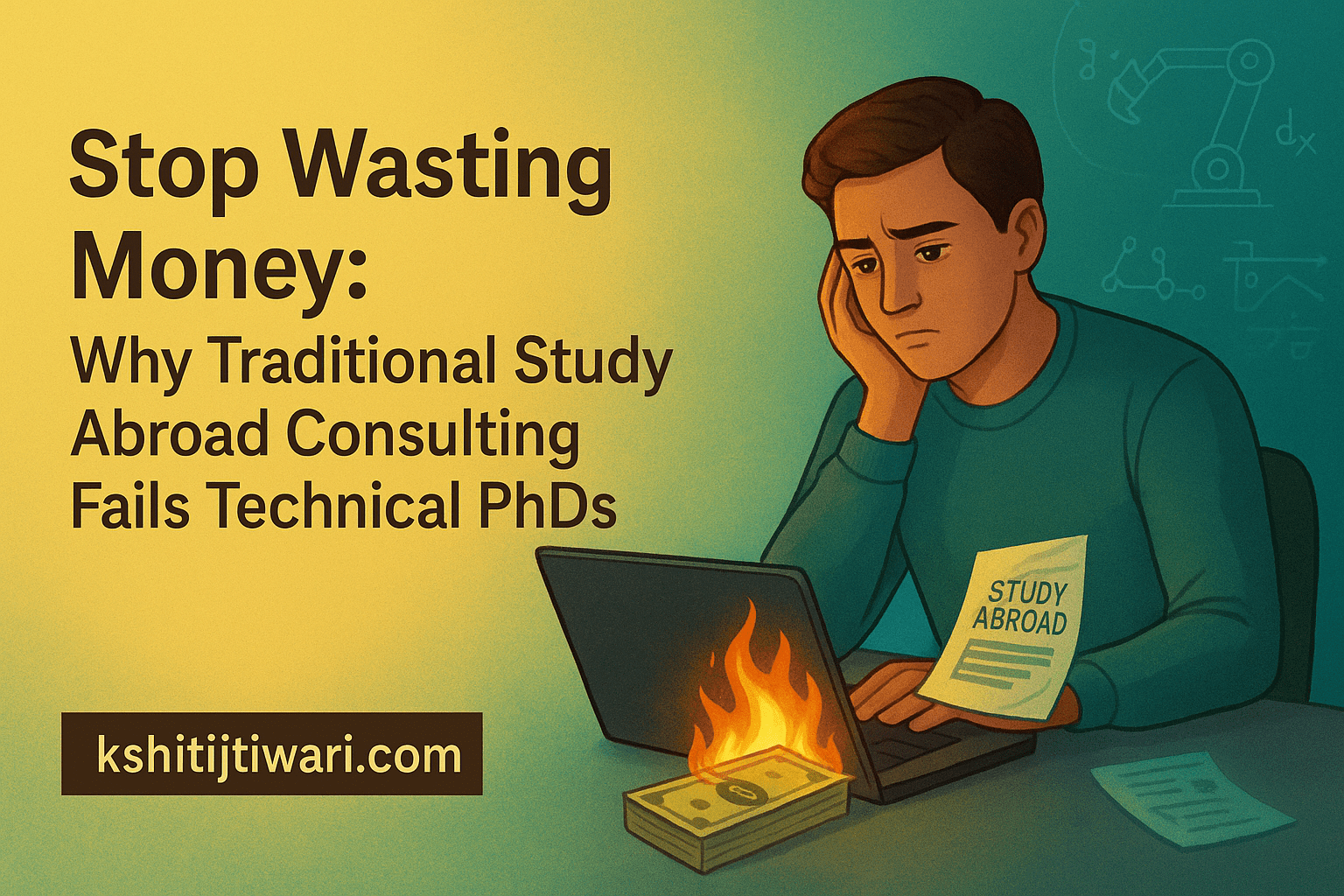
The decision to pursue a technical PhD in fields like Robotics, Mobile Autonomy, or Advanced Engineering is arguably the biggest professional investment of your early career. The stakes are immense: five years of your life, the opportunity cost of lost industry salary, and the trajectory of your entire R&D future.
Naturally, you begin your journey by searching for study abroad consulting for PhDs. You look for a guide, a partner to help navigate the complex admissions process into top international universities. Traditional consulting firms promise to help you secure an acceptance letter.
But here lies the fundamental trap: A technical PhD is not an admission—it is a research contract.
General study abroad consulting is primarily geared toward the mass market: helping undergraduates and Master’s students select schools, format documents, and navigate visa logistics. They are masters of paperwork, deadlines, and narrative refinement. They promise to get you in.
However, for a high-value, high-risk technical doctorate, securing the acceptance letter is the easiest part. The real challenge is securing a high-impact, commercially viable research project with a well-funded, competent advisor who will successfully graduate you on time. This is where the general model fails and where the strategic difference becomes absolutely critical.
This post serves as a definitive intervention. We will prove why the independent PhD Mentorship approach is fundamentally superior to traditional study abroad consulting for technical PhD aspirants. We will dissect the risks inherent in the general approach and unveil the specialized process required to minimize research risk and maximize your post-PhD career outcomes.
If your goal is merely to get accepted, traditional consulting may suffice. If your goal is to become a Lead R&D Scientist or a Fractional CTO and secure a tenfold return on your time investment, you need to go Beyond the Brochure—you need an R&D strategy.
 Related Resource: This article is part of the Unwritten PhD Resource Library—a comprehensive collection of guides, decision frameworks, and practical resources covering every stage of the PhD journey, from choosing a research topic and applying for a PhD to publishing papers, managing burnout, and planning your career after graduation.
Table of Contents
ToggleThe Broken Promise of General Study Abroad Consulting
Traditional study abroad consulting operates under a set of assumptions that are fundamentally flawed when applied to specialized, industry-linked PhD programs. Their focus is misaligned with the actual mechanics of R&D placement and career success.
1. The Acceptance Rate Trap: Quantity Over Quality
The business model of general consulting hinges on demonstrating high acceptance rates. This encourages two behaviors that are detrimental to the technical PhD aspirant:
Risk-Averse School Selection: Consultants often push applicants toward less-competitive programs or departments with high acceptance rates, regardless of that institution’s R&D funding, specialized infrastructure, or faculty quality in your specific niche (e.g., advising a Mobile Autonomy expert toward a university known only for general mechanical engineering).
Focus on Generalist Narrative: They prioritize a broad, safe Statement of Purpose (SOP) that appeals to many departments rather than a razor-sharp Strategic Technical Proposal that aligns perfectly with the specific, funded needs of one research professor. A general SOP is designed to fail safe; a targeted technical proposal is designed to succeed big.
2. Document Typesetting vs. Technical Vetting
General consultancies excel at document typesetting: correcting grammar, improving flow, and matching the tone of your SOP, CV, and Letters of Recommendation (LORs). This is a necessary service, but it is not sufficient.
Lack of Domain Expertise: A general consultant cannot tell you if your proposed research on “Decoupled Trajectory Optimization” is technically novel, already solved, or unfeasible with the professor’s current lab resources. They lack the background in Robotics, control systems, or deep learning architectures to technically vet your idea.
The Flawed Proposal Risk: A polished SOP with a technically flawed or overly ambitious research idea will pass the admissions office screen but will be instantly dismissed by the professor who is your potential R&D supervisor. They are looking for a Hired Gun who can solve a funded problem, not a literary genius. This oversight wastes your most valuable resource: time.
3. Ignoring the R&D Contract Model
PhD positions, especially in Europe (Germany, Netherlands, Scandinavia) and top US/Asian labs, are frequently employment contracts, not simply student enrollments. This means that the traditional study abroad consulting is marred with:
The Salary Blind Spot: General consultants rarely advise on negotiating salary, health benefits, or employment clauses. They only focus on tuition waivers. Your R&D strategy, conversely, must prioritize securing the highest possible salary because this dramatically changes your financial ROI and overall quality of life.
The Timeline Mismatch: General advice often ignores the 3-4 year hard deadlines common in European, industry-funded programs. They don’t prepare you for the intense, project-management-focused structure required to graduate on time.
4. The Blind Spot: Psychometric and Family Vetting
Traditional consulting assumes that if you have the grades, you have the resilience. This is a naive and dangerous assumption for the PhD journey.
Scholar Endurance: The PhD is an isolated intellectual marathon characterized by constant failure and self-doubt. General consulting never assesses the applicant’s psychological endurance—their capacity for self-regulation, grit, and managing isolation—which are the primary predictors of thesis completion.
Family and Lifestyle Fit: For professionals with partners and children, moving abroad for a PhD is a family contract. General firms ignore this, but a specialized R&D strategy must involve a candid assessment of the family’s capacity for cultural adaptation, career interruption for the spouse, and overall lifestyle disruption. A lack of family buy-in is a leading cause of PhD failure.
The Core Principles of R&D Strategy Mentorship
The R&D Strategy approach treats your PhD application as a high-stakes business proposal to a Principal Investigator (PI) who is seeking a competent, low-risk employee to complete a funded research objective. This approach requires a formalized system to ensure maximum impact and efficiency.
That codified system is the PhD Competence Accelerator.
The Accelerator provides the complete, anti-failure methodology, ensuring you move from novice to published author by mastering the process of R&D. Our entire mentorship—and your success—is built on three interlocking pillars:
Technical Deep Vetting: (Phase 1: Research Question Blueprinting)
Strategic Alignment & De-Risking: (Phase 2, 3, & 4: MPU Design, Editorial Mindset, and High-Velocity Pipeline)
This rigorous framework eliminates guesswork and ensures every action contributes to your final publication portfolio.
1. Technical Deep Vetting and Stream Selection
We eliminate the guesswork by focusing first on research viability, not university prestige.
A. Identifying the Optimal Technical Stream
Beyond the Department: A general consultant will advise on applying to the “Electrical Engineering Department.” We identify the optimal technical stream within that department. For instance, we differentiate between a “Collaborative Robotics” lab and a “Computer Vision for Robotics” lab. We specifically help you target programs that prioritize robotics system integration, as mastering the interplay between hardware and software is a critical skill for high-impact R&D roles.
Infrastructure Assessment: We teach you to vet the lab’s infrastructure. Does the “Mobile Autonomy” lab have a dedicated testing area, or do they only run simulations? Are they using commercial-off-the-shelf (COTS) equipment, or do they have proprietary sensor suites? Infrastructure is the single greatest determinant of a high-impact thesis.
The IP Gap: We help you identify the Intellectual Property (IP) you will gain. A successful PhD gives you a specialized, defensible IP stack. We help ensure your proposed research leads to a skillset that will place you in the top 1% of R&D candidates globally.
B. Crafting the Strategic Technical Proposal (SOP Re-Engineered)
Your SOP is not an essay about your passion; it is a Technical Proposal with quantified deliverables.
The STAR Method for R&D: We mandate a Skills-Task-Action-Result (STAR) approach, focusing on quantified results from your Master’s or professional experience. (Weak: “I worked on ROS.” Strong: “I reduced the path planning latency on the robotic arm by 200ms using a customized A algorithm*, resulting in a 15% increase in pick-and-place throughput.”)
The Solution-Oriented Hook: Your proposal must demonstrate that you have the prerequisite skills to solve the professor’s specific, funded problem. Your application must say: “I see your lab is working on X problem. My experience in Y makes me the most efficient person to solve that problem in Z years.”
2. De-Risking the Thesis: Your Anti-Failure Strategy
The core of our mentorship is to systematically eliminate the known causes of PhD failure, ensuring your PhD timing is optimized.
A. The Advisor Red Flag System
The advisor is your co-pilot. If they fail, you fail. We use a rigorous framework to vet the PI before you apply.
Publication Frequency: Do they regularly graduate PhDs, or do students stall for 6-8 years?
Funding Sources: Are they funded by a single, volatile grant, or a stable mix of government and industry contracts? Industry funding indicates applied relevance and a higher salary potential.
Supervision Style: We coach you on what questions to ask current and past students to determine if the advisor is supportive or an absentee/toxic manager. Read our detailed blog on evaluating the advisor-advisee fit: The Red and Green Flags to Look for in a Prospective Ph.D. Supervisor.
B. The Exit Strategy Blueprint
Even before you start, a strategic R&D plan includes the Exit Strategy.
M.Phil. as a Safety Net: We help you identify the conditions under which you would execute a strategic pivot to an M.Phil. or M.S. by Research. This means identifying the deliverables that constitute a defensible exit degree early in the process.
Marketing the Pivot: We prepare you to market the pivot as a strategic choice to future employers (“I optimized my career capital by pivoting when the research project lost its market viability”), transforming a perceived failure into a demonstration of managerial courage.
3. The Comprehensive Fit Assessment (The Psychological Moat)
We go beyond the transcript to ensure your success isn’t sabotaged by non-academic factors.
Scholar Endurance Testing: Using a blend of behavioral interviewing and self-assessment, we explore your mechanisms for dealing with research isolation, failure, and the protracted nature of the PhD. We address imposter syndrome as a strategic vulnerability.
Cultural and Financial Vetting: We align your research destination with your financial goals and family needs. Is the potential salary sufficient for the cost of living in Zurich? Does the university provide spousal visa support? We treat the overseas move as a full Family Logistics Operation.
Head-to-Head Comparison: R&D Strategy vs. Traditional Study Abroad Consulting
he table below summarizes the critical differences in service and mindset. Choosing your guide means choosing the trajectory of your entire R&D career.
|
Service Feature
|
Traditional Study Abroad Consulting
|
Specialized R&D Strategy Mentorship
|
|---|---|---|
|
Core Goal
|
Maximizing Admissions Acceptance Rate (Quantity)
|
Minimizing Research Risk & Maximizing Career ROI (Quality)
|
|
Primary Focus
|
Document Typesetting, School Selection, Visa Logistics
|
Technical Proposal Vetting, Project Viability, IP Strategy
|
|
Application Vetting
|
GPA, GRE, Language Test Scores (General Academics)
|
Technical Stream Fit, Infrastructure Access, Advisor’s Funding Stability
|
|
SOP/Proposal
|
General Narrative of Passion and Interest
|
Quantified Technical Proposal to solve the PI’s specific funded problem.
|
|
Risk Assessment
|
Low—Assumes acceptance equals success.
|
High—Systematically vets multiple risk factors (e.g., advisor, funding, technical novelty).
|
|
Career Outcome
|
A degree and an entry-level position (risks unknown)
|
A Strategic R&D Contract resulting in desirable placement opportunities.
|
|
Pricing Model
|
Often based on the number of applications/colleges.
|
Based on specialized technical expertise and de-risking consultancy.
|
Key Takeaways
he choice you face is clear: Will you treat your PhD as a generic application process or as the high-stakes R&D career contract it truly is?
Traditional study abroad consulting is optimized for high-volume admissions, but it is fundamentally unsuitable for technical aspirants in niche, high-value fields. It leaves you exposed to the greatest risks: project failure, wasted time, and a low-impact thesis.
Your career trajectory demands a specialized approach that focuses on R&D Strategy, technical deep-vetting, and systematic de-risking. It demands a partner who understands that success is defined not by the acceptance letter, but by the quantified, commercial value of your thesis five years from now.
If you are serious about achieving a tenfold ROI on your PhD investment and joining the global elite of R&D scientists, the time for general advice is over. R&D Strategy Mentorship is not a luxury; it is a necessity—the specialized armor required to navigate the treacherous waters of technical PhD placement.
💡 Your Strategic Next Steps:
Stop Wasting Time: If you are currently working with a general consultant, understand the limits of their technical expertise. Your technical proposal must be vetted by a specialist.
Assess Your Risk: Use our definitive guides to vet the environment before committing to the contract. Evaluate if you and your advisor are a good fit for each other and make sure you clearly understand the PhD timing trap so you can time your PhD right.
Define Your Value Proposition: Ensure your application is framed as a Strategic Technical Proposal (and not just a boilerplate SOP) that makes you indispensable to the PI.
The future of R&D is highly specialized. Is your mentorship ready for it?
Ready for a Strategic Discussion?
Your robotics project or academic career deserves a strategic roadmap built on international, Ph.D.-level expertise. Let’s map out your path to accelerated results.