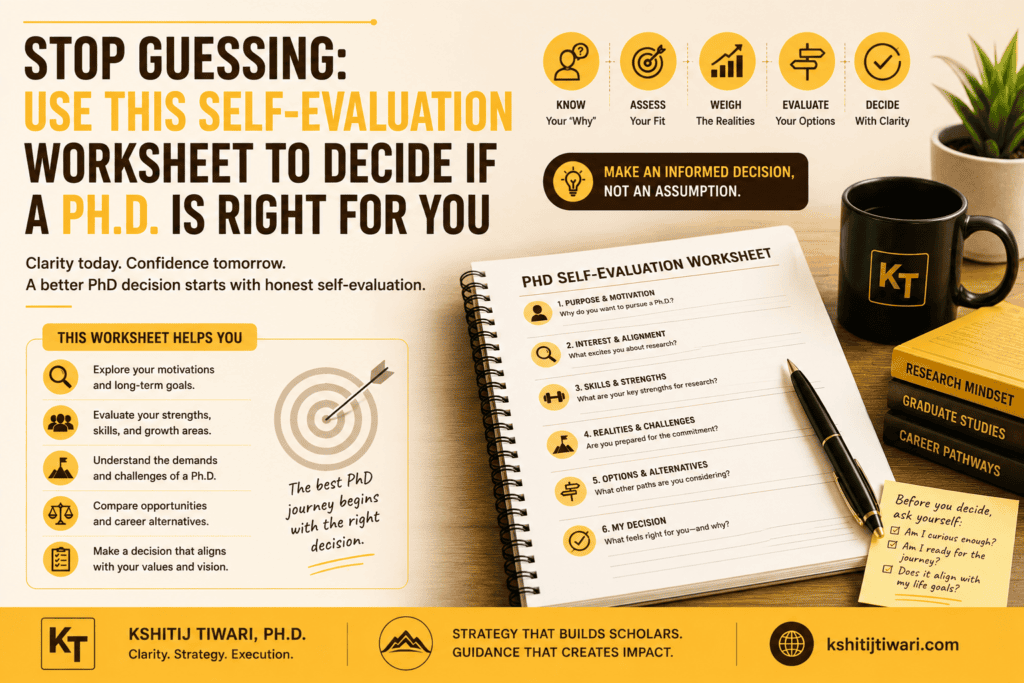
You’ve decided to pursue a PhD (and if you’re still on the fence, make sure to use our Self-Evaluation Worksheet to Decide If a Ph.D. is Right for You). You’ve identified potential supervisors, perhaps even sent your initial cold email and gotten a response successfully. Now comes the most critical document: the Statement of Purpose (SOP).
Forget what you’ve heard. The PhD SOP is not a narrative of your life, nor is it a place to recount every single course you’ve ever taken. For highly competitive, technical PhD programs, especially in R&D-focused fields like robotics and automation engineering, your SOP is a Strategic Technical Proposal. It’s an executive summary designed to convince a busy, research-focused professor that you are not just a suitable candidate, but the ideal future researcher to advance their lab’s mission.
Most SOPs fail because they focus on the past (what you’ve learned) rather than the future (what you will achieve in their lab). This blog post will lay out a 5-Part Strategic Framework to transform your generic SOP into an irresistible technical pitch, proving your expertise and unparalleled advisor-advisee fit.
This isn’t about telling a story; it’s about making a compelling technical argument and here is how you do it.
 Related Resource: This article is part of the Unwritten PhD Resource Library—a comprehensive collection of guides, decision frameworks, and practical resources covering every stage of the PhD journey, from choosing a research topic and applying for a PhD to publishing papers, managing burnout, and planning your career after graduation.
Table of Contents
ToggleThe Tactical Opening – The "Hook" That Aligns
The first paragraph of your PhD Statement of Purpose is the most crucial. It’s where busy professors decide if they’ll read on or move to the next application. Your goal here is simple: within 3-5 sentences, prove you understand their current research, identify a specific challenge in their recent work, and propose how your PhD will address it.
Reject the Narrative Intro: Why “Since Childhood…” Fails
Far too many SOPs begin with a sentimental journey: “Ever since I was a child, I’ve been fascinated by robots…” or “My passion for science began with a high school chemistry set…” This is a critical mistake. Professors are not looking for a biography; they are looking for a colleague who can contribute to their active research program. These intros waste precious real estate and signal a lack of strategic understanding.
The Technical Hook: The Reverse-Engineering Method
Instead, immediately pivot to a technical and strategic alignment. Here’s the method:
Identify the Professor’s Latest High-Impact Publication: Scan their Google Scholar profile, lab website, and recent conference proceedings. Focus on papers published within the last 12-18 months that are directly relevant to your interests.
Pinpoint an Open Problem or Limitation: Read the “Discussion,” “Future Work,” or “Conclusion” section of this paper. Professors are very open about the next challenges they want to solve. Look for phrases like “further research is needed to address…”, “a limitation of this approach is…”, or “future work will explore…”. This is your entry point.
Articulate Your Proposed Solution/Contribution: State clearly how your research will build upon, extend, or solve a specific limitation of their published work.
Example of a Weak vs. Strong Opening for an SOP:
Weak: “My passion for robotics began in my undergraduate degree, where I took several courses in control systems and AI. I am now seeking to pursue a PhD at your esteemed university because of its strong reputation in robotics.” (Generic, focuses on self, lacks specific alignment)
Strong (Robotics/Autonomy Focus): “Professor [Name]’s recent work on decoupled trajectory optimization for multi-agent aerial systems [cite paper] offers a compelling framework for scalable autonomous coordination. My research proposes to address the critical challenge of real-time, robust re-planning in dynamically occluded urban environments—a limitation identified in your previous work on [specific part of their paper]. Leveraging my expertise in adaptive control theory and ROS2-based sensor fusion, I aim to develop novel algorithms that enhance system resilience and extend operational envelopes in complex, unstructured settings.” (Immediately technical, directly references their work, highlights a specific gap, positions your skills as the solution.)
This opening immediately tells the professor: “I’ve done my homework, I understand your current research trajectory, and I have a clear, relevant proposal that directly benefits your lab.” This is how you differentiate yourself from hundreds of other applicants.
Technical Foundation and Domain Mastery – The Evidence
Once you’ve hooked them with your strategic alignment, you must quickly demonstrate that you possess the technical skills and research experience necessary to execute your proposed work. This section is about showcasing your “Competency Stack” – the specific tools, methodologies, and practical experiences you bring to the table.
The Competency Stack: What R&D Labs Truly Value
For a technical PhD, professors aren’t just looking for good grades; they’re looking for researchers who can do the work. This means hands-on experience with:
Programming Languages: C++, Python (for robotics, deep learning).
Robotics Frameworks: ROS, ROS2 (crucial for autonomy).
Specific Algorithms/Techniques: SLAM (Simultaneous Localization and Mapping), Kalman Filters, Particle Filters, Model Predictive Control (MPC), Reinforcement Learning, Computer Vision libraries (OpenCV), Point Cloud Libraries (PCL).
Hardware Experience: Specific sensor types (LiDAR, IMUs, cameras), microcontrollers, robot platforms (quadrotors, ground robots).
Software Development Practices: Version control (Git), testing, documentation.
The STAR Method for Research: Quantify Your Contributions
Instead of merely listing projects or courses, use a modified STAR (Situation, Task, Action, Result) method to describe your most relevant research experiences. This demonstrates not just what you’ve done, but how you did it and the impact of your work.
S (Situation): Briefly describe the context of your research project (e.g., “During my Master’s thesis, I focused on improving the real-time localization accuracy of a quadruped robot operating in GPS-denied environments.”).
T (Task): State the specific objective you aimed to achieve (e.g., “The goal was to integrate a low-cost LiDAR with an IMU to reduce drift and achieve sub-10cm accuracy over a 50-meter trajectory.”).
A (Action): Detail the technical actions you took. This is where you deploy your keywords and specific skills (e.g., “I developed a novel Extended Kalman Filter (EKF) based sensor fusion pipeline, leveraging ROS Noetic for data synchronization and C++ for efficient real-time processing of point cloud data and IMU measurements. I specifically implemented a scan-matching algorithm optimized for dynamic obstacles.”).
R (Result): Quantify the outcome. Use numbers, percentages, and direct impact (e.g., “This approach resulted in a 28% reduction in mean absolute trajectory error (MATE) compared to the baseline odometer-only approach, enabling robust autonomous navigation in previously challenging indoor environments.”).
Example STAR Paragraph:
“During my research internship at [Company/University], I was tasked with enhancing the robustness of an autonomous forklift’s navigation system in highly congested warehouse environments where GPS was unavailable and LiDAR data was frequently occluded. To achieve this, I implemented a particle filter-based localization system in ROS2 Foxy, fusing odometry from wheel encoders with sparse ranging data from UWB sensors. My contributions included developing custom message filters in Python to handle asynchronous sensor inputs and optimizing the resampling step of the particle filter for real-time performance on an embedded CPU. This system demonstrably reduced localization failures by 35% in cluttered aisles and improved the average path deviation by 15%, significantly de-risking operational deployments.”
Why This Works: You’re not just saying “I know ROS.” You’re saying, “I applied ROS and specific algorithms to solve a real problem with a quantifiable outcome.” This is the language of R&D.
The Mini Research Proposal – Your Vision and Novelty
This is the strategic heart of your SOP. Here, you demonstrate your capacity for independent thought and novel contribution. It’s not about designing a complete 5-year thesis, but about outlining a compelling vision that aligns with the professor’s lab and showcases your understanding of research gaps.
The Novelty Statement: Identifying the Gap
Every great PhD project starts by identifying a gap in existing knowledge or a limitation in current approaches.
Brief Literature Context: Very briefly, establish your understanding of the current state-of-the-art in your chosen sub-field. Avoid a full literature review; just enough to show you know the landscape.
The Identified Gap: Clearly state what existing solutions don’t do well, or what current research hasn’t yet addressed.
Example: “While [Professor X]’s work on [Technique A] shows promise for [Application Y], it has significant limitations when deployed in [Specific Environment Z], particularly regarding [Problem W]. This gap highlights the need for a more robust approach to [Solution Category].”
- Your Proposed Method: The 3 Key Research Objectives
Once you’ve established the gap, propose how you intend to fill it. Frame this as 3-5 distinct, yet interconnected, research objectives that would form the backbone of a potential PhD project. This proves you can structure a multi-year research plan.
Objective 1 (Foundation): “To develop a novel [algorithm/model] for [specific task], building upon [existing technique] but incorporating [your innovative twist].”
Objective 2 (Validation/Implementation): “To rigorously validate this [algorithm/model] through [simulation/real-world experiments] using [specific dataset/hardware platform], comparing performance against state-of-the-art benchmarks.”
Objective 3 (Extension/Application): “To investigate the integration of this [algorithm/model] into a [larger system/new application domain], exploring its scalability and robustness in [complex scenarios].”
Example Mini Research Proposal Segment (Robotics/Autonomy):
“Despite significant advancements in object detection using deep learning, real-time detection of highly deformable, small objects in unstructured, sparse point cloud data remains a critical challenge for autonomous manipulation in chaotic environments, such as construction sites. Existing 2D image-based methods struggle with occlusions and lack precise 3D localization, while standard 3D point cloud methods are computationally expensive for dynamic, deformable targets.
My proposed research aims to address this gap by developing a novel semantic segmentation and instance detection framework for noisy 3D point clouds, specifically tailored for identifying irregularly shaped objects like construction debris. My objectives include:
Developing a lightweight, multi-scale graph neural network (GNN) architecture that efficiently processes sparse point cloud features, enhancing detection accuracy for deformable objects under partial occlusion.
Integrating a temporal coherence module that leverages sequential point cloud data to improve detection robustness and track objects across frames, particularly in rapidly changing scenes.
Validating this framework on custom-generated datasets from real-world construction site scans, comparing its performance against current state-of-the-art 3D object detection algorithms on metrics like mAP and processing latency.”
This mini-proposal is the ultimate demonstration that you are not just a student, but a future researcher capable of independent, impactful work. It also subtly reinforces your initial decision to pursue a PhD by showcasing the potential for novel contribution, a key aspect discussed in The PhD Scholar’s Compass: How to Conquer Burnout and Master the Ambiguity of Your PhD Research.
Pro-Tip: Nervous about how you’ll explain your research once you actually get the position? Start building your academic presentation confidence early. Use our Q&A Survival Kit to learn the 50+ scripts for defending your work on stage.
Closing the Loop and Next Steps
After laying out your technical prowess and research vision, it’s time to solidify your fit and reiterate your commitment.
The Personal/Cultural Fit: Why THIS Lab?
This section should be brief and professional, focusing on specific, tangible reasons why this particular lab is the ideal environment for your proposed research. Avoid generic statements about “world-renowned faculty.”
Specific Resources: Mention unique equipment (e.g., “Professor [Name]’s access to the [Specific Robot Platform] and the high-fidelity [Sensor Array] is critical for validating the real-world performance of my proposed algorithms.”).
Collaborative Opportunities: Highlight specific interdisciplinary projects or existing collaborations that would benefit your work (e.g., “The lab’s ongoing collaboration with the [Computer Vision Group] would provide invaluable expertise for the perception aspects of my project.”).
Mentorship Style: You can subtly reference your alignment with their known mentorship style if you’ve gleaned insights from current students or previous interactions (e.g., “I am particularly drawn to your lab’s emphasis on fostering independent research while providing structured feedback, which aligns with my learning style.”) – this connects back to our Advisor-Advisee Fit discussion.
Avoid: Generic statements about university ranking, city attractions, or a vague desire for “challenging research.” Every applicant says that.
The Strategic Conclusion: Ready to Contribute
Your conclusion should be a concise, powerful reiteration of your value proposition.
Reiterate Alignment: Briefly summarize how your skills and proposed research align perfectly with the professor’s current interests and the lab’s mission.
Highlight Key Strengths: Remind them of your most compelling technical strengths (e.g., “My proven expertise in ROS2 development, robust sensor fusion, and adaptive control positions me to immediately contribute to your lab’s efforts in scalable multi-robot coordination.”).
Express Enthusiasm and Readiness: Conclude with a strong statement of your eagerness to begin and contribute immediately. “I am confident that my background and research vision make me an exceptional candidate, and I am eager to discuss how I can contribute to your lab’s cutting-edge research in [Specific Area].”
Remember, the goal is to leave them with the impression that you are a highly capable, self-directed researcher who already has a clear vision for how to add value to their team.
Key Takeaways
Writing a strategic Statement of Purpose (SOP) is a complex endeavor that requires precision, technical depth, and a keen understanding of academic R&D. This template provides the framework, but filling it with your unique experience and vision is the true challenge.
This isn’t just about getting in; it’s about positioning yourself for a PhD that will be a breakthrough, not a burnout.
Ready for a Strategic Discussion?
Your robotics project or academic career deserves a strategic roadmap built on international, Ph.D.-level expertise. Let’s map out your path to accelerated results.