Choosing a PhD advisor is one of the highest-leverage decisions you will make before starting a doctorate.
Your research topic matters. Your university matters. Funding matters. The laboratory infrastructure matters.
But there is another variable that can quietly influence almost every one of them:
the working relationship between you and your PhD advisor.
A strong PhD advisor-advisee fit can give you the intellectual freedom, feedback, accountability, resources, and professional development needed to become an independent researcher.
A poor fit can create the opposite: unclear expectations, delayed feedback, repeated misunderstandings, micromanagement, lack of direction, stalled experiments, conflict over authorship, career misalignment, and unnecessary stress.
The problem is that most prospective PhD students evaluate advisors using an incomplete checklist:
- Does the professor work in my research area?
- Is the professor from a good university?
- Does the lab have funding?
- How many papers does the professor publish?
- Does the professor seem nice during the interview?
Those questions matter.
They are simply not enough.
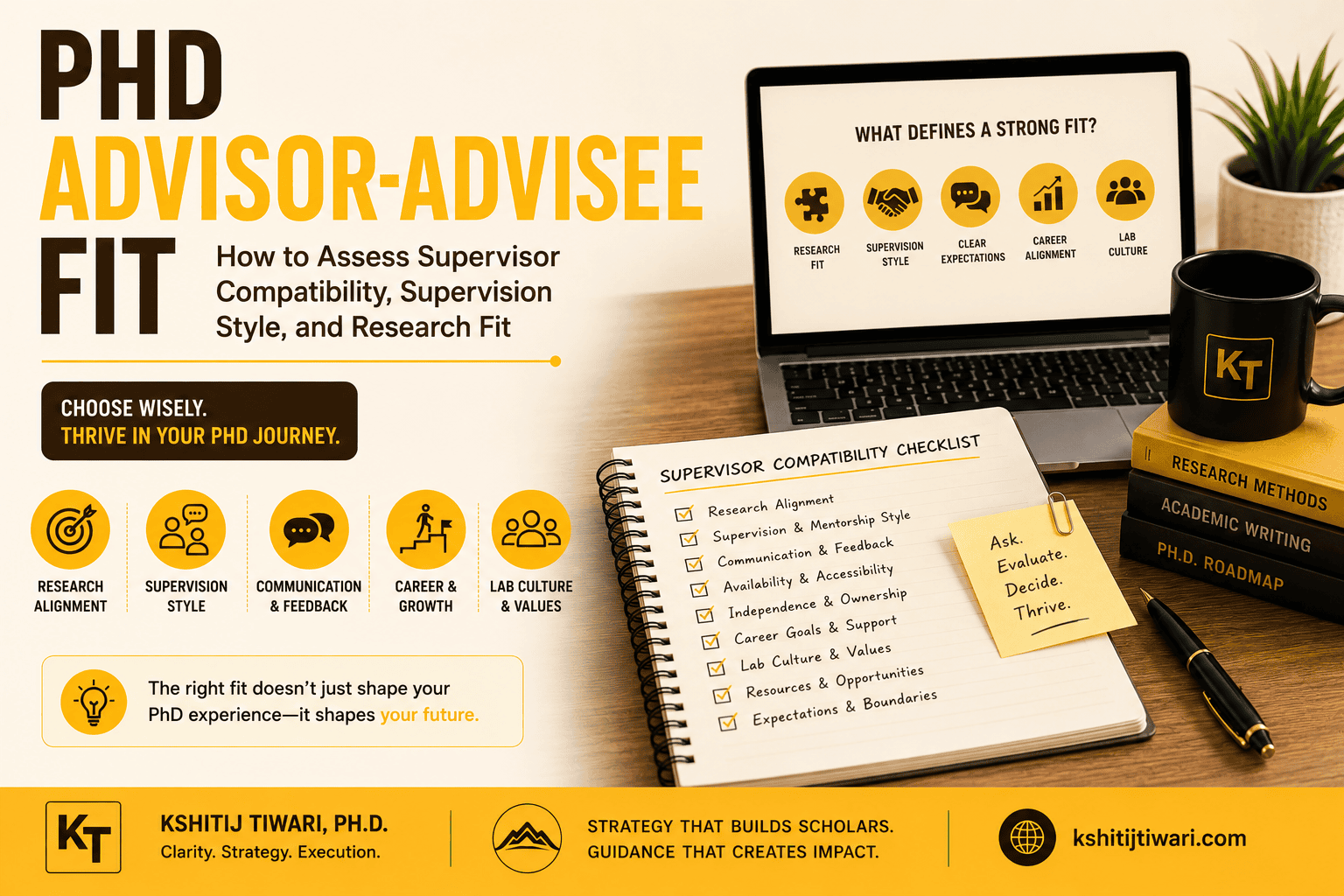
PhD advisor-advisee fit is better understood as a multidimensional compatibility problem involving research alignment, supervision style, communication, expectations, independence, availability, resources, career goals, lab culture, and professional boundaries.
This guide provides a systematic way to evaluate that fit before you commit to a PhD.
It also includes a framework for identifying the supervision style that is likely to work best for you, questions to ask prospective advisors and current students, red and green flags, a practical compatibility scorecard, and a Notion-based assessment framework you can use to compare multiple potential supervisors.
Important distinction: A good PhD advisor does not necessarily need to be your intellectual clone, your friend, or the professor with the most prestigious CV. The goal is not to find the “best” advisor in absolute terms. The goal is to find an advisor and research environment in which you can realistically become the researcher you want to become.
Choosing a supervisor is one decision within a much larger doctoral journey. The PhD Scholar’s Compass explores the broader skills of navigating uncertainty, developing independence and making better decisions throughout the PhD.
 Related Resource: This article is part of the Unwritten PhD Resource Library—a comprehensive collection of guides, decision frameworks, and practical resources covering every stage of the PhD journey, from choosing a research topic and applying for a PhD to publishing papers, managing burnout, and planning your career after graduation.
Table of Contents
ToggleWhat Is PhD Advisor-Advisee Fit?
PhD advisor-advisee fit is the degree to which a doctoral student’s research goals, working preferences, expectations, communication style, need for independence, career objectives, and professional boundaries are compatible with the way a prospective PhD advisor supervises researchers.
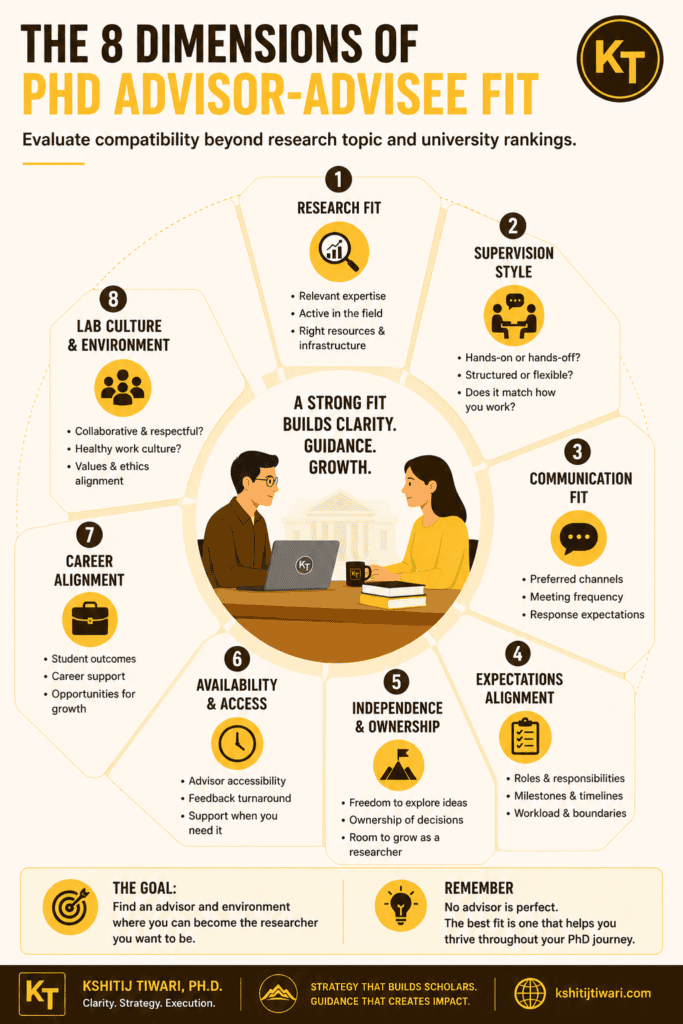
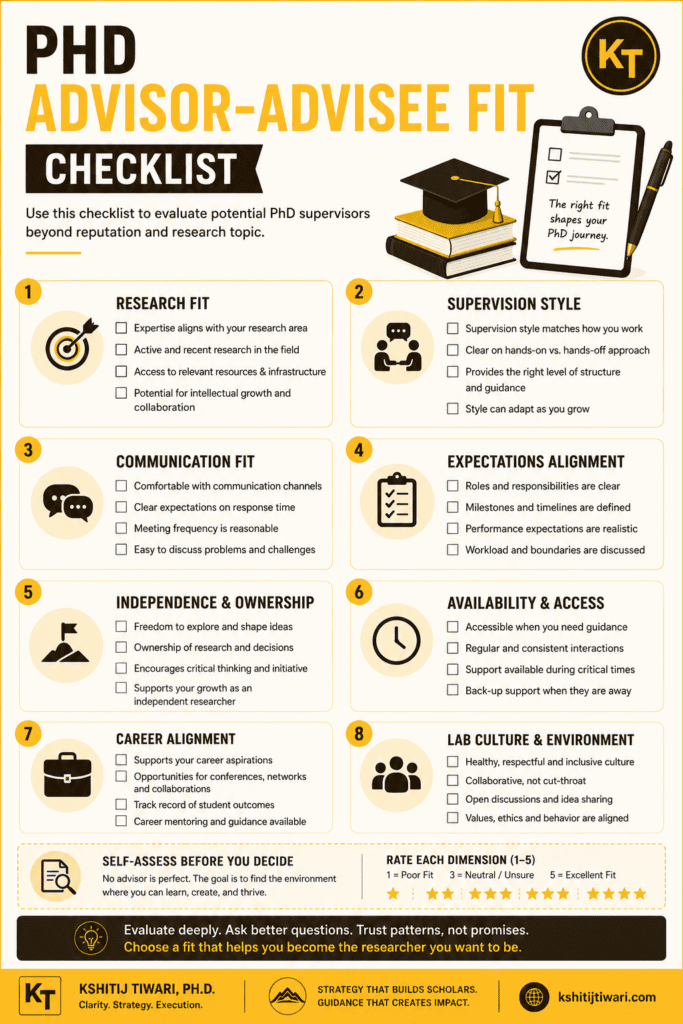
A useful assessment should examine at least eight dimensions:
|
Dimension
|
What to evaluate
|
|---|---|
|
Research fit
|
Can the advisor provide meaningful intellectual guidance for your research?
|
|
Supervision style
|
How hands-on, structured, or autonomous is the advisor?
|
|
Communication style
|
How do you communicate, meet, and exchange feedback?
|
|
Expectations
|
Are responsibilities, timelines, and standards clear?
|
|
Independence
|
How much ownership will you have over your research?
|
|
Availability
|
Can you realistically obtain guidance when you need it?
|
|
Career fit
|
Does the advisor support the career direction you want?
|
|
Lab culture fit
|
Is the environment professionally healthy and compatible with you?
|
There is no universally ideal PhD advisor.
There is only an advisor who may be a better or worse fit for a particular student, research project, career trajectory, and stage of doctoral development.
That distinction is crucial.
Why PhD Advisor-Advisee Fit Matters More Than Most Applicants Realize
A PhD is not simply another degree where you attend classes, complete assignments, pass examinations, and graduate.
It is a prolonged research apprenticeship.
Your advisor may influence:
- the direction of your research;
- the scope of your thesis;
- how independently you work;
- how frequently your work is reviewed;
- which conferences you attend;
- which papers you publish;
- how authorship is handled;
- which collaborations become available;
- what technical resources you can access;
- how you respond to failed experiments;
- how you prepare for your defense;
- how you approach your post-PhD career.
This makes the advisor relationship fundamentally different from choosing an ordinary course instructor.
Research on doctoral supervision has repeatedly highlighted the importance of shared expectations between supervisors and students. One study of supervisor-student dyads identified expectations around the supervisor’s role, intellectual capacity, emotional intelligence, and resources/logistics as important dimensions of the supervisory relationship. [1]
University supervision agreements reflect the same principle in practice.
For example, doctoral supervision frameworks at institutions including KU Leuven, the University of New England, and the University of Zurich explicitly address issues such as meeting frequency, feedback, independence, responsibilities, milestones, communication, and expectations.
In other words:
Good supervision is not simply about having a smart professor. It is about establishing a workable professional system between two researchers.
The Biggest Mistake: Confusing Research Fit With Advisor Fit
Suppose you find a professor whose recent publications are almost perfectly aligned with your proposed PhD topic.
You are excited.
The professor is publishing in exactly the conferences and journals you care about.
Their lab has impressive equipment.
They have substantial funding.
You might conclude:
“This is obviously the right advisor for me.”
Not necessarily.
You have established research fit.
You have not yet established advisor-advisee fit.
Consider two hypothetical advisors.
Advisor A
- works directly on your topic;
- has enormous funding;
- publishes frequently;
- supervises 20+ researchers;
- expects students to operate independently;
- rarely schedules meetings;
- provides feedback primarily when deadlines approach.
Advisor B
- works in a closely related field;
- has a smaller laboratory;
- meets students regularly;
- provides structured feedback;
- encourages students to develop their own research questions;
- has a strong record of graduating students;
- actively supports students’ career development.
Which is better?
There is no universal answer.
If you are already highly independent and thrive with minimal supervision, Advisor A may work extremely well.
If you are entering a completely new research field and need structured feedback during your first year, Advisor B may be considerably better.
This is why advisor selection should be treated as a fit problem rather than a prestige-ranking exercise.
The 8 Dimensions of PhD Advisor-Advisee Fit
A robust evaluation should move beyond red flags and green flags.
Think of compatibility as an eight-dimensional system.
1. Research Fit: Can This Person Actually Help You Become an Expert?
This is the first filter.
Your advisor does not necessarily need to have published on your exact proposed thesis question.
In fact, requiring an exact match can be counterproductive.
Research evolves.
Your initial PhD proposal may change substantially during your first year as you read more literature, conduct experiments, discover constraints, or encounter unexpected results.
Instead, evaluate whether the advisor has sufficient expertise to guide the research territory in which you intend to operate.
Ask:
- Does the advisor understand the underlying research problem?
- Are they active in the relevant research area?
- Have they published recently in the field?
- Do they have relevant collaborators?
- Does the lab possess the necessary infrastructure?
- Can the advisor identify methodological weaknesses in your proposed work?
- Can they connect you to researchers who possess expertise they do not have?
Don’t demand an exact topic match.
For example, suppose you want to research:
Robust multi-robot navigation in degraded sensing environments.
A professor whose expertise is:
Multi-agent planning and autonomous navigation
may be an excellent fit.
A professor who has published one paper specifically titled:
Robust Multi-Robot Navigation in Degraded Sensing Environments
is not automatically better.
The real question is:
Can this advisor provide the intellectual environment necessary for your research to develop?
2. Supervision Style: How Does This Advisor Actually Manage Researchers?
This is one of the most important dimensions—and one of the least investigated before students accept PhD offers.
Two advisors can have identical research expertise and produce completely different PhD experiences because they supervise differently.
Some advisors:
- meet weekly;
- provide detailed comments;
- establish deadlines;
- closely monitor experiments.
Others:
- expect students to schedule meetings;
- read material only when necessary;
- intervene when a major problem emerges;
- give students considerable freedom.
Neither approach is automatically superior.
The question is:
Which supervision style is compatible with how you work—and how you need to develop?
What Supervision Style Is Ideal for You?
There is no single “best” PhD supervision style.
Instead, think of supervision as a spectrum.
Style 1: Highly Directive / Hands-On
The advisor:
- sets frequent milestones;
- reviews work closely;
- gives detailed methodological guidance;
- expects regular updates;
- may participate heavily in early research design.
Best suited to:
Students who:
- are entering a new research area;
- need frequent feedback;
- benefit from external accountability;
- are early in developing research skills;
- prefer structured progress.
Potential downside
If this style continues indefinitely, it can become micromanagement.
A PhD is ultimately supposed to develop independent research capability.
Style 2: Structured and Goal-Oriented
The advisor provides:
- regular meetings;
- defined milestones;
- clear expectations;
- periodic feedback;
- substantial student ownership.
This is often a strong middle ground.
The student knows:
“Here is where I need to get to.”
But the student retains ownership of:
“How I get there.”
Best suited to:
Students who want:
- accountability;
- clarity;
- predictable feedback;
- increasing independence.
For many doctoral students, this is a particularly useful structure because it combines support with autonomy.
Style 3: Collaborative / Coaching
The advisor behaves more like an intellectual coach.
They may:
- discuss ideas extensively;
- challenge assumptions;
- ask questions rather than provide solutions;
- introduce collaborators;
- encourage independent decision-making;
- help the student reason through difficult problems.
The advisor may not tell you exactly what to do.
Instead, they help you become capable of determining what to do.
Best suited to:
Students who:
- enjoy intellectual discussion;
- learn through questioning;
- want strong research ownership;
- are comfortable with ambiguity;
- aspire to become independent researchers.
Style 4: Hands-Off / High Autonomy
The advisor gives substantial freedom.
You may be expected to:
- identify research problems;
- design experiments;
- schedule meetings;
- identify literature;
- develop manuscripts;
- troubleshoot independently;
- decide when assistance is required.
Best suited to:
Students who:
- are highly self-directed;
- have strong research experience;
- manage projects independently;
- are comfortable making decisions under uncertainty.
Potential downside
A hands-off advisor is not necessarily an unavailable advisor.
That distinction is critical.
A healthy hands-off advisor may say:
“I expect you to take ownership. If you need me, tell me what decision you are trying to make and what evidence you have.”
An unhealthy absent advisor may simply disappear.
Autonomy without access to guidance is not necessarily good supervision.
The Most Important Insight: Your Ideal Supervision Style May Change During the PhD
This is where simplistic “hands-on vs. hands-off” advice breaks down.
You may need different levels of supervision at different stages.
Early PhD
You may need:
more structure + more feedback
because you are learning the research environment.
Middle PhD
You may need:
less instruction + more intellectual challenge
because you are developing competence.
Late PhD
You ideally need:
high autonomy + strategic feedback
because you should increasingly operate as an independent researcher.
Therefore, the best advisor may not be the person who gives you exactly the amount of supervision you prefer today.
A better question is:
Can this advisor adapt their supervision as I develop?
That is a much stronger predictor of long-term compatibility.
University supervision guidance reflects this idea. KU Leuven’s supervision agreement, for example, explicitly asks doctoral researchers and supervisors to discuss how independently the researcher will work and what supervision style works best for both parties, while recognizing that these arrangements may need to be revisited during the doctorate. [2]
3. Communication Fit: How Do You Actually Work Together?
Communication problems are rarely about whether someone can communicate.
They are usually about communication expectations.
Consider the following questions:
- Does the advisor prefer email or messaging?
- How quickly do they typically respond?
- Do they expect weekly written updates?
- Do meetings require prepared agendas?
- Should you send drafts days in advance?
- Does the advisor prefer discussing problems verbally?
- Are critical issues handled immediately or saved for meetings?
- How detailed is their feedback?
- Do they prefer polished drafts or rough working documents?
These details sound trivial.
Over several years, they are not.
4. Feedback Fit: Can You Work With the Way This Advisor Critiques?
This is an underrated dimension of compatibility.
A PhD involves criticism.
Your advisor will reject ideas.
They may tell you:
- your hypothesis is weak;
- your experiment is poorly controlled;
- your analysis is insufficient;
- your paper is not ready;
- your interpretation is unsupported;
- your research question is too broad.
That is part of research.
The important question is how criticism is delivered and whether it helps you improve.
There is a major difference between:
“This experiment is poorly designed. Here are the three variables you need to control.”
and:
“This is bad. You clearly haven’t thought this through.”
Both are negative feedback.
Only one is useful mentorship.
Constructive criticism is not the absence of criticism.
It is criticism that helps the researcher understand:
- what is wrong;
- why it matters;
- what could be done differently.
Good supervision agreements similarly emphasize feedback expectations, including how frequently written work is reviewed and how much time supervisors need to provide feedback. [2][4]
5. Independence Fit: How Much Ownership Will You Have?
This is perhaps the most important philosophical question.
Ask:
Will I be allowed to become the researcher behind my thesis, or will I effectively become an extension of the advisor’s research program?
Your advisor may have:
- an existing grant;
- established experiments;
- predefined research questions;
- existing datasets;
- established collaborators;
- publication priorities.
There is nothing inherently wrong with joining such a project.
Many excellent PhDs are project-funded.
The question is whether there is sufficient intellectual ownership for you to develop an independent contribution.
Red flags
Be cautious if:
- every research decision is predetermined;
- the advisor expects you to reproduce an existing project;
- you are discouraged from questioning assumptions;
- the advisor claims ownership over ideas you develop;
- your thesis direction changes whenever the advisor’s grant priorities change.
Green flags
Look for advisors who can explain:
- what is fixed;
- what is flexible;
- what you will own;
- how your research can evolve;
- how authorship will be determined;
- how you can develop your own research identity.
A PhD is training for research independence.
The goal is not simply to produce papers for your advisor.
6. Availability Fit: Is the Advisor Actually Accessible?
Do not confuse fame with quality.
A highly cited professor with 30 doctoral students may be an outstanding scientist.
They may also be a poor practical fit if you need frequent supervision.
Before joining, investigate:
- How many current PhD students do they supervise?
- How many postdocs and research staff are in the group?
- How frequently do students meet the advisor?
- Who handles day-to-day technical questions?
- Is there a senior PhD student or postdoc structure?
- Does the advisor travel frequently?
- Are students expected to work independently for long periods?
One particularly useful question is:
“If I get stuck on an important research decision, what normally happens?”
The answer reveals much more than:
“We have an open-door policy.”
7. Career Fit: Does the Advisor Support the Researcher You Want to Become?
Your advisor’s career is not necessarily your career.
A professor who strongly prioritizes academic publication may be an excellent mentor for someone targeting academia.
But what if you want to work in industry?
Or become:
- an R&D scientist;
- robotics engineer;
- research engineer;
- entrepreneur;
- technical founder;
- government researcher;
- research manager?
Ask:
“Where have your recent PhD graduates gone?”
Then investigate those outcomes.
Look at:
- academic placements;
- industry placements;
- postdoctoral positions;
- startup involvement;
- research institutes;
- geographic mobility.
Do not simply ask:
“Do you support industry careers?”
Ask for examples.
Past student outcomes are evidence. General promises are not.
8. Lab Culture and Professional Boundaries
Your advisor is only one part of your PhD environment.
The laboratory or research group may determine much of your daily experience.
Evaluate:
- how students treat each other;
- whether collaboration is encouraged;
- whether students compete destructively;
- whether junior researchers can disagree;
- whether mistakes are discussed constructively;
- whether people appear afraid of the advisor;
- whether students routinely work extreme hours;
- whether students disappear from the group without explanation;
- whether authorship disputes are common;
- whether credit is distributed fairly.
Also evaluate professional boundaries.
Ask about:
- expected working hours;
- weekends;
- vacation;
- remote work;
- conference travel;
- teaching;
- side projects;
- internships;
- external collaborations.
The important point is not that every lab must have identical policies.
It is that you should know what you are agreeing to before you join.
Don't Evaluate an Advisor From Their Website Alone
A professor’s website is an advertisement.
It will tell you:
- research interests;
- publications;
- grants;
- awards;
- current projects.
It may not tell you:
- how they respond to failure;
- how they handle disagreement;
- whether they provide feedback;
- whether students graduate on time;
- whether they micromanage;
- whether students feel supported.
That requires triangulation.
Use at least four information sources.
Source 1: The advisor
Ask direct questions.
Source 2: Current PhD students
They provide information about the current reality.
Source 3: Former PhD students
They reveal longer-term outcomes.
Source 4: The wider research ecosystem
Look at:
- publications;
- collaborations;
- grants;
- conference activity;
- former students’ careers;
- lab website history.
The goal is not to find one person’s opinion.
The goal is to identify patterns.
Questions to Ask a Prospective PhD Advisor
Do not ask all of these in a single interview.
Use them strategically.
Research
- What research questions are you currently most interested in?
- How flexible are PhD students in defining their research questions?
- How much of the proposed project is already defined?
- How frequently do PhD projects change direction?
- What infrastructure would I have access to?
- What technical expertise already exists in the group?
Supervision
- How often do you normally meet PhD students?
- How do you prefer students to prepare for meetings?
- How do you provide feedback on manuscripts?
- How quickly do you typically review drafts?
- How do you handle students who are stuck?
- How do you expect students to communicate problems?
Independence
- How much independence do your PhD students typically have?
- At what stage do you expect students to define their own research questions?
- How do you balance grant objectives with individual thesis objectives?
Career
- Where have your recent PhD graduates gone?
- How do you support students pursuing industry careers?
- How do students gain conference and collaboration opportunities?
- Are internships or external collaborations possible?
Working environment
- How many PhD students do you currently supervise?
- How large is the research group?
- What are the normal working expectations?
- How do you handle vacation and time away from the lab?
- How are authorship decisions made?
Questions to Ask Current PhD Students (your future lab mates)
These questions are often more revealing.
Instead of asking:
“Is Professor X a good advisor?”
ask:
“How does Professor X actually supervise you?”
Then ask:
- How frequently do you meet?
- What happens when you need feedback?
- How long does feedback normally take?
- How much freedom do you have?
- What happens when an experiment fails?
- Can you disagree with the advisor?
- How are authorship decisions made?
- What happens if you want to pursue an idea outside the advisor’s original plan?
- How much work is expected outside normal hours?
- How much support do students receive?
- What happens when the advisor is traveling?
- How many students have graduated recently?
- What happened to the former students?
The final question is especially valuable:
“If you could choose again, would you still join this group?”
Then ask:
“Why?”
How to Interpret Red Flags Properly
A red flag is not necessarily a deal-breaker.
This distinction matters.
For example:
Professor travels frequently
Potential concern:
Availability
But perhaps the lab has excellent co-supervision and the professor maintains weekly remote meetings.
Not necessarily a problem.
Professor is very demanding
Potential concern:
Expectations
But perhaps the expectations are clearly communicated, consistently applied, and accompanied by excellent mentorship.
Not necessarily a problem.
Professor is hands-off
Potential concern:
Supervision mismatch
But if you are highly autonomous, this may actually be ideal.
Therefore:
Do not count red flags. Interpret them in context.
A better framework is:
Risk × Severity × Evidence × Compatibility
High-Risk Red Flags
Some issues deserve substantially more attention than ordinary style differences.
1. Repeated unexplained student attrition
One student leaving proves very little.
A repeated pattern deserves investigation.
2. Chronic unavailability
If students repeatedly cannot obtain guidance when critical decisions arise, this can become a serious operational problem.
3. Unclear funding
Understand:
- who funds your position;
- how long funding lasts;
- what happens if the grant ends;
- whether your stipend/salary is guaranteed;
- whether you are expected to find funding.
4. Authorship ambiguity
Ask how authorship decisions are normally handled.
5. Intellectual ownership problems
Be cautious if students describe situations where their ideas routinely become the advisor’s ideas without appropriate recognition.
6. Fear-based lab culture
If students are afraid to ask questions, report failures, or disagree, take that seriously.
7. Ethical concerns
Any credible concerns involving:
- research misconduct;
- harassment;
- discrimination;
- retaliation;
- manipulation of data;
- inappropriate professional relationships;
- systematic exploitation
should be treated much more seriously than an ordinary supervision-style mismatch.
Green Flags That Matter
Instead of simply looking for a “nice professor,” look for evidence of a functioning research system.
Green Flag 1: Clear expectations
You know:
- when meetings occur;
- what you should prepare;
- how feedback works;
- what progress means.
Green Flag 2: Graduating students
The advisor has a consistent history of graduating doctoral researchers.
Green Flag 3: Increasing independence
Students gradually take ownership of their research.
Green Flag 4: Constructive criticism
The advisor challenges researchers without humiliating them.
Green Flag 5: Career support
The advisor actively helps students build careers beyond the thesis.
Green Flag 6: Transparent funding
The financial structure is understandable.
Green Flag 7: Intellectual openness
Students can question assumptions and propose alternatives.
Green Flag 8: Adaptable supervision
The advisor adjusts their approach as students mature.
The PhD Advisor Compatibility Scorecard
Instead of making a decision based on instinct, score each potential advisor.
Use a 1–5 scale:
1 = very poor fit
2 = weak fit
3 = acceptable / uncertain
4 = strong fit
5 = excellent fit
| Category | Weight | Score |
| Research expertise | 20% | /5 |
| Supervision style | 15% | /5 |
| Communication | 10% | /5 |
| Feedback style | 10% | /5 |
| Independence / autonomy | 10% | /5 |
| Availability | 10% | /5 |
| Career alignment | 10% | /5 |
| Lab culture | 10% | /5 |
| Funding / resources | 5% | /5 |
You can calculate a weighted score:
Compatibility Score = Σ (Category Score × Category Weight)
But do not let the number make the decision for you.
The score is a decision-support tool, not an oracle.
A candidate who scores 4.3/5 but has a serious unresolved ethical concern is not necessarily preferable to someone who scores 4.0/5.
The Notion Template: PhD Supervisor Compatibility Assessment
This is where a structured database becomes particularly useful.
Rather than keeping scattered notes across emails, university websites, and conversations, create one Notion database containing every prospective supervisor.
Each supervisor becomes one record.
Suggested database properties
Basic information
- Professor
- University
- Department
- Laboratory
- Country
- Website
- Research area
- Potential funding source
- Application deadline
Research fit
- Topic alignment
- Methodology alignment
- Infrastructure fit
- Publication relevance
- Collaboration potential
Supervision
- Supervision style
- Meeting frequency
- Feedback process
- Expected independence
- Communication preference
Career
- Academic placement
- Industry placement
- Conference support
- Networking opportunities
- Career alignment
Lab
- Current PhD students
- Recent graduates
- Lab size
- Culture observations
- Working hours
- Funding stability
Risk
- Availability risk
- Funding risk
- Research risk
- Culture risk
- Communication risk
- Ethical concerns
Final assessment
- Overall score
- Confidence level
- Questions remaining
- Decision
- Next action
Grab your FREE notion template for PhD Compatibility assessment, clone it and modify it to your liking.
How to Use the Compatibility Assessment
Do not fill it out once.
Use it progressively.
Stage 1: Desk research
Fill what you can discover publicly.
Stage 2: Cold email
Record the professor’s responsiveness and communication style.
Stage 3: Interview
Record answers to your supervision questions.
Stage 4: Student conversations
Record patterns from current and former students.
Stage 5: Final comparison
Compare several potential advisors side-by-side.
This prevents an extremely common cognitive error:
falling in love with the first professor who replies positively.
The "Evidence vs. Assumption" Rule
For every important assessment, classify your information.
Evidence
“Three current students said meetings occur every two weeks.”
Direct evidence
“The professor said students schedule their own meetings.”
Observation
“The professor interrupted students repeatedly during the lab meeting.”
Assumption
“The professor seems like a nice person.”
These are not equally reliable.
Your compatibility database should therefore include an evidence source for important observations.
This turns advisor selection from:
“I have a good feeling about this professor.”
into:
“I have evaluated this person across eight dimensions using multiple sources of evidence.”
That is a much better decision process.
The 3-Question Supervision Style Test
If you do not have enough information to classify a professor’s supervision style, ask three questions.
Question 1
“How often do you typically meet with your PhD students?”
Question 2
“How much freedom do students usually have in defining their research direction?”
Question 3
“What happens when a student gets stuck on a research problem?”
The combination of answers is revealing.
For example:
Frequent meetings + predefined milestones + detailed feedback
suggests a structured style.
Frequent discussions + open research direction + Socratic questioning
suggests a collaborative/coaching style.
Infrequent meetings + high student ownership + strong expectations for initiative
suggests a high-autonomy style.
Infrequent meetings + unclear expectations + little feedback
is not necessarily “hands-off supervision.”
It may simply be insufficient supervision.
What If Your Ideal Advisor Is Not the Most Prestigious One?
This is where applicants often make a mistake.
Suppose you have two offers.
Professor A
Top-ranked university.
Massive publication record.
Highly famous.
Huge lab.
Low availability.
Professor B
Less famous institution.
Strong research alignment.
Small lab.
Regular meetings.
Excellent student outcomes.
Strong industry network.
If your goal is to become an independent researcher, Professor B may provide substantially better developmental conditions.
Prestige can matter.
But prestige is an input, not a substitute for fit.
A PhD is too long and too consequential to optimize exclusively for university rankings.
Should You Choose a Famous Advisor or an Accessible Advisor?
Neither automatically.
Instead ask:
What does the advisor’s reputation actually buy me?
Potential benefits include:
- research network;
- collaborations;
- funding;
- visibility;
- recommendation strength;
- conference opportunities;
- access to infrastructure.
But these benefits only matter if you can actually access them.
A famous professor who barely knows your work may provide a weaker recommendation than a less famous professor who has worked closely with you for four years.
The correct question is not:
“How famous is this professor?”
It is:
“What opportunities will this advisor realistically enable me to access?”
What If Your Research Topic Is Excellent but the Advisor Fit Is Poor?
This is one of the hardest decisions.
You may discover an advisor who is perfect technically but poor operationally.
Do not immediately reject the opportunity.
First investigate whether the mismatch can be mitigated through:
- co-supervision;
- committee members;
- senior postdocs;
- external collaborators;
- research mentors;
- structured progress meetings;
- written supervision agreements.
Some universities explicitly use supervision agreements to clarify roles, expectations, milestones, meetings, feedback, and responsibilities. [2][3][4]
This can convert implicit assumptions into explicit agreements.
However, documentation cannot fix every relationship.
A formal agreement cannot compensate for serious ethical, cultural, or interpersonal problems.
What If You Already Joined and the Fit Is Bad?
Not every mismatch means you need to quit your PhD.
First diagnose the problem.
Problem 1: Communication mismatch
Try creating:
- regular meetings;
- written agendas;
- concise progress reports;
- agreed response expectations.
Problem 2: Too much independence
Ask for:
- milestone reviews;
- more frequent meetings;
- explicit feedback.
Problem 3: Too much supervision
Ask for:
- ownership of specific decisions;
- greater autonomy;
- outcome-based rather than task-based monitoring.
Problem 4: Research direction mismatch
Discuss:
- thesis objectives;
- project constraints;
- possible alternative research questions.
Problem 5: Serious misconduct or harmful behavior
This is different.
Use your university’s formal support and escalation mechanisms.
Depending on the institution, this may include:
- graduate school;
- doctoral program coordinator;
- department chair;
- ombudsperson;
- student support office;
- ethics office;
- formal grievance mechanisms.
Do not assume that you have to solve a serious institutional problem privately with the advisor.
Advisor Fit Is Not the Same as Personality Fit
This distinction deserves its own section.
You do not need an advisor who:
- has your personality;
- shares your hobbies;
- talks like you;
- has the same communication style;
- agrees with you all the time.
In fact, intellectual disagreement can be valuable.
A highly effective advisor may challenge you constantly.
What matters is whether the relationship allows you to disagree productively.
You should be able to hear:
“I don’t think your interpretation is correct.”
without it becoming:
“You are incompetent.”
And you should be able to say:
“I disagree because the data suggest X.”
without fearing retaliation.
That is a much more meaningful definition of compatibility than personality similarity.
The Ideal PhD Advisor-Advisee Relationship
If you compress everything in this article into one model, it looks like this:
Early stage
Advisor provides structure.
Developing stage
Advisor provides challenge.
Mature stage
Advisor provides strategic guidance.
Final stage
Advisor treats the student increasingly like an independent researcher.
The student simultaneously moves in the opposite direction:
Dependence → Competence → Ownership → Independence
That is the developmental arc you should look for.
The ideal relationship is therefore not:
“My advisor tells me exactly what to do.”
Nor is it:
“My advisor leaves me completely alone.”
It is:
“My advisor provides the level of structure, challenge, access, and freedom that helps me become an independent researcher.”
A Practical PhD Advisor-Advisee Fit Decision Framework
Before committing to a supervisor, work through these five questions.
Question 1: Can this person guide my research?
If no:
Stop.
Question 2: Can their supervision style work for me?
If no:
Investigate whether the style can adapt.
Question 3: Can I realistically get the support I need?
If no:
Investigate co-supervision, lab structure, and accessibility.
Question 4: Does the environment support the career I want?
If no:
Reconsider the opportunity.
Question 5: Is there evidence that students in this environment actually succeed?
If no:
Investigate further before committing.
Your Final Advisor Fit Checklist
Before saying yes, you should ideally be able to answer these questions.
Research
I understand the advisor’s current research.
My research interests overlap sufficiently.
The advisor has relevant methodological expertise.
The necessary infrastructure exists.
I understand what parts of my project are fixed and flexible.
Supervision
I know the advisor’s supervision style.
I know how often meetings occur.
I know how feedback works.
I understand expectations around independence.
I know how problems are escalated.
Career
I know where recent students went.
Their outcomes are compatible with my goals.
The advisor supports my preferred career direction.
I understand opportunities for conferences and collaborations.
Lab
I have spoken with current students.
I have investigated former students.
I understand the working culture.
I understand working-hour expectations.
I understand funding and resource constraints.
Relationship
I can communicate comfortably with this advisor.
I can disagree professionally.
I am comfortable receiving their feedback.
I believe they will respect intellectual ownership.
I believe expectations are mutually understood.
If several boxes remain unanswered, you are not necessarily looking at a bad advisor.
You are looking at an insufficiently evaluated advisor.
And those are very different things.
Key Takeaways
The biggest mistake in advisor selection is reducing the decision to:
“Does this professor work on my topic?”
That is only the beginning.
A successful PhD requires an environment where:
- your research can develop;
- your questions are taken seriously;
- your mistakes can be discussed;
- your work receives useful feedback;
- your independence increases;
- expectations are clear;
- resources are available;
- your career goals are supported;
- and you can maintain a professional working relationship with the people around you.
Your advisor does not have to be perfect.
You do not need a professor who thinks exactly like you.
You need a relationship that allows both sides to understand what they expect from the other and to evolve as the PhD progresses.
That is the real meaning of PhD advisor-advisee fit.
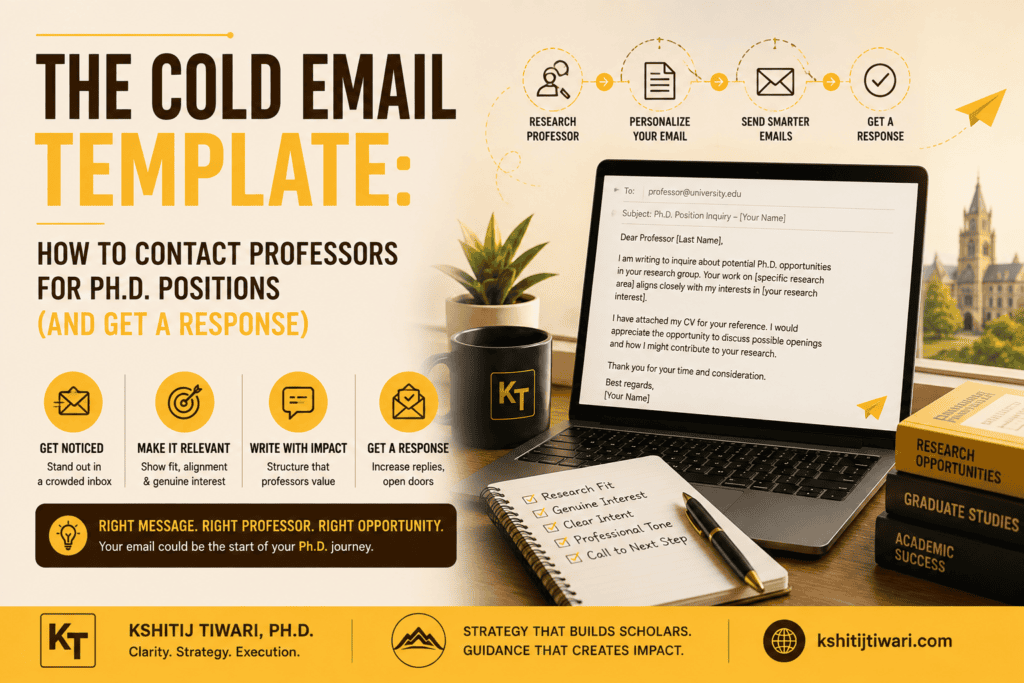
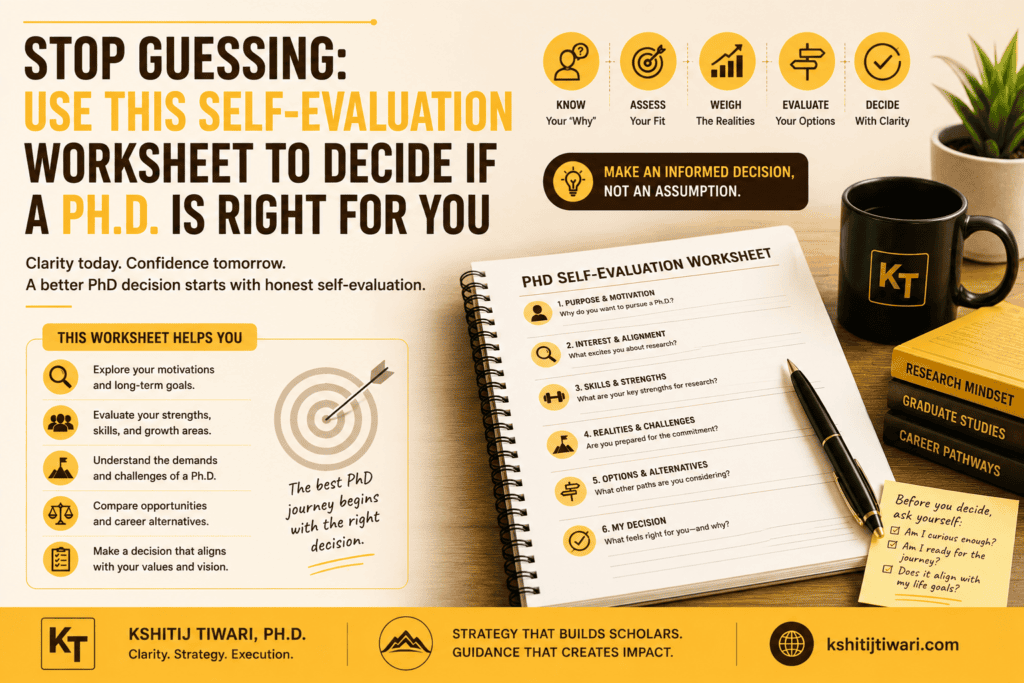
Before sending your first email to a prospective advisor, evaluate whether a PhD is actually the right investment for you. Then investigate the research topic, program, funding, laboratory, and advisor as one connected system.
And when you finally compare potential supervisors, don’t ask only:
“Who is the most impressive professor?”
Ask:
“Under whose supervision am I most likely to become the researcher I want to become?”
That is the question that matters.
Think You’ve Found the Right PhD Advisor? Test the Fit Before You Commit.
Advisor–advisee fit is too important to leave to intuition, reputation, or a single interview. Use the PhD Supervisor Compatibility Assessment to evaluate your potential supervisor across the eight dimensions of fit—and identify potential mismatches before they become PhD problems.