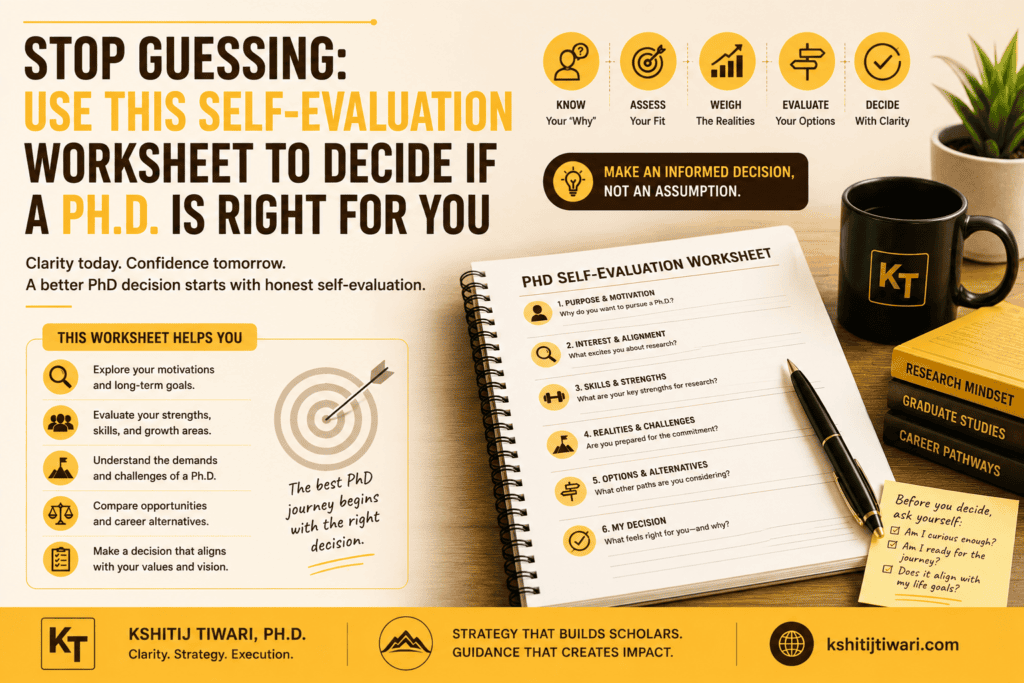
Securing a Ph.D. position is less about filling out an online form and more about initiating a conversation- with yourself to ensure PhD is the right choice for you and you fit well with your prospective PhD advisor. Before your application even hits the system, you must make a compelling case for yourself directly to the professor who will become your advisor. This is where the cold email becomes your most powerful tool but there is a catch to it.
A poorly executed cold email is instantly deleted. A great one, however, can bypass the administrative noise, land your application directly on the professor’s desk, and secure you an interview. This post breaks down the precise structure, strategy, and template required to craft an email that stands out and gets a response.
 Related Resource: This article is part of the Unwritten PhD Resource Library—a comprehensive collection of guides, decision frameworks, and practical resources covering every stage of the PhD journey, from choosing a research topic and applying for a PhD to publishing papers, managing burnout, and planning your career after graduation.
Table of Contents
ToggleWhy the Cold Email is Non-Negotiable
For competitive Ph.D. programs, especially in specialized technical fields like robotics, AI, or engineering, a professor often receives hundreds of generic inquiries per year. Your goal is not to simply hit apply, but to demonstrate that you are a pre-qualified candidate who has done their homework.
Signals Serious Intent: A tailored email shows you are targeting their specific work, not just any Ph.D. slot.
Bypasses the “Black Hole”: Many formal applications vanish into administrative systems. An email from a professor to the admissions team is a fast track.
Assesses Lab Fit: It’s your chance to determine if the professor is currently taking students and if your research interests truly align with the lab’s direction. This is all the more crucial if you planning to do a PhD abroad.
Gives You an Edge: A pre-established rapport can turn a competitive “maybe” into a definite “yes.”
- First Movers Advantage: Sometimes you might end up reaching out a bit too soon but like this, you’d likely get to know when an opportunity is being advertised so you can plan ahead.
Phase 1: The Essential Strategy Before You Write
Before you touch the keyboard, you must conduct meticulous research. The quality of your research directly correlates to the persuasiveness of your email.
1. Identify Your Target and Research Deeply
Pinpoint Specific Papers: Do not just read the professor’s main research page. Read their three most recent publications (ideally within the last 1–3 years). Focus on the papers that align most closely with your background.
Find the Gap: Identify a specific challenge, limitation, or future work mentioned in their latest paper. This shows you understand their cutting-edge work and can contribute a novel idea.
Verify Funding/Availability: Check the professor’s lab website, LinkedIn, or recent news to see if they have advertised any funded Ph.D. positions or are explicitly looking for students. This saves everyone time.
2. Verify Contact Information and Protocol
Use the University Email: Always use the official university email address.
Check Lab Websites: Some professors prefer you contact a specific lab manager or senior Ph.D. student first. Always follow the stated protocol.
Time it Right: Professors are often busy at the start and end of semesters. Aim for the middle of a term, and send your email during local business hours (9 AM – 5 PM) to ensure it appears near the top of their inbox when they check it.
Phase 2: The Ultimate Cold Email Template (with Deconstruction)
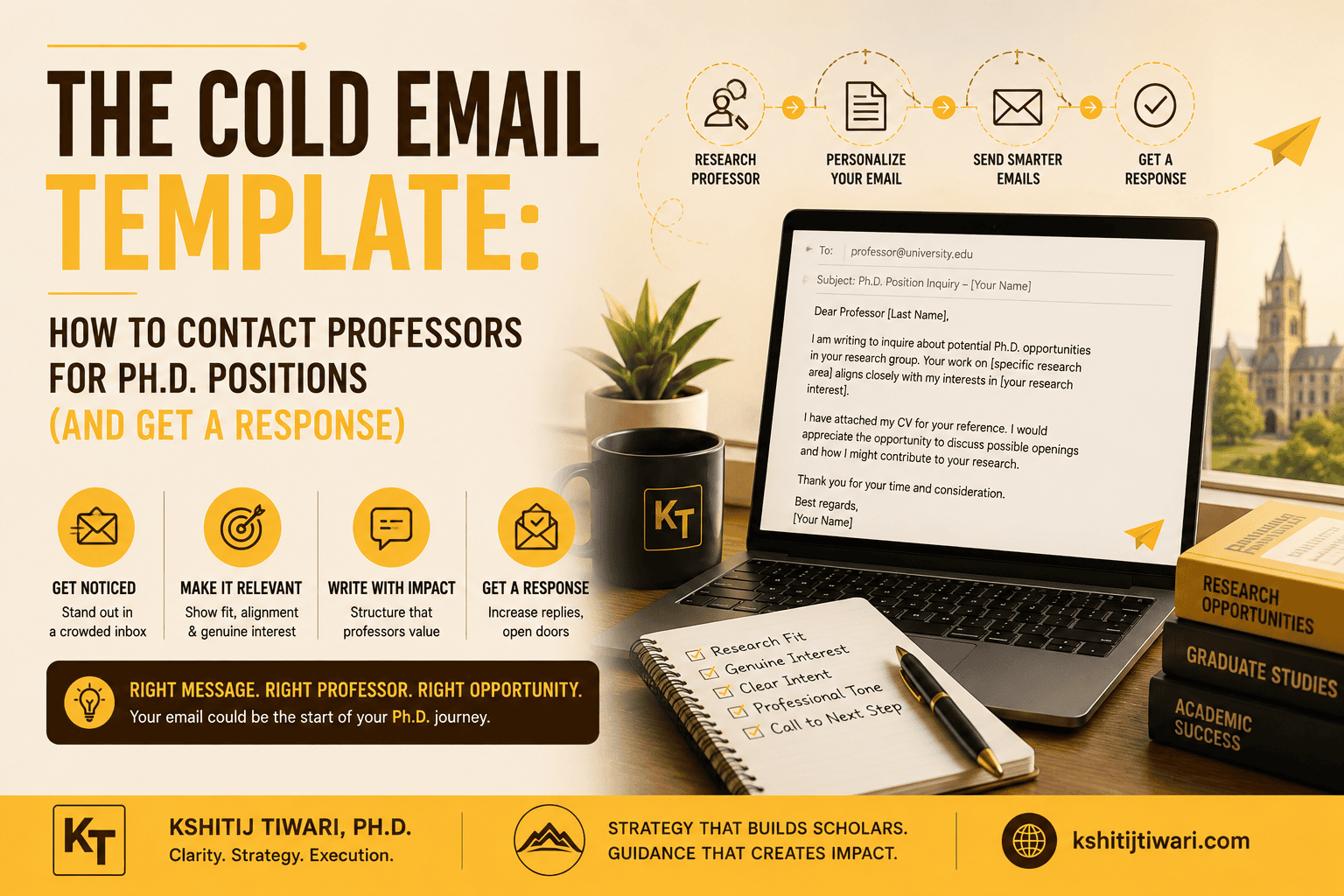
Here is a time-tested, high-response-rate template designed to be brief, respectful, and impactful.
1. The Subject Line (The Gatekeeper)
The subject line must be precise and non-generic. It should immediately communicate two things: your intent and your relevant expertise.
Do This ✅
Not This ❌
Why it Works
Ph.D. Inquiry: Alignment on [Specific Paper Topic] + [Your Skill/Project]
Ph.D. Position Inquiry
Too generic; instantly deleted.
Prospective Ph.D. Student (Master’s in X) interested in your work on [Specific Algorithm]
Interested in Ph.D. opportunities
Vague; sounds like you haven’t researched.
2. The Salutation and Introduction (The Hook)
Be formal and get straight to the point. Never start with flattery.
Dear Professor [Last Name],
My name is [Your Name], and I am a [Your Current Status: e.g., Master’s student at X University, Senior Engineer at Y Company] with a strong research interest in [Professor’s Specific Subfield]. I am writing to inquire about the possibility of joining your research group as a prospective Ph.D. student for the [Specify Semester/Year: e.g., Fall 2026] intake.
3. The Alignment Paragraph (The Proof of Research)
This is the most critical paragraph. It must demonstrate you have read and understood their recent work. Be specific and cite an exact piece of their work.
I have been following your lab’s work on [Professor’s Project Name/Area], particularly your recent paper, “[Specific Paper Title],” published in [Journal/Conference Name]. I found your approach to [Specific Technical Detail, e.g., the unified framework for operational range estimation] highly innovative. In particular, I believe the challenge you noted regarding [Specific Limitation/Future Work mentioned in the paper] could be further explored by integrating [Your Specific Idea/Skill, e.g., a data-driven battery aging model] into the recursive online estimator.
4. Your Qualification Paragraph (The Value Proposition)
Connect your experience directly to their lab’s needs. Use quantifiable achievements if possible.
My background in [Your Field, e.g., Control Systems and Embedded C++] provides a solid foundation for this work. In my Master’s thesis, “[Your Thesis Title],” I designed and implemented [Quantifiable Achievement, e.g., a 90% accurate localization system for ground robots], which utilized [Specific Software/Methodology, e.g., ROS and Bayesian filtering]. I am proficient in [List 2-3 relevant tools/languages: e.g., Python, MATLAB, C++].
5. The Call to Action (The Next Step)
Keep the requested action simple and low-commitment for the professor. Don’t ask for a one-hour meeting immediately.
I have attached my CV and transcript for your review. Would you be open to a brief 15-minute meeting in the coming weeks to discuss your current research directions and how my background in [Specific Skill] might align with the ongoing work in your lab?
6. The Closing
Thank you for your time and consideration. I look forward to hearing from you.
Best regards,
[Your Full Name] [Your Contact Phone Number] [Link to your personal/professional website or LinkedIn]
Phase 3: Essential Do’s and Don’ts
Following the template is only half the battle. Your conduct and attention to detail must be flawless.
Do This ✅
Not This ❌
Keep it under 300 words. Professors are busy. Clarity and conciseness demonstrate professional respect.
Send a generic email. Copy/pasting the same email to ten different professors is the fastest way to the trash folder.
Attach a current CV/Resume and an unofficial transcript (combined into one PDF is easiest).
Use informal language, emojis, or slang. Maintain a strictly professional and respectful tone.
Proofread meticulously. Typos, especially in the professor’s name or paper titles, are fatal errors.
Demand a response or meeting. The tone should always be one of respectful inquiry, not entitlement.
Follow up once after 7–10 business days if you haven’t received a response. Keep the follow-up brief (“Just checking that this email reached you”).
Only talk about yourself. Frame your qualifications in the context of what you can contribute to their lab’s existing work.
Use your professional email address (e.g., your university account), not a casual or obscure personal address.
Forget to address their stated hiring protocol. If the website says “Email Lab Manager X,” do that.
By mastering this strategy and tailoring this cold email template, you transform a desperate plea for admission into a professional proposition of collaboration, significantly increasing your chances of securing that coveted Ph.D. position.
Example Cold Email Outreach for PhD position in Robotics
Subject: Prospective PhD: Alignment on [Professor’s Key Research Area] & [Your Relevant Technical Skill]
Dear Professor [Last Name],
My name is [Your Name], and I am a Master’s graduate in [Specialization] from [University Name with Department and Year].I am writing to inquire about the possibility of joining your research group as a prospective Ph.D. student for the [Specify Intake Year, e.g., Fall 2026] intake.
I have been following your lab’s work on [Professor’s Key Research Area, e.g., persistent autonomy], particularly your recent paper, “[Specific Paper Title],” published in [Journal/Conference Name]. I found your approach to [Specific Technical Detail from the paper] highly innovative.
In particular, I believe the challenge you noted regarding [E.g.: adaptive power regulation under localized thermal load] could be significantly mitigated by integrating a novel, decentralized energy management system. My Master’s thesis on [E.g.: Resilient Power Scheduling for Ground Robotics] provided me with extensive experience in developing and deploying embedded C++ control systems, which directly aligns with the real-time requirements of your current platform.
I have working knowledge of [List 2-3 relevant tools/languages: e.g., control theory, ROS 2, and embedded development].
Would you be open to a brief 15-minute introductory call next week to discuss your current grant directions and how my background in [Your Specific Technical Skill] might contribute to your persistent operations initiative?
I’d be happy to share my updated CV and transcripts if you’d like to take a look.
Thank you for your time and consideration.
[Sign off with name]
[Current affiliation]
Notice how the aim here to be brief, highlight why you see synergies and do not add PDFs or any similar attachments unless asked for. Professors get a lot of emails and if the mailbox starts to fill up, it’s the emails with bulky attachments that get trashed the fastest. Wait for them to guide you with the next steps.
Considerations before sending the cold email
By now, you would have a pretty good idea of what you want to write. The question then is, who should you send this cold email to? Not every prospective PhD advisor is going to align with you and vice versa.
Everyone, including you as the scholar, has their own style of work. So, before you hit send on that cold email, you need to evaluate the PhD advisor-advisee fit too. This is not simply about whether your research interests overlap; it is also about understanding how you work, what kind of supervision you need, and whether the prospective research environment is likely to support your goals. If you are unsure how to evaluate these factors objectively, independent PhD guidance can provide an external perspective before you commit to a particular supervisor or PhD opportunity. This helps you ensure that if you are given an opportunity to pursue your PhD, you will likely thrive and not regret reaching out.
Pro-Tip: Struggling to find the right words? Use our PhD Communication Vault to get instant templates for contacting supervisors and collaborators without the “Delete” key anxiety.
Ready for a Strategic Discussion?
Your robotics project or academic career deserves a strategic roadmap built on international, Ph.D.-level expertise. Let’s map out your path to accelerated results.