You’re a robotics founder with cutting-edge hardware, investor interest, and a clear vision. But there’s a problem: your robotics software hiring is stalled. Key roles remain open for months, leading to missed milestones, increased burn rate, and a growing frustration within your R&D team. It’s a pervasive issue in the mobile autonomy sector, a silent killer of promising startups. The question isn’t whether the talent exists, but why you can’t seem to attract, vet, and retain it.
This isn’t just a “recruitment problem”; it’s a technical strategy problem. It is often a symptom of a larger robotics R&D strategy and organizational design problem. As a Fractional CTO, I’ve seen firsthand how an unoptimized R&D environment creates an invisible barrier to hiring, turning top-tier candidates away. Let’s dissect this bottleneck and provide actionable solutions.
Table of Contents
ToggleThe "Unicorn" Trap: The Myth of the Full-Stack Robotics Engineer
Many startups unknowingly set themselves up for failure by chasing a mythical “unicorn”—a single engineer who is an expert in everything:
Perception: SLAM, computer vision, lidar processing, sensor fusion.
Control: Kinematics, dynamics, motion planning, real-time control loops.
Embedded Systems: RTOS, microcontrollers, low-level drivers, power management.
Software Engineering: ROS 2, C++, Python, CI/CD, cloud deployment.
Such a person rarely exists, and if they do, they’re likely leading an established team or starting their own venture. When you search for this “unicorn,” you alienate highly competent engineers who specialize in one or two of these critical areas. This leads to:
Extended Hiring Cycles: Months become quarters, and your product roadmap slips.
Compromised Quality: Settling for a “generalist” who lacks depth in crucial areas.
Burnout & Churn: Overburdening new hires with an impossibly broad scope.
The solution isn’t to find a unicorn, but to build an environment where specialized talent can thrive and integrate seamlessly.
Infrastructure as a Hiring Magnet: Beyond Ping-Pong Tables
Top-tier robotics talent isn’t swayed by flashy office perks. They’re attracted to engineering excellence. If your R&D environment is characterized by:
Ad-Hoc Prototyping: A “move fast and break things” mentality that never transitions to “build robust and scale.”
Spaghetti Code: Undocumented ROS 2 nodes, untracked dependencies, and a lack of CI/CD.
“It Works on My Machine” Syndrome: Inconsistent development environments, manual deployments, and brittle testing.
The “Integration Gap”: Your hardware and software teams operate in silos, leading to constant friction and last-minute fixes.
…then even if you somehow hire a great engineer, they won’t stay. They’ll quickly realize that their time is spent fighting technical debt rather than building innovative solutions. This is why your Robotics System Integration strategy is directly tied to your hiring success. A well-architected system is a magnet for talent.
The Cost of "Bad" Technical Debt: Why New Hires Can't Contribute
Technical debt isn’t just “dirty code”; it’s a structural flaw that makes new hires unproductive. When your existing codebase is:
Undocumented: No clear API, no READMEs, no design philosophy.
Brittle: Changes in one module break five others.
Monolithic: Difficult to modularize and assign distinct work packages.
…then onboarding an engineer becomes a months-long process of deciphering arcane logic. Their first three months are spent understanding the “why” of the existing system, not adding value. This high friction leads to:
Delayed Time-to-Value: New hires are expensive, and their productivity is delayed.
Frustration & Churn: Talented engineers quickly seek environments where they can make an immediate impact.
Compounding Debt: The cycle continues as shortcuts are taken to meet immediate deadlines.
This isn’t a problem a recruiter can solve; it’s a fundamental issue with your R&D architecture.
The Strategic Solution: Architecting for Talent Acquisition
Solving the robotics software hiring bottleneck requires a strategic shift from reactive recruitment to proactive engineering infrastructure development. This is where the role of a Fractional CTO (FCTO) becomes invaluable.
Define Roles with Precision: Instead of a “robotics software engineer,” break down your needs:
“ROS 2 Middleware Engineer” (focused on QoS, DDS tuning, and message passing).
“Perception Engineer” (specializing in sensor fusion and robust state estimation).
“Motion Control Engineer” (focused on kinematics, path planning, and embedded C++).
An FCTO can help you build these precise job descriptions and design technical interview processes that accurately vet these specialized skill sets.
Build a “Hiring-Ready” R&D Environment:
Implement a V-Model: Move from ad-hoc prototyping to a structured Systems Engineering V-Model that integrates validation and verification from day one.
Optimize ROS 2 Middleware: Ensure your ROS 2 stack is clean, documented, and optimized for performance. Top talent wants to work with deterministic and scalable systems, not debugging basic communication issues.
Robust CI/CD & Testing: Automate your build, test, and deployment pipelines. Engineers love clean environments where their code goes to production reliably.
Pro-Tip: Tools like my Robo-Kinetix Builder can simplify complex design logic and validate kinematic trees before coding begins, setting a higher standard for your R&D environment. This demonstrates a commitment to robust tooling, which attracts quality candidates.
Cultivate a “PhD Mentorship Framework”:
Clear Onboarding: Create structured onboarding processes with clear documentation, code walkthroughs, and defined initial tasks.
Growth Paths: Define career progression within your specialized technical roles. Top talent wants to see a future.
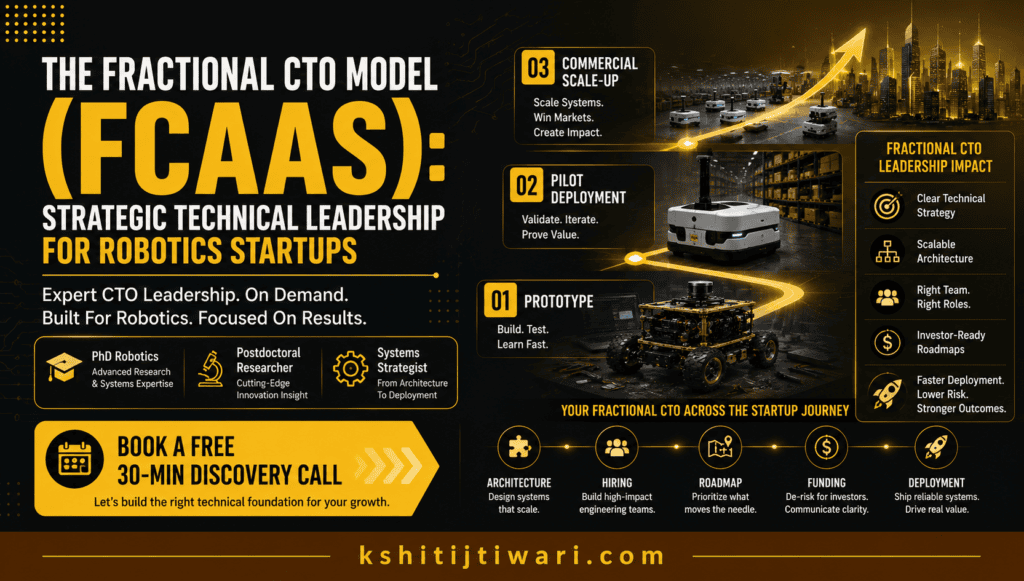
Knowledge Transfer: Foster a culture of rigorous documentation and code reviews, enabling seamless knowledge transfer to new hires. This is a core component of my Fractional CTO Model (FCAAS), ensuring that institutional knowledge isn’t bottlenecked by individual engineers.
Key Takeaways
The robotics software hiring bottleneck isn’t a symptom of a talent shortage; it’s a symptom of a missing strategic technical architecture. By shifting focus from chasing mythical “unicorns” to cultivating an environment of Systems Integrity, clear technical roles, and efficient onboarding, you transform your R&D into a talent magnet.
If your hiring bottleneck is actually being caused by unclear architecture, roadmap ownership or lack of senior technical direction, a Fractional CTO may solve the underlying problem more effectively than simply adding another engineer.
Don’t just fill open roles; architect a robust pipeline for engineering excellence. As your Fractional CTO, I specialize in building the technical frameworks that attract, empower, and retain the specialized talent your robotics startup needs to cross the finish line.
Ready for a Strategic Discussion?
Your robotics project or academic career deserves a strategic roadmap built on international, Ph.D.-level expertise. Let’s map out your path to accelerated results.