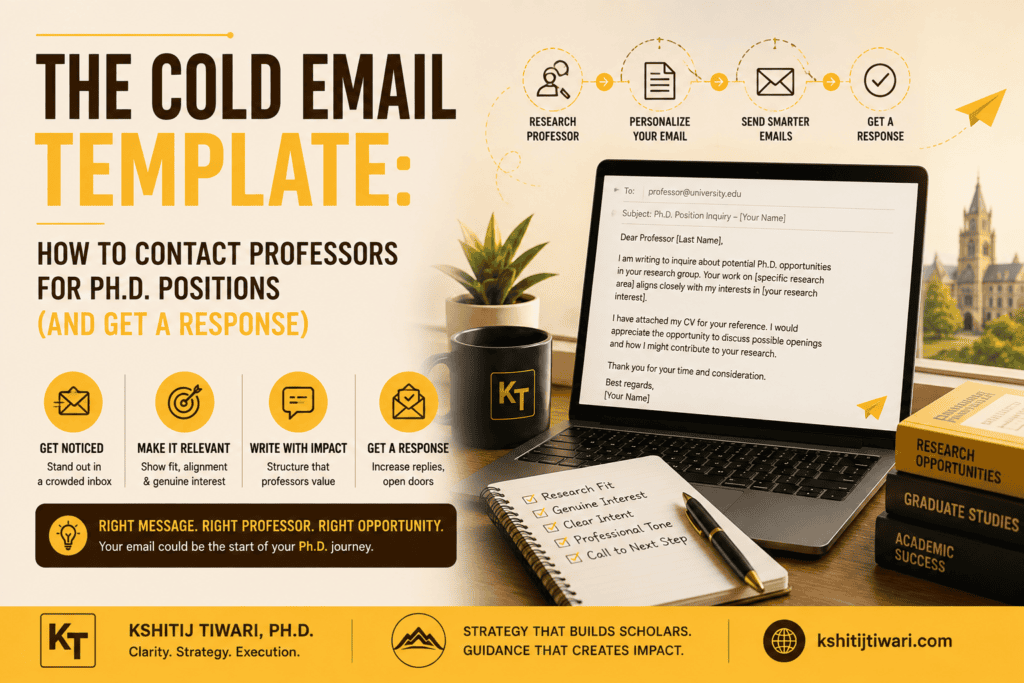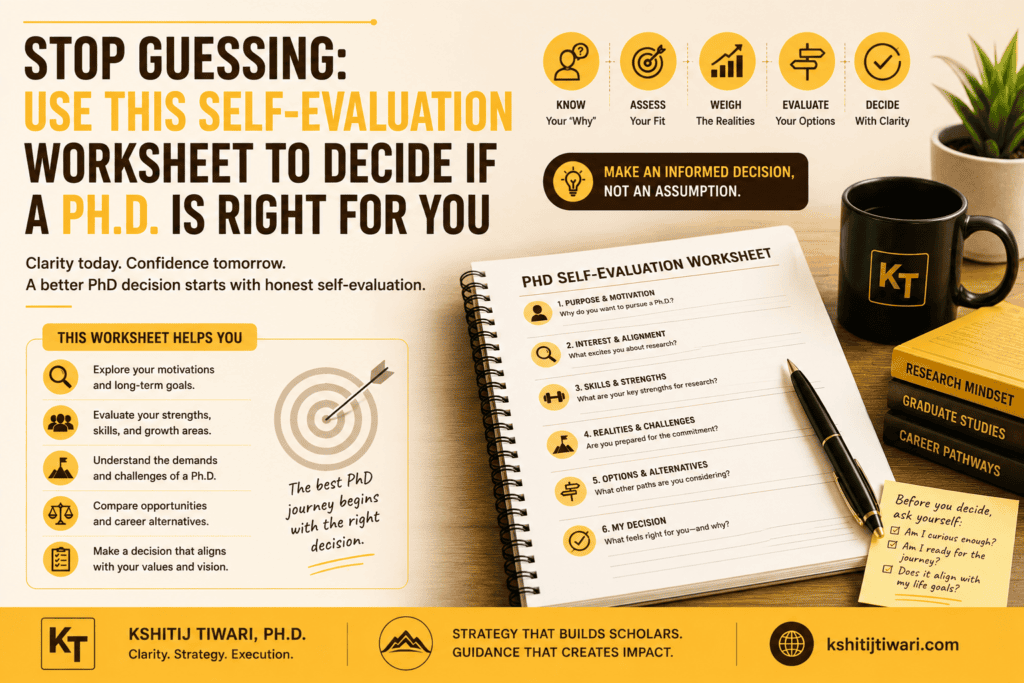
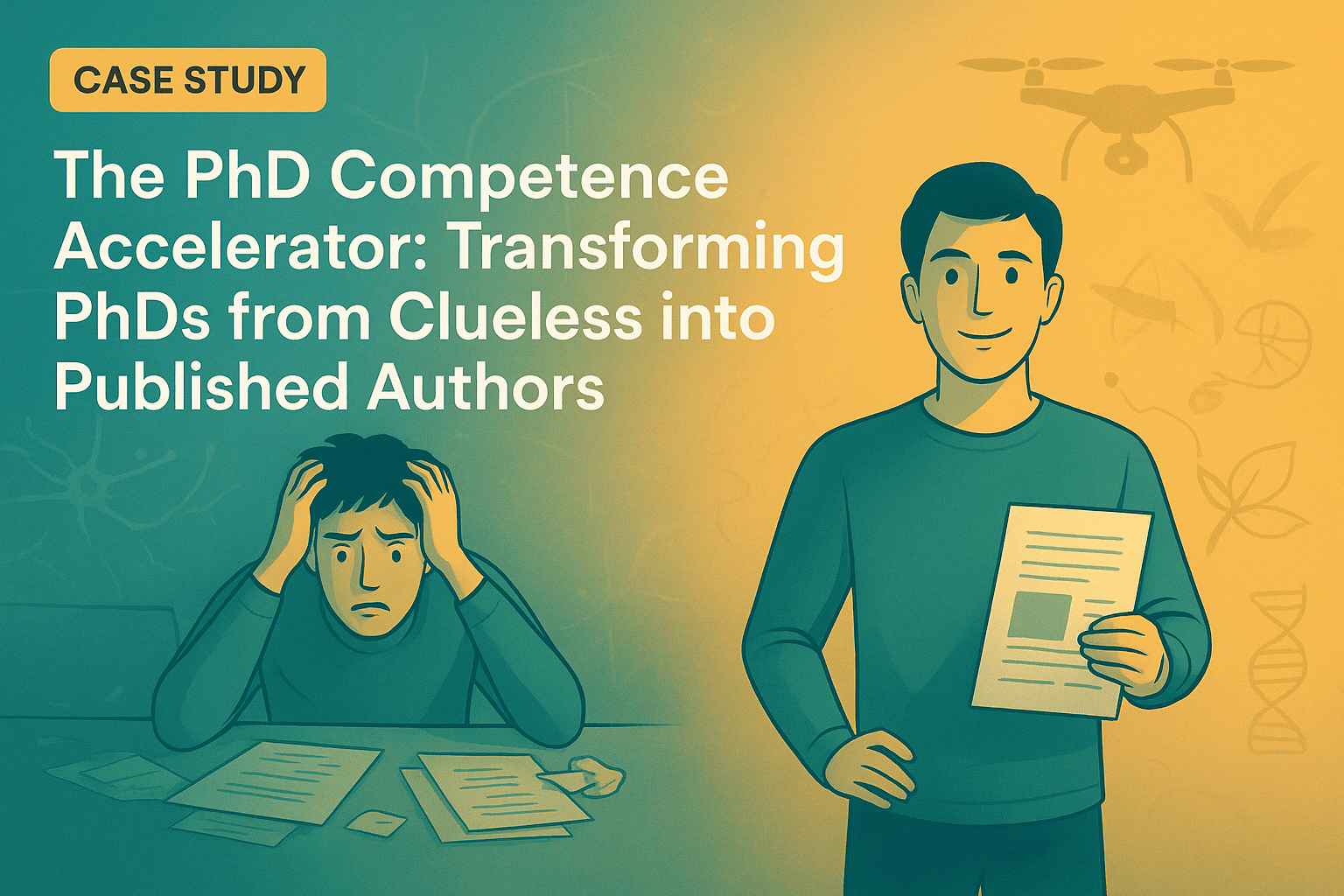
The doctoral journey begins long before the first lab experiment, starting with the complex decisions of application and preparing customized PhD Statement of Purpose (SOP) and prospective advisor identification. Yet, the core mission remains the same: transforming intelligent PhD scholars into independent researchers.
Despite the initial vetting, many PhD candidates stall. They struggle not with the technical demands of their field, but with the process of R&D—namely, defining a novel question, structuring a compelling argument, and navigating peer review. This competence gap is the root cause of the “PhD Competence Crisis,” leading to delayed graduations, high stress, and wasted research funding. This is why relying on traditional consulting often fails technical PhDs.
This case study examines the impact of the PhD Competence Accelerator, a highly structured, data-driven PhD Mentorship Framework designed to rapidly build research competency. By codifying the non-obvious skills of R&D—the skills that determine the Real Cost vs. Value of the entire degree—we transform “clueless” novices into published, high-impact authors. We will detail the four-phase methodology and provide the evidence proving its success.
 Related Resource: This article is part of the Unwritten PhD Resource Library—a comprehensive collection of guides, decision frameworks, and practical resources covering every stage of the PhD journey, from choosing a research topic and applying for a PhD to publishing papers, managing burnout, and planning your career after graduation.
Table of Contents
ToggleThe Challenge: Defining the PhD Competence Crisis
A student struggling with competence is not a failure of intellect, but a failure of system. The “clueless” PhD candidate typically exhibits predictable, costly bottlenecks:
Analysis Paralysis: Inability to narrow a broad topic into a specific, high-stakes Minimal Publishable Unit (MPU).
The “Technical Dump”: Writing papers that focus solely on methodology and data, failing to lead with the novelty and strategic impact required by top-tier journals.
Process Aversion: Viewing the peer-review cycle as an obstacle rather than a structured path to refinement.
The Cost of Lacking a Structured PhD Mentorship Framework
The lack of a structured PhD Mentorship Framework directly impacts the bottom line of R&D:
Increased Time-to-Graduation: Every extra year costs the institution, the supervisor, and the student.
Rework and Redundancy: Vague research questions lead to wasted experiments and irrelevant data collection.
Reputation Risk: High-quality research remains unpublished, diminishing the lab’s academic authority.
The Solution: Our Structured PhD Mentorship Framework
The PhD Competence Accelerator is a four-phase methodology that replaces abstract guidance with clear, repeatable systems. It teaches students to think like an Editor.
Phase 1: Question Deconstruction & Blueprinting (Competence Building)
Methodology: We force the early definition of the Novelty Statement and the Defensible Research Question (RQ). Students use a structured template to perform a Gap Analysis of existing literature based on a rigorous narrative literature review, ensuring their RQ is both novel and feasible.
Competency Acquired: Strategic Ideation and Scope Management. You don’t want to end up picking a topic too broad or too niche for your technical PhD.
Phase 2: Minimal Publishable Unit (MPU) Design (The “What”)
Methodology: The entire thesis is broken into 3-5 distinct, high-impact publications. Each MPU is treated as a separate product. This shifts the focus from a single, overwhelming thesis to achievable, confidence-building milestones. This number may vary in order to accommodate the minimal PhD graduation requirements of your School/Department/Institute/Advisor.
Competency Acquired: Project Segmentation and Milestone Planning.
Phase 3: The Editorial Mindset Writing System (The “How”)
Methodology: Intensive training on the Inverse Pyramid Structure for scientific writing. Students learn to frame the paper around the Contribution (the “takeaway message”) in the first paragraph, reserving technical methodology for the middle.
Competency Acquired: High-Impact Scientific Communication and Persuasive Writing.
Phase 4: High-Velocity Publication Pipeline (The “When”)
Methodology: Implementation of mandatory, small-volume, high-frequency “Writing Sprints” and early internal peer review. The goal is a first-submission-ready manuscript within 12-18 months of your PhD journey, often leading to a publication before the third year review.
Competency Acquired: Process Discipline, Time Management, and Review Defense.
The Professional Edge: A core part of building PhD competence is mastering the “Editorial Mindset” in your professional interactions. Our students use the PhD Communication Vault as a tactical shortcut to streamline their high-stakes R&D communication.
Results and Evidence: Validation of the Accelerator Model
The ultimate validation of a PhD Mentorship Framework is the successful publication of its students. The Accelerator’s focus on structured competence yields predictable results, evidenced by the feedback from our successful authors:
Testimonial 1: The Transformative Mentorship Experience
“Since the beginning of my PhD… I have had the pleasure to work with [Kshitij] as my supervisor. Together we have overcome many challenges, published multiple papers and, most importantly, had fun together. [He] is very versatile, organized, self-confident and always ready to push himself… It is inspiring and motivating to work with [him] and he is always ready to help with his experience. Thank you for introducing me to the work as a researcher, teaching me the tricks of the trade and for the good times.”
— Dr. O.S., PhD Mentee
Competency Demonstrated: Full-Stack Competence & Publication Pipeline (Phase 1-4). This testimonial validates the framework’s ability to drive multi-paper publications and instill the essential “tricks of the trade”—the non-obvious process skills that define a competent researcher.
Testimonial 2: Strategic Thinking and Achievement
“From the first day… you were very affable, supportive and eager to help. I was astonished by your dedication and inspired by your diligence. You were always thinking about the next step and it was this provident thinking that we were able to achieve so much in the short amount of time we had together. Thank you for making my brief stay… so wonderful and productive.”
— A.M., Summer Intern
Competency Demonstrated: Question Deconstruction & High-Velocity Pipeline (Phase 1 & 4). The focus here is on strategic, provident thinking—the ability to plan several steps ahead—which is the core skill taught in the Accelerator for achieving high productivity and rapid results.
Testimonial 3: Structure Meets Autonomy
“I really enjoyed working with you during the summer. My favorite part was that you allowed me to have a lot of responsibility and control over the project, but was also always there when I had questions or doubts. The working environment had a nice balance of being both friendly and stress-free on one side and inspiring to be hardworking on the other.”
— O.S., Summer Intern
Competency Demonstrated: Process Management & Independence (Phase 2 & 4). This feedback highlights the framework’s success in fostering independence (control over the project) while providing a safety net (always there for doubts). The goal is competent autonomy, not constant supervision.
Testimonial 4: Organized Approach and Feasibility
“The lectures were really fun and I enjoyed doing projects with you. I liked your organized approach towards doing research and it helped me formulate ideas and break them down into feasible problem statements.”
— H.V., PhD Mentee
Competency Demonstrated: Question Blueprinting (Phase 1). This directly affirms the framework’s success in one of the most common student struggles: taking vague ideas and transforming them into feasible, organized problem statements—the foundation of the Minimal Publishable Unit (MPU).
Key Takeaways
The four-phase Competence Accelerator proves that achieving publication success is not about natural genius; it’s about process mastery. You don’t have to spend years in a state of “clueless” stress waiting for abstract guidance. The most powerful choice you can make is demanding or implementing a structured PhD Mentorship Framework for your own work.
Your degree’s value is defined by your publications, and your publications are defined by your process.
The Competence Accelerator is your blueprint to seize control over your research career:
Own Your Process: Move beyond guessing to a data-driven system for defining the Minimal Publishable Unit (MPU) and achieving publication velocity.
Maximize Your Value: By turning your deep domain knowledge into guaranteed, high-impact publications, you significantly increase your market value for both academic and industrial leadership roles.
Build Lasting Competence: You won’t just finish the PhD; you will graduate as a fully equipped R&D author, ready to lead the next generation of scientific inquiry.
The question is no longer “Can I succeed?” but “Will I adopt the system that guarantees success?”
It’s time to transition your approach from passive hope to active, results-driven mastery. If your current supervision lacks this framework, you need the tools to provide it for yourself.
Ready for a Strategic Discussion?
Your robotics project or academic career deserves a strategic roadmap built on international, Ph.D.-level expertise. Let’s map out your path to accelerated results.