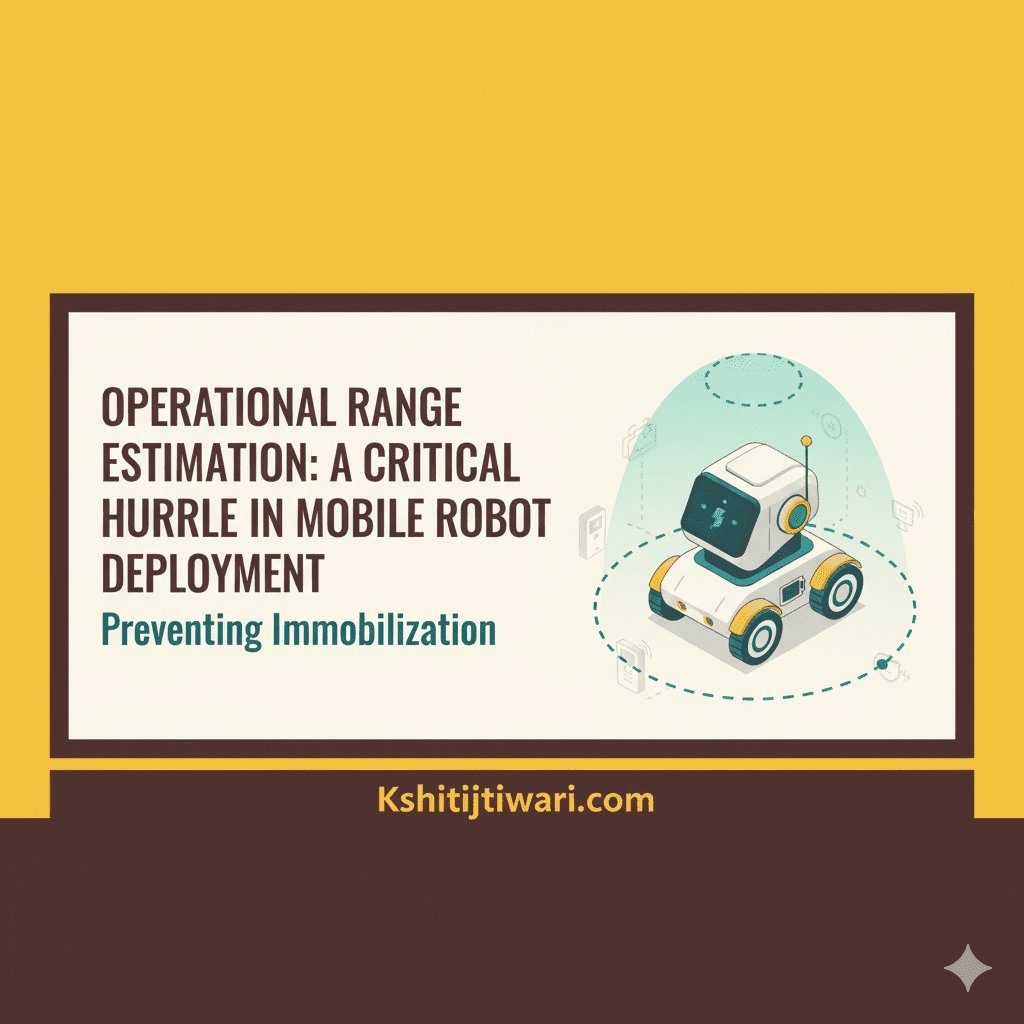
Mobile robots—from Autonomous Mobile Robots (AMRs) in logistics to Unmanned Ground Vehicles (UGVs) in exploration and defense—are transforming countless industries. They promise efficiency, reduced risk, and 24/7 operation. Yet, this promise hinges on a single, finite resource: battery power.
Unlike manned vehicles that operate on predictable fuel gauges, mobile robots face a much more complex challenge: accurately determining their Operational Range i.e., operational range estimation. This is not simply a matter of reading a voltage meter; it’s a dynamic, multi-variable problem that, if left unsolved, leads to the most critical deployment failure: complete immobilization (a robot running out of power mid-mission, often in a remote or dangerous area).
Accurate Operational Range Estimation is, therefore, a fundamental hurdle that must be cleared for the successful, reliable, and safe deployment of any battery-powered mobile robot fleet.
Table of Contents
ToggleWhat is Operational Range Estimation?
Operational Range Estimation is the process of predicting the maximum distance a mobile robot can travel on a single battery discharge cycle (i.e. starting out with 100% charged battery), given the planned activities, current environmental conditions, and the robot’s own hardware profile.
This estimation allows the robot (or its operator) to make mission-critical decisions, such as:
Go/No-Go: Can the robot reach its target and safely return to a charging station?
Path Planning: Which route minimizes energy consumption?
Resource Allocation: How much battery power must be reserved for ancillary functions (like sensing and communication) versus movement?
The Multi-Faceted Challenge: Why Standard Battery Gauges Fail
Electric vehicles (EVs) have complex range estimators, but they benefit from predictable environments (roads) and a drive system that consumes the vast majority of power. Mobile robots, however, are different. They move slower, operate in dynamic or unstructured environments, and rely heavily on ancillary components. Thus, the physics doesn’t scale linearly from an EV to a mobile robot neither does the range estimation method.
The difficulty in accurate range estimation stems from the complex interplay of several major power consumers and external factors:
Factor
Description
Impact on Range
Ancillary Energy
Power consumed by non-propulsion components: LiDAR, depth cameras, on-board processors, communication radios (Wi-Fi/5G), and safety systems.
Constant, significant draw. Unlike EVs, this can be the majority of consumption for a slow-moving robot actively sensing its environment.
Maneuvering (Propulsion) Energy
Power consumed by motors for movement and steering.
Highly variable, influenced by speed, acceleration, payload, and the terrain over which the movement is carried out.
Robot Kinematics/Dynamics
The mechanical model of the robot (e.g., wheeled, tracked, legged, drone). Different systems have vastly different power-to-movement efficiencies.
A wheeled robot on pavement has a much better mechanical efficiency than a tracked robot in sand, directly impacting range.
Operational Environment (ODD)
Operational Design Domain (ODD) factors like terrain changes (e.g., carpet vs. concrete, uphill vs. flat), wind gusts, or obstacles requiring highly agile maneuvers.
Unforeseen disturbances spike energy consumption unpredictably, rapidly shrinking the remaining range.
Mission Profile/Agility
The task at hand—a straight patrol vs. a search-and-rescue mission involving frequent stopping, starting, and turning.
High agility and frequent speed changes drastically increase energy consumption compared to nominal, constant-velocity travel.
Battery Model
The non-linear chemical dynamics of the battery itself (e.g., charge depletion rate is not linear; capacity degrades over time).
Simple voltage readings are inadequate; a chemical model is needed for precision.
Two Approaches to Range Estimation
To overcome these complexities, advanced mobile robots utilize two main methodologies for modeling energy consumption and estimating range:
1. Offline One-Shot Estimation (The A Priori Model)
How it works: A human supervisor, or a high-level planner, approximates the total energy demand before the mission starts. This often uses averaged or idealized models based on laboratory tests and the planned path.
Process:
Define the mission path and duration.
Use a predetermined energy consumption model (e.g., Etotal=Epropulsion+Eancillary) with coefficients derived from prior testing.
The result is a single range value, assumed to hold for the duration.
Limitation: This is a static (open loop) model. It fails when the environment or mission profile deviates significantly from the initial plan—which is a frequent occurrence in real-world deployment. A sudden change in friction (e.g., driving onto wet ground) or an unpredicted path deviation renders the original estimate instantly inaccurate. An offline model estimated an average accuracy of only 82.97% in our study, highlighting its limitations for critical missions.
2. Online Recursive Range Estimation (The Dynamic Model)
How it works: This is a dynamic, real-time approach that constantly updates the remaining operational range as the mission unfolds. It is essential for minimizing the probability of complete immobilization.
Process:
Sense & Measure: The robot continuously monitors actual energy consumption (current draw, voltage) across all components (propulsion, ancillary).
Estimate Remaining Energy: A recursive estimator (often based on a Kalman Filter or similar state-space model) tracks the battery state of charge (SoC) based on the real-time drain.
Predict Future Demand: The estimator accounts for the probability of future energy demands (e.g., predicting the energy needed to traverse the remaining path and return to base).
Update Range: A safe, guaranteed return path is recalculated based on the updated remaining energy.
Benefit: This model is resilient to unforeseen circumstances. By recursively updating its estimate, it learns from immediate environment changes and can signal a critical battery warning much earlier. Online models have demonstrated significantly higher accuracy, with one example achieving an average accuracy of 93.87% in field trials.
Preventing Immobilization: The Ultimate Goal
The ability to accurately predict operational range is synonymous with operational success. For a drone, it means avoiding a crash; for a logistics AMR, it means avoiding a costly system stoppage; and for a search-and-rescue UGV, it means guaranteeing a safe return.
Deployment strategies must incorporate range estimation not as a feature, but as a core safety and planning layer. This includes:
System Identification: Rigorously measuring all forms of energy loss (mechanical friction, motor losses, ancillary heat loss) to build a high-fidelity internal model.
Mission-Informed Planning: Integrating the range model directly into the path planner, turning energy into a constraint. The robot should choose the most energy-efficient path, not just the shortest or fastest.
Adaptive Control: Allowing the robot to adjust its operational parameters (e.g., reducing sensor refresh rate or lowering cruising speed) when the online estimator signals that the safe return margin is shrinking.
Key Takeaways
In the competitive landscape of mobile robotics, the difference between successful deployment and costly failure often comes down to power management. The complexity of modeling energy dissemination across motion, sensing, and ancillary functions in dynamic environments makes Operational Range Estimation a far more challenging problem than a simple “fuel gauge” for EVs.
By shifting from static, offline approximations to dynamic, online recursive range estimation, robot manufacturers and operators can unlock new levels of autonomy, ensure mission success, and, most importantly, prevent the mission-ending crisis of complete robot immobilization. The future of mobile robotics depends on the reliability of its energy predictions. If you are unsure how to incorporate operational range estimation with your own mobile robot platform, you can hire me as a Fractional CTO for your firm and we can chart out a plan to integrate dynamic range estimation for your robot to avoid immobilization during operations.
Ready for a Strategic Discussion?
Your robotics project or academic career deserves a strategic roadmap built on international, Ph.D.-level expertise. Let’s map out your path to accelerated results.