You didn’t sign up for a PhD to be miserable. You put in the efforts to apply, wrote cold emails to prospective advisors, and started your PhD because of a passion for research, but somewhere between the failed experiments and the endless literature review, that passion can turn into exhaustion. The reality is, the very nature of a PhD sets the stage for burnout.
Unlike industry projects, PhD work is defined by:
Ambiguity: No clear boss, no clear daily tasks, and the finish line keeps moving.
Solitude: You are the world expert on a niche topic, which often means working in intellectual isolation.
Endless Revision: Success means constantly identifying and correcting your own errors.
- Intangible progress: You are the master of your own chariot and there aren’t preset milestones to be met. Meaning progress often feels intangible.
To overcome this, you need a system that offers clarity and structure where the academic world offers none. This is the core principle behind the PhD Scholar’s Compass—a framework designed to turn the overwhelming into the manageable.
Table of Contents
ToggleConquering PhD Burnout: The Compass Framework for Clarity
The single most destructive force in a PhD is ambiguity. When you lack clear goals, every failed experiment or critical paper review feels like a sign of personal failure. The PhD Scholar’s Compass tackles this head-on by forcing you to define your own operational reality.
Stop viewing your research as one massive five-year project. Instead, treat it like an agile, iterative R&D cycle comprised of small, measurable sprints:
The Weekly Sprint: Define the single, most impactful task for the week (e.g., “Complete Section 2.1 of the Literature Review,” or “Run the 5 validation trials”). If you accomplish this one task, the week is a success.
The Monthly Milestone: Every 30 days, you must produce a tangible output—a manuscript draft, a presentation, or a refined model. This forces progress and creates the illusion of a deadline.
The Quarterly Review: Meet with yourself (or a mentor) to objectively assess if your current trajectory is aligned with your thesis goal. Crucially: Is the effort you’re expending leading to a novel scientific contribution, or is it merely busywork?
This framework, detailed extensively in the PhD Scholar’s Compass, transforms “researching” into “completing milestones,” which is the critical difference between progress and procrastination. Like this, you are not running a single marathon but a series of sprints with time to reset in between.
Strategic Time Management to Prevent PhD Burnout
Generic productivity tips fail in a PhD because they ignore the reality of deep work. You can’t budget “8 hours of research” the same way you budget “8 hours of email.” Your brain needs strategic rest and protection from low-value tasks.
To truly conquer overwhelm, the PhD Scholar’s Compass advocates for two high-leverage time strategies:
The Strategic Productivity Slot: Everyone has a certain time of the day when they are the most productive. Whether it’s 5AM for you or 10PM, that is for you to decide and dedicate as your productivity slot. Do not check email or social media during this time.
Boundary-First Scheduling: Block out time for non-negotiable self-care first (exercise, family time, sleep). Then, allocate research time. Your energy is a finite resource. Protecting it is not a luxury; it is your most powerful defense against burnout.
By implementing these strategies, you stop reacting to your environment and start acting with purpose, giving you a renewed sense of control.
Your Companion on the PhD journey: The PhD Scholar's Compass
The greatest challenge of the PhD is not the complexity of the science—it is the isolation and the lack of a clear operating manual. Your supervisor guides your research, but who guides you?
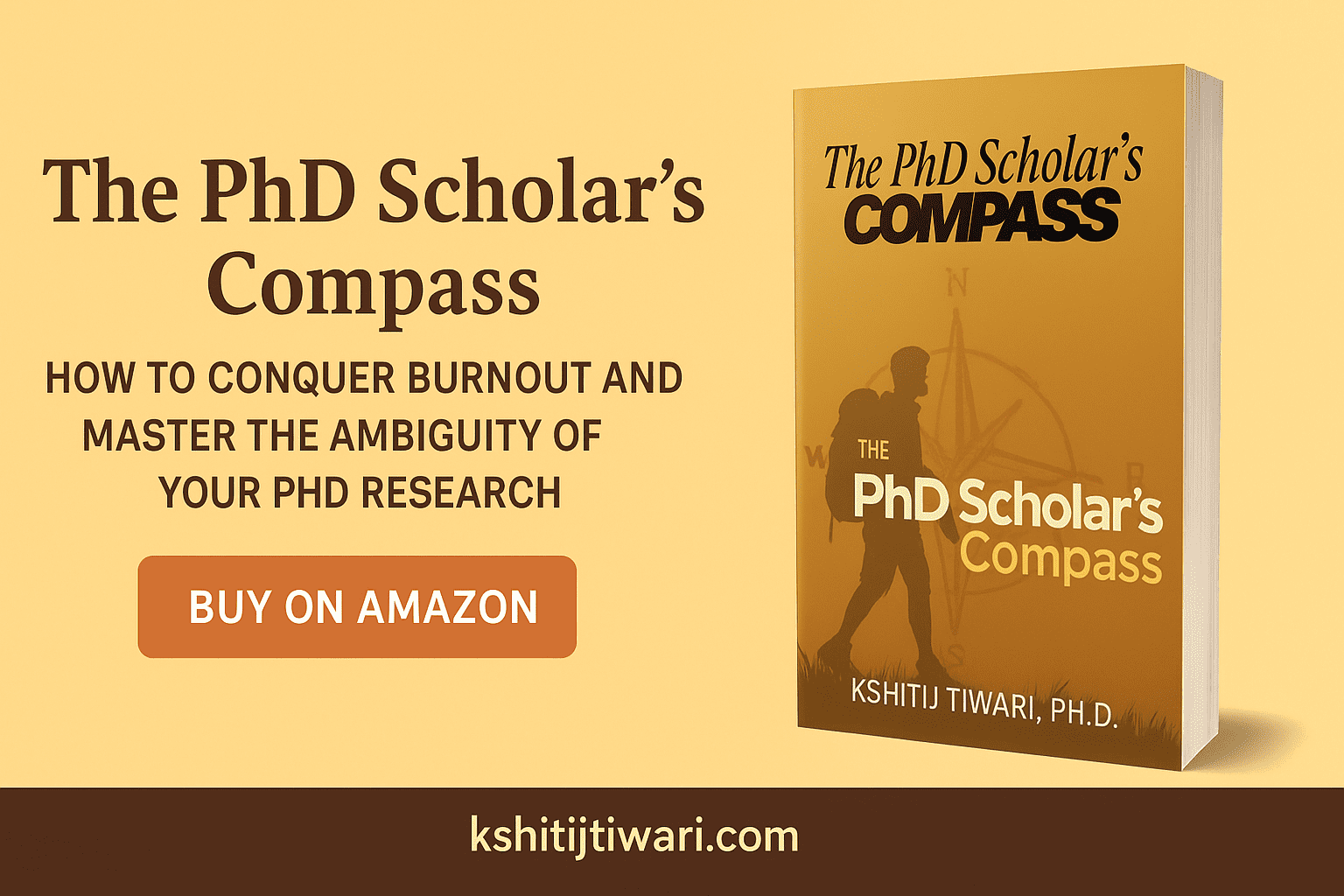
The PhD Scholar’s Compass: From burnout to breakthrough is that manual. It is a structured guide that distills the strategic lessons from years of successful R&D and academic research, focusing on the mental and strategic architecture required to survive and thrive.
The self-help book is aimed at early stage PhD scholars to help them:
Identify and halt the creeping signs of PhD burnout.
Develop the strategic mindset of a high-performing R&D professional.
Master the art of self-directed project management in an unstructured environment.
Take Action: Presentation anxiety is a major contributor to PhD stress. Stop worrying about “Reviewer #2” in the audience. Grab the Q&A Survival Kit and learn the patterns to handle any research question with ease.
Key Takeaways
The book provides the self-help framework. However, if you are an R&D professional or advanced student seeking one-on-one customized strategy for your highly technical research topic, application, or thesis plan, a generalized book is only the starting point.
Take Action: Communication anxiety is a leading cause of research burnout. Don’t let your inbox drain your mental energy. Grab the PhD Communication Vault for 20+ battle-tested scripts to manage expectations and set boundaries.
If you are ready to apply these principles under a guided, rigorous strategic plan, my PhD Mentorship service provides the personalized technical deep-dive and accountability you need to guarantee your success.
Ready for a Strategic Discussion?
Your robotics project or academic career deserves a strategic roadmap built on international, Ph.D.-level expertise. Let’s map out your path to accelerated results.