The decision to pursue a PhD is a high-stakes time investment. Whether you are a professional contemplating a career pivot or a current student struggling with the project’s viability, your primary anxiety is the PhD timing trap: Am I starting too late? or Is it too late to quit?
These questions are not emotional; they are strategic. For a PhD journey, the clock matters immensely. Wasting five years on a stalled or market-saturated project is the highest professional risk you can take.
This guide provides a definitive framework for managing the two greatest PhD timing risks: the risk of starting too late and the risk of quitting too late. We’ll show you why a strategic R&D mindset—which views a PhD as a job contract, not a degree program—is the only way to avoid the “timing trap” and maximize your career ROI.
 Related Resource: This article is part of the Unwritten PhD Resource Library—a comprehensive collection of guides, decision frameworks, and practical resources covering every stage of the PhD journey, from choosing a research topic and applying for a PhD to publishing papers, managing burnout, and planning your career after graduation.
Table of Contents
ToggleWhen is it Too Late to Start Your PhD? (The Age Myth)
The fear that you are “too old for a PhD” is one of the biggest limiting beliefs for ambitious professionals. It’s a relic of an academic system that prioritizes young, low-cost labor over experienced R&D talent. Our approach flips this script.
Myth: PhDs are Only for Recent Graduates
The PhD-Timing Reality
Industry Experience is an Asset, Not a Drawback: Advisors in high-level R&D labs (e.g., Robotics, Engineering) are actively looking for mature, self-directed research colleagues who can hit the ground running. Your years in the industry mean you already understand project management, real-world data constraints, and commercial viability—skills a fresh graduate lacks.
You Pose Less Risk to Funded Projects: Many prestigious international fellowships and industry-linked PhD projects are specifically targeted at candidates with professional experience. Your professional background increases your chance of securing a high-paying research fellow position because you lower the risk profile of the project in the eyes of the funding body.
The Strategic Advantage
The Technical Competence Vetting: For a technical PhD, the question is not, “How old are you?” but “What complex problem have you successfully solved?” You are only too old if your technical skills are outdated. A veteran with current, high-demand skills is more valuable to an advisor seeking R&D competence.
The Strategic Conclusion: The correct PhD timing to start is when you have the necessary R&D experience to make your application a compelling technical proposal. If your technical skills are sharp, your age is a powerful advantage.
When is it Too Late to Quit Your PhD? (The Sunk Cost Trap)
The fear of quitting is often driven by the Sunk Cost Fallacy—the emotional belief that because you’ve already invested years of time, you must continue. This is the deadliest form of the PhD timing trap.
Reality: The Point of No Return is Strategic, Not Emotional
The optimal time to quit your PhD is the moment the estimated future cost of completing it exceeds the market value of the eventual degree. This can be due to three primary strategic breakdowns:
Technical Unviability (The “Is it Possible?” Test): Your core research idea is scientifically flawed, technically impossible with the lab’s current infrastructure, or has been rendered obsolete by new, external research. Continuing is just time-suck for a thesis that will be low-impact.
Here is when this could happen- Is the advisor constantly changing the goalposts? Is the equipment perpetually broken or outdated? Is the necessary proprietary data unattainable? If so, here is a reality check:
If you spend 80% of your time fighting bad infrastructure or bad project scope, your PhD timing is already compromised.
Market Saturation/Shift (The “Is it Valuable?” Test): The research area is no longer valued by industry, or the problem has become commercially saturated. Here is what you should be asking for this test:
Is the novel component of your research becoming a commodity? Have two other labs just published work that renders your approach obsolete?
If you cannot clearly articulate how your eventual thesis will earn you a $200k+ R&D role, the sunk cost is not worth the potential future debt.
Irreparable Supervisor Fit (The “Is it Functional?” Test): The supervisor relationship is so broken that it prevents functional progress. A toxic or absentee advisor will prolong your PhD beyond its viable window. Here is how you test it:
Has the advisor stopped replying,/stopped providing technical input, or actively sabotages publication efforts?
The Strategic Action: Quitting early is a strategic pivot to conserve your most valuable asset—time. It allows you to exit gracefully with an exit degree (M.Phil. or M.S. by research) and immediately pivot to a high-paying industry job or a more viable research position. The longer you wait, the harder it is to recover your career momentum.
This risk assessment is precisely why you must vet your advisor strategically. We detail how to spot and manage this risk here: The Red and Green Flags to Look for in a Prospective Ph.D. Supervisor.
The Strategic PhD Exit Path
So, if PhD exit is indeed your next step, what happens once you quit your PhD?
The Exit Degree: Explain that a strategic quit often results in an M.Phil. or M.S. by Research, which is a high-value, defensible degree that can be leveraged for R&D jobs. It’s a high-value consolation prize, not a failure.
Career Pivot: Explain how you can market the time spent. You can tell a future employer:
“I performed three years of high-level research, realized the project’s commercial viability was low, and made the strategic decision to pivot to a role with higher ROI.”
This demonstrates managerial courage and strategic thinking.
- Changing countries and associated paperwork (if doing a PhD abroad): If your exit path entails termination of a PhD abroad, you should carefully understand the visa requirements and if you that necessitates leaving the country to return back to your home country.
This of course, is not applicable if you are pursuing PhD in your home country itself in which case, you would likely change towns either for your next role or move back to your hometown till the next role kicks in.
The Cost of Indecision: The Timing Trap's Toll
The most significant cost of the “PhD Timing Trap” isn’t measured in lost salary; it’s measured in lost opportunity and compounding stress. Indecision about when to start, what to research, or when to quit is, in effect, a form of active delay. This lack of strategic decisiveness creates a domino effect with serious consequences:
Financial Erosion: Every extra semester spent in a PhD program—or every period of delay post-graduation—represents a massive opportunity cost. The lack of a clear, high-velocity plan means you’re draining your fellowship or personal savings for longer, delaying your entry into a high-paying leadership role.
The Competence Drain: When you’re constantly debating the process (e.g., Should I start this experiment? Is this the right topic?), you aren’t focused on building PhD competence. This ambiguity leads to analysis paralysis, which wastes months on low-impact work or rework that a structured framework could have eliminated in weeks.
Burnout and Mental Health: Unstructured research is the primary fuel for doctoral burnout. The feeling of being “clueless” about the next step or the path to publication erodes confidence and transforms the PhD into a source of chronic anxiety rather than an exciting intellectual challenge. .
Diminished Returns: Your ultimate goal is a career-defining publication portfolio. Delays mean your research becomes outdated, your findings are scooped, and the value of your completed work is diminished. The only way to guarantee maximum return on your time investment is by adopting a structured PhD Mentorship Framework that guarantees acceleration (like the Competence Accelerator).
Strategic Exit: Communicating Your Decision (The Professional Pivot)
Once you’ve performed the strategic viability check and determined that quitting is the correct PhD timing for your career, the final challenge is execution: communicating your decision to your supervisor and the department.
This conversation must be framed as a professional pivot based on data and strategic alignment, not an emotional failure. Your goal is to secure an exit degree (M.Phil. or M.S. by Research) and leave with your professional reputation intact.
The Professional Communication Mindset
Focus on Market/Project Viability, Not Personal Failure: Never use language that implies personal inability (“I couldn’t handle the work”) or emotional distress. Frame the decision around the project’s changing market viability or the lack of suitable resources to achieve the project’s original, high-impact goals.
Present a Solution, Not a Problem: Do not initiate the conversation by simply saying “I quit.” Present a plan: “Given the saturation in Area X, I’ve decided to pivot my career to Industry Y. My proposal is to transition my current work into an M.S. thesis to conclude my work professionally.”
Be Direct and Concise: Schedule a specific meeting. Do not hint at the problem or send vague emails. Be ready to discuss the handoff of any proprietary data or equipment.
The Strategic Email Template to Your Supervisor
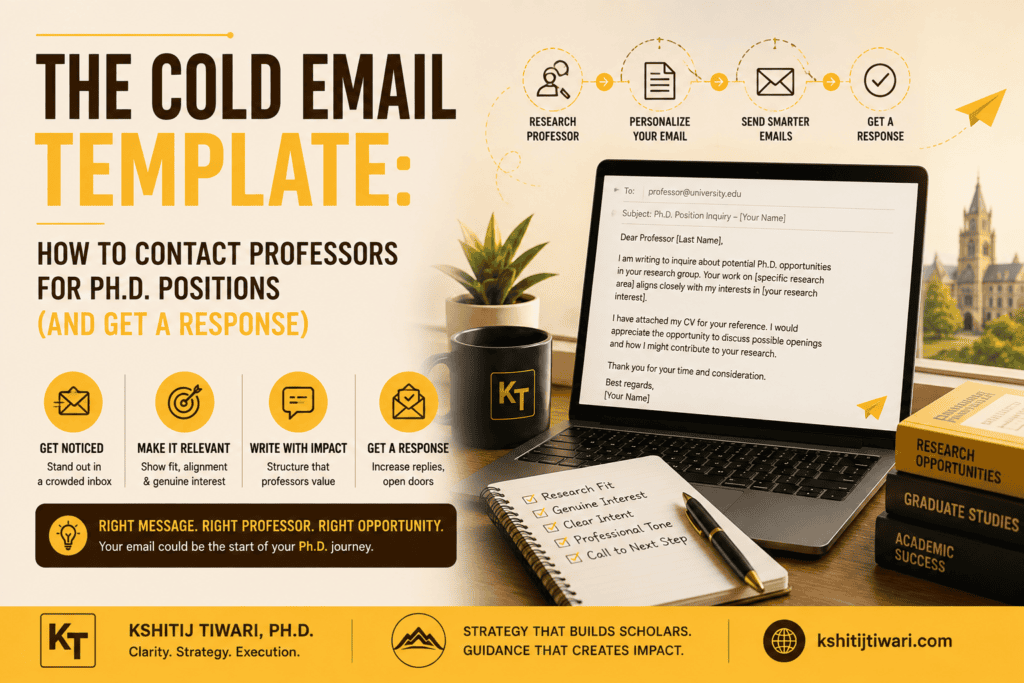
Use this template as a professional starting point. Send it to formally request a meeting, ensuring the supervisor is prepared for the topic.
Subject: Request for Meeting: Discussion on Future Direction of My Research & Career Timeline
Dear Professor [Supervisor’s Last Name],
I am writing to formally request a meeting to discuss the future direction and timeline of my research and its alignment with my long-term career goals.
As we have discussed, the challenges in securing the necessary resources/data/infrastructure for the full [Original PhD Topic] have made the high-impact completion of the original proposal increasingly difficult within the standard PhD timing.
After careful consideration and strategic planning for my next career phase, I have decided to pivot my focus back toward an industry role that aligns with my previous experience in [mention relevant industry/skill].
My proposal is to transition my current body of work—specifically [mention your strongest chapters/papers/deliverables]—into a high-quality M.S. or M.Phil. thesis, aiming for completion and defense by [date, e.g., 6 months from now].
This decision is purely strategic, and I want to ensure a professional and smooth transition for the lab. I am committed to documenting all research code and handing over [mention any equipment/data] seamlessly.
Please let me know which day next week would be best for us to meet and finalize this plan.
Sincerely,
[Your Name]
Key Takeaways
The PhD timing question is not about clocks and calendars; it’s about calculated risk and strategic career ROI.
To Start: Base your decision on your technical competence and strategic project fit, not your birth year. Your experience is currency.
To Quit: Base your decision on research viability and market value, not on sunk costs. Your time is finite capital.
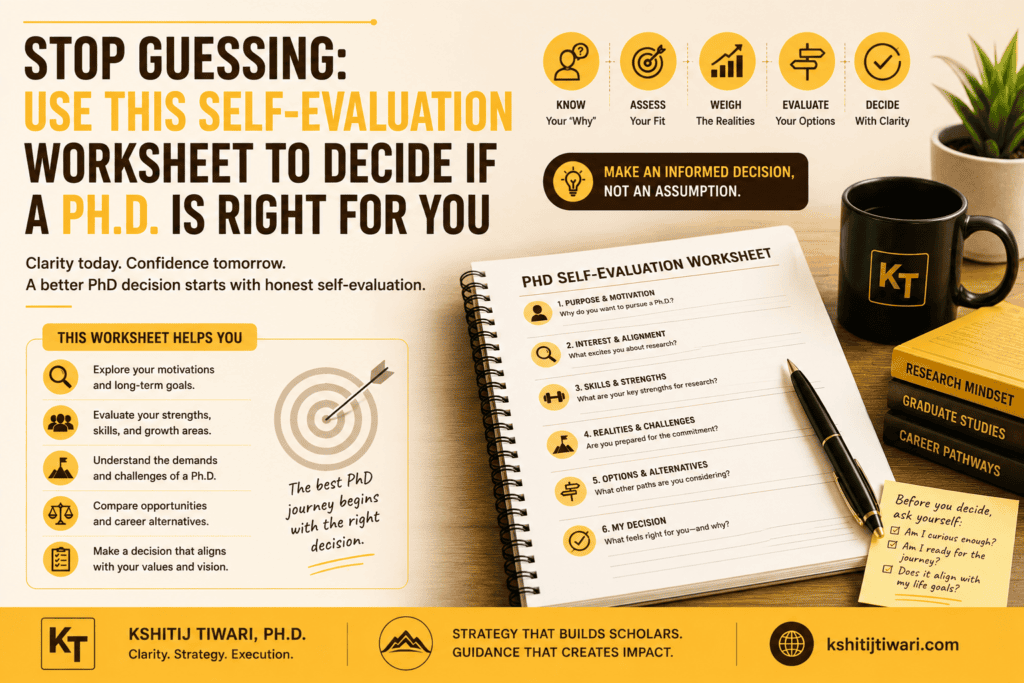
For a technical PhD in high-demand fields, the path is fraught with risk, but the reward is immense—if you approach it with a strategic, R&D mindset. By mastering the PhD timing decision, you move from a hopeful student to a strategic R&D professional. Assess your starting viability or your exit plan with our foundational resources: Stop Guessing: Use This Self-Evaluation Worksheet to Decide If a Ph.D. is Right for You.
Ready for a Strategic Discussion?
Your robotics project or academic career deserves a strategic roadmap built on international, Ph.D.-level expertise. Let’s map out your path to accelerated results.