
In the world of mobile robotics, successful Robotics System Integration is the bridge between a laboratory curiosity and a commercial-grade product. However, for most startups, this phase becomes a “Valley of Death” that swallows well-funded R&D projects.
The scenario is universal: You have a chassis that moves perfectly. You have a robotic arm that picks with precision. But the moment you attempt full-scale Robotics System Integration, the system collapses. The battery drains in 20 minutes, the ROS 2 nodes crash every time the motor draws peak current, and your “real-time” perception lags by 500ms. This failure isn’t due to a lack of talent—it’s a lack of System Integrity.
Table of Contents
Toggle3 Common Challenges in Robotics System Integration
System integration is where the physics of the hardware meets the logic of the software. When these two aren’t architected as a single entity, you encounter three critical failures:
1. Power & EMI Orchestration
When your actuators draw peak current, they create electromagnetic interference (EMI) and voltage drops. Without a robust power distribution architecture, your compute will brown out or your sensors will return noisy, unusable data.
2. The Middleware Latency Trap
“It eventually talks” is the death knell of a commercial robot. Moving from a functional prototype to a product requires Deterministic Middleware. If your ROS 2 nodes aren’t optimized for sub-millisecond latency, your robot’s reaction time will never be fast enough for dynamic, unstructured environments.
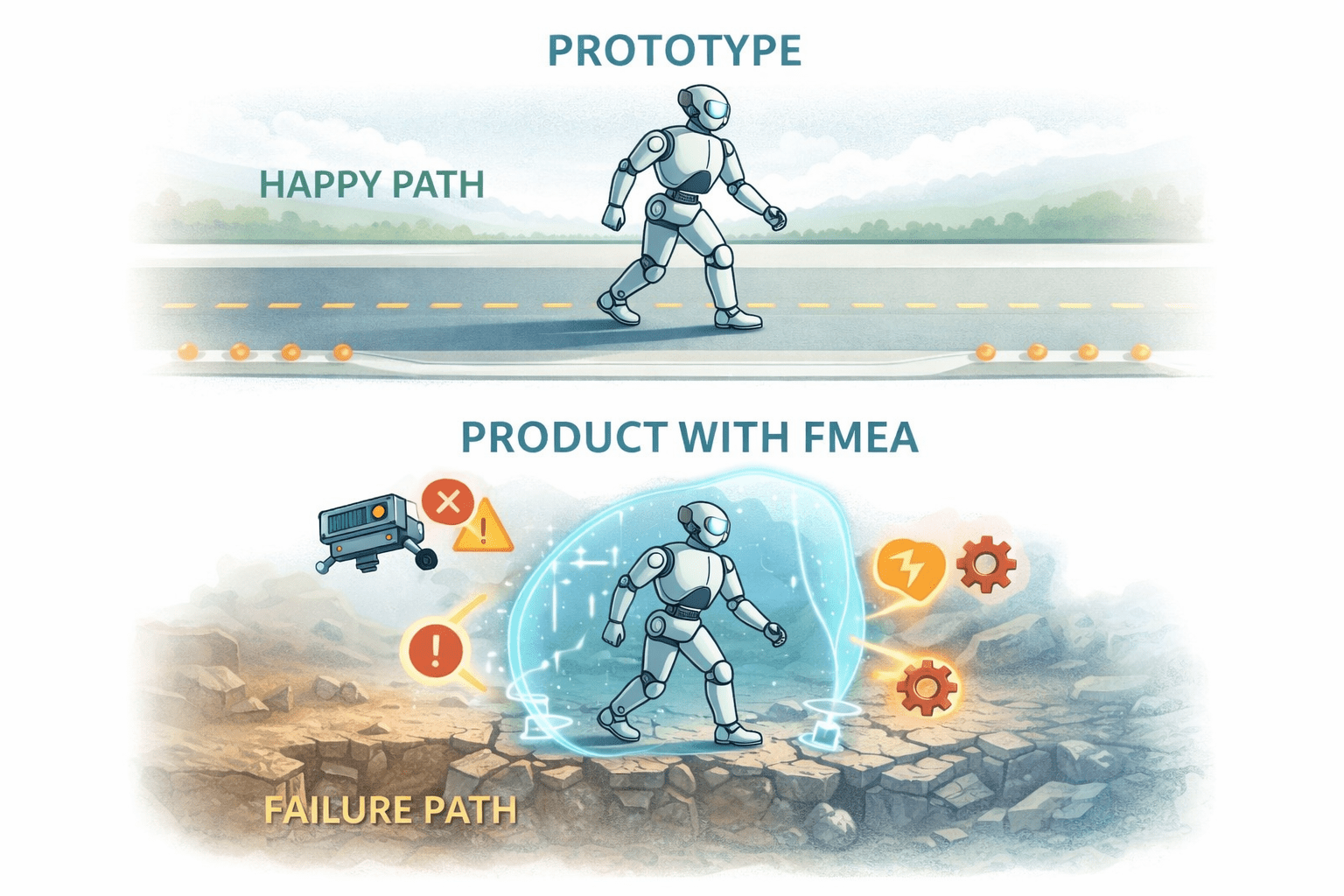
3. The Failure of FMEA (Failure Mode and Effects Analysis)
Most prototypes are built for the “Happy Path”—where everything works. A commercial-grade product is built for the “Failure Path.” Without a Robustness Layer that handles sensor dropouts, motor stalls, and network jitter, your robot is a liability, not an asset.
Without proper system integration, the synergy between hardware and software is compromised, leading to inefficiencies and failures.
System integration is not an isolated engineering challenge. It is one of the central problems within a broader robotics R&D strategy: moving from technical feasibility to a reliable, scalable and commercially viable product. If your integration problems are symptoms of deeper architectural issues, a robotics architecture audit can help identify where the system is becoming difficult to scale.
The Silent Killer: Accumulating Technical Debt
When startups rush to “make it work” for an investor demo, they accumulate massive Technical Debt. This debt isn’t just bad code; it’s a fundamental lack of modularity and scalability in the hardware-software stack.
As an FCTO, I identify these bottlenecks before they become permanent. If your system requires a “hard reset” every hour, or if adding a new sensor requires rewriting half your codebase, you aren’t building a product—you are managing a fragile science project. Bridging the gap requires an architectural shift from ad-hoc coding to systems engineering.
Why a Freelancer Isn't Enough: The FCTO Difference
At this stage, many founders hire a freelance developer or a narrow consultant. But there is a fundamental difference between a developer and an architect:
The Developer: Writes code to fix a specific task (e.g., “Fix the SLAM node”).
The Fractional CTO: Architects the Integrity of the entire system.
As your Fractional CTO, I don’t just “fix your navigation.” I ensure that your navigation, power management, and perception verticals function as a single, commercial-grade entity. I help you move away from the “adhoc” prototyping mindset and toward a rigorous [Fractional CTO and Robotics Consulting] framework that de-risks your R&D.
What I Solve as Your Fractional CTO
I bridge the Integration Gap by focusing on the “invisible” layers that developers often overlook:
System-Wide Power Management: Ensuring high-current actuators don’t compromise low-voltage compute.
Middleware Optimization: Tuning ROS 2 for reliability and deterministic performance.
Architectural De-Risking: Implementing FMEA at the design stage to prevent catastrophic field failures.
Strategic Roadmapping: Moving your team from “feature-building” to “product-building.”
Key Takeaways
Investors don’t fund prototypes forever; they fund scalable products. If your robot can’t survive an hour in the field without a hard reset, you don’t have a product—you have an expensive science project.
If you are ready to navigate the Robotic Valley of Death and build a system with true integrity, let’s talk about architecting your success.
Frequently Asked Questions (FAQs)
The most common cause of failure is the "Integration Gap"—where hardware components (chassis, arms, sensors) and software stacks are developed in silos. Without a unified architectural approach, teams encounter catastrophic EMI noise, power brownouts, and middleware latency that only appear once the systems are combined. Solving this requires a shift from feature-based coding to a rigorous systems engineering V-model.
While a typical consultant or freelance developer focuses on solving a narrow, task-specific problem (like fixing a SLAM node), a Fractional CTO architects the Systems Integrity of the entire project. An FCTO provides high-level strategic roadmapping, manages technical debt, and ensures that navigation, power, and perception verticals function as a single, commercial-grade entity rather than a fragile prototype.
Many prototypes suffer from "The Middleware Latency Trap," where nodes communicate but not with the determinism required for real-world safety. Optimizing ROS 2 involves tuning Quality of Service (QoS) settings and utilizing specialized executors to achieve sub-millisecond latency. This ensures the robot can respond to dynamic obstacles in real-time, which is essential for moving from a lab environment to a client site.
Failure Mode and Effects Analysis (FMEA) is the process of building the "Failure Path" for your robot. Most prototypes only account for the "Happy Path" where everything works. By implementing a robustness layer that handles motor stalls, sensor dropouts, or network jitter, you prevent your robot from becoming a liability during high-stakes client demonstrations or initial deployments.
If adding a new sensor requires a major rewrite of your codebase, or if your robot requires a hard reset every hour due to "mysterious" software crashes, you are likely buried in technical debt. This often happens when teams rush toward investor demos without a modular, scalable architecture. A Fractional CTO identifies these bottlenecks early to ensure your R&D is scalable for Series A and B funding rounds.
Ready for a Strategic Discussion?
Architecting your path out of the Valley of Death” to maintain the high-authority tone of the article.